Free Daily Podcast Summary
The Partially Examined Life Philosophy Podcast: Daily Summaries Delivered
by Mark Linsenmayer, Wes Alwan, Seth Paskin, Dylan Casey
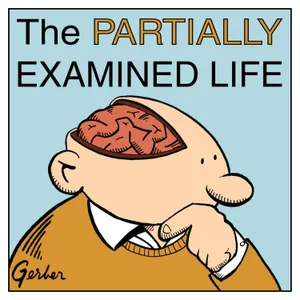
The Partially Examined Life is a podcast by some guys who were at one point set on doing philosophy for a living but then thought better of it. Each episode, we pick a short text and chat about it with some balance between insight and flippancy. You don't have to know any philosophy, or even to have read the text we're talking about to (mostly) follow and (hopefully) enjoy the discussion. We also feature episodes from other podcasts by our hosts to round out your partially examined life, including Pretty Much Pop (covering all media), Nakedly Examined Music (deconstructing songs), Philosophy vs. Improv (fun with performance skills and philosophical ideas), and (sub)Text (looking deeply at lit and film).
Latest Episodes
The most recent episodes — sign up to get AI-powered summaries of each one.
- 2 days ago59 min
Ep. 401: Mind/Brain Identity Theory (U.T. Place, J.J.C. Smart) (Part Two)
Finishing up U.T. Place's "Is Consciousness a Brain Process?" (1956) and starting on J.J.C. Smart's "Sensations and Brain Processes" (1959). Place argues against the "phenomenological fallacy," i.e. the reality of the contents of one's inner life. Then Smart considers objects against mind/brain identity: Must qualities of sensations be something over and above qualities of brain processes? Finally, is mind/brain identity a scientific hypothesis at all? Get more at partiallyexaminedlife.com. Visit partiallyexaminedlife.com/support to get ad-free episodes and tons of bonus discussion.
- 3 days ago58 min
PEL Presents NEM#261: Joan as Policewoman's Living Growth
Joan Wasser started as violinist/support member in the 90s for The Dambuilders and then for Mind Science of the Mind and Antony and the Johnsons. In the mid-90s, she co-led a band called Black Beetle that released nothing, but taught her songwriting. She's had 13 solo releases, as she has continued to guest and tour with major artists including Iggy Pop, and Gorillaz. We discuss "Eternal Flame" from Real Life Evolution (2026), "I Defy" from Real Life (2006), and "Full-Time Heist" from Lemons, Limes and Orchids (2024). Intro: "The Magic" from The Deep Field (2011). End song: "Valid Jagger" from Damned Devotion (2018). More at joanaspolicewoman.com. Hear more Nakedly Examined Music at nakedlyexaminedmusic.com. Support us at patreon.com/nakedlyexaminedmusic.
- 6 days ago53 min
PEL Presents PMP#231: Euphoric Teens
We discuss high school drama TV shows and films in light of the genre-breaking, star-birthing teen drama Euphoria. Mark, Lawrence, Sarahlyn and Al touch on Riverdale, Skins, Degrassi, John Hughes films, Buffy, Saved By the Bell, 90210, and many others. How much of the plots are driven by "affluenza?" What do they have to say about friendship? Is there something very white about even shows like Euphoria that have plenty of POC characters? Do the "genre" shows (e.g. The Craft) count? What about anime? Get more at prettymuchpop.com. Get an ad-free experience, plus bonus talking for nearly every episode at patreon.com/prettymuchpop. Sponsor: Get started with Claude AI at claude.ai/pmp.
- 1 weeks ago49 min
Ep. 401: Mind/Brain Identity Theory (U.T. Place, J.J.C. Smart) (Part One)
On U.T. Place's "Is Consciousness a Brain Process?" (1956) and J.J.C. Smart's "Sensations and Brain Processes" (1959), w/ guest Chris Heath. Is there some a priori reason for denying that the mind can actually be the brain? Obviously those two words don't mean the same thing, but can we think of them as a single thing under two descriptions? Place argues that the identity is not unlike other scientific identities, like lightning being the same as a motion of electric charges. Get more at partiallyexaminedlife.com. Visit partiallyexaminedlife.com/support to get ad-free episodes and tons of bonus discussion.
- 1 weeks ago10 min
PREMIUM-Ep. 400: Dennett Rejects Qualia (Part Three)
Mark and Seth rejoin to complete our treatment of Consciousness Explained, focusing on Dennett's responses to Frank Jackson's Mary the Color Scientist thought experiment, Searle's Chinese Room, inverted qualia, and more. If you're not hearing the full version of this part of the discussion, sign up via one of the options described at partiallyexaminedlife.com/support.
- 1 weeks ago1h 1m
PEL Presents Philosophy vs. Theater w/ David Epstein
As an interlude between our Philosophy vs. Improv seasons, here's an interview left over from July with Mark's former classmate, actor/director/writer David, who runs Actor Class on Times Square. We talk about his career and his insights about Broadway, Shakespeare, contemporary entertainment, theory in acting, and more. Hear more at philosophyimprov.com. Support the podcast and listen ad-free at patreon.com/philosophyimprov.
- 2 weeks ago51 min
Ep. 400: Dennett Rejects Qualia (Part Two)
Continuing on Consciousness Explained, ch. 12-14, especially responding to Dennett's discussion of Nagel's "What Is It Like to Be a Bat?" which which gets us in a whole conversation about animal consciousness. What is it like to be any languageless creature? How is the debate relevant to ethical issues? Get more at partiallyexaminedlife.com. Visit partiallyexaminedlife.com/support to get ad-free episodes and tons of bonus discussion.
- 2 weeks ago55 min
PEL Presents Closereads: Late Dennett on Consciousness (Part One)
On "Are We Explaining Consciousness Yet" (2001), an article published with and commenting on papers by psychologists, neurologists, etc. on the state of consciousness studies at the time, featuring his newer metaphor for consciousness, "fame in the brain." Follow along with us. You can choose to watch this on video. Subscribe to Closereads at patreon.com/closereadsphilosophy; follow us there via the free tier to get many other episodes like this one ad free, or pay us to get part 2 and everything else we've recorded. (Alternatively, support both PEL and Closereads at patreon.com/partiallyexaminedlife for a nice combo deal.)
Get The Partially Examined Life Philosophy Podcast summaries in your inbox
Free AI-powered daily recaps. Key takeaways, quotes, and mentions — in a 5-minute read.
Get Free Summaries →Free forever for up to 3 podcasts. No credit card required.
You Might Also Like
Listeners also like.
Philosophize This!
Explores the history of philosophy by breaking down key thinkers and ideas in chronological order for a general audience.

Private Life: A New York Review Podcast
Conversations with writers about their lives, work, and ideas, paired with readings from The New York Review of Books archive.

The UnMute Podcast
Philosophers discuss current social and political issues with insight, humor, and a drive for change.

Psychiatry & Psychotherapy Podcast
Explores psychiatry and psychotherapy through interviews with experts, trainees, and individuals sharing lived mental health experiences.

History of Philosophy Without Any Gaps
A chronological exploration of the history of philosophy across cultures and centuries, from ancient to modern thought.

Theories of Everything with Curt Jaimungal
A deep, rigorous exploration of theories uniting physics, consciousness, AI, and metaphysics through analytical and unconventional thinking.
In Our Time: Philosophy
Discusses philosophers, theories, and key themes in philosophy, from altruism to Wittgenstein.
The Psychology Podcast
Explores human potential and possibility through conversations with scientists, thinkers, and self-actualized individuals.
Good Life Project
Deep conversations about building a meaningful life through midlife reinventions, grounded in science and human experience.

Forum Borealis
In-depth interviews with authors and thinkers on unconventional topics in history, science, philosophy, and politics.

Hi-Phi Nation
Philosophy is explored through real-life stories and expert insights on topics like justice, morality, and existence.
Inner Cosmos with David Eagleman
Neuroscientist David Eagleman examines how the brain interprets reality through science, stories, and interviews.
About The Partially Examined Life Philosophy Podcast
The Partially Examined Life is a podcast by some guys who were at one point set on doing philosophy for a living but then thought better of it. Each episode, we pick a short text and chat about it with some balance between insight and flippancy. You don't have to know any philosophy, or even to have read the text we're talking about to (mostly) follow and (hopefully) enjoy the discussion. We also feature episodes from other podcasts by our hosts to round out your partially examined life, including Pretty Much Pop (covering all media), Nakedly Examined Music (deconstructing songs), Philosophy vs. Improv (fun with performance skills and philosophical ideas), and (sub)Text (looking deeply at lit and film).
Customized Recaps
AI-powered recaps with compact key takeaways, quotes, and insights.
Straight to Your Inbox
Get key takeaways from The Partially Examined Life Philosophy Podcast in a 5-minute read.
Save Hours Every Week
Stay current on your favorite podcasts without falling behind.
Frequently Asked Questions
What is Podzilla's The Partially Examined Life Philosophy Podcast daily summary?
It's a free AI-powered email that summarizes new episodes of The Partially Examined Life Philosophy Podcast as soon as they're published. You get the key takeaways, notable quotes, and links & mentions — all in a quick read.
How does the The Partially Examined Life Philosophy Podcast podcast summary work?
When a new episode drops, our AI transcribes and analyzes it, then generates a personalized summary tailored to your interests and profession. It's delivered to your inbox every morning.
Is this an official The Partially Examined Life Philosophy Podcast product?
No. Podzilla is an independent service that summarizes publicly available podcast content. We're not affiliated with or endorsed by Mark Linsenmayer, Wes Alwan, Seth Paskin, Dylan Casey.
Can I get summaries of other podcasts too?
Absolutely! The free plan covers up to 3 podcasts. Upgrade to Pro for 15, or Premium for 50. Browse our full catalog at /podcasts.
How often does The Partially Examined Life Philosophy Podcast release new episodes?
The Partially Examined Life Philosophy Podcast publishes every few days. Our AI generates a summary within hours of each new episode.
What topics does The Partially Examined Life Philosophy Podcast cover?
The Partially Examined Life Philosophy Podcast covers topics including Philosophy, Culture, Society & Culture. Our AI identifies the specific themes in each episode and highlights what matters most to you.
Start getting The Partially Examined Life Philosophy Podcast summaries tomorrow morning.
Free forever for up to 3 podcasts. No credit card required.
Free forever for up to 3 podcasts. No credit card required.