Free Daily Podcast Summary
The Quark Side - Quantum Physics Podcast: Daily Summaries Delivered
by Synthetic Universe
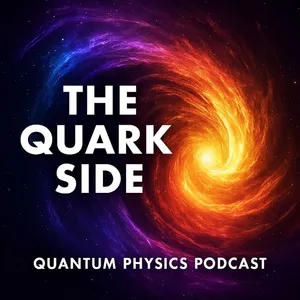
The Quark Side is a quantum physics podcast that explores the strange foundations of reality—from quarks and fields to spacetime, uncertainty, and the limits of knowledge. Each episode breaks down cutting-edge research and deep ideas in modern physics with clarity, rigor, and curiosity, revealing how the quantum world shapes everything we observe.
Latest Episodes
The most recent episodes — sign up to get AI-powered summaries of each one.
- Today18 min
A Cosmic Photon May Be Challenging Einstein’s Physics
A mysterious ultra-high-energy photon from the brightest gamma-ray burst ever detected somehow survived a two-billion-light-year journey that standard physics says should have stopped it.Scientists propose that axion-like particles and a possible violation of Lorentz invariance could explain its unexpected survival and delayed arrival—potentially offering clues to new laws of quantum gravity.This episode includes AI-generated content.
- Yesterday15 min
Einstein’s Gravity Just Entered the Quantum World
For the first time, scientists have observed Einstein’s gravity acting on an object in a quantum state.By placing rubidium atoms in different paths, the experiment tested the equivalence principle at the quantum scale. The result offers a remarkable new connection between quantum mechanics and general relativity—and opens the door to even more extreme tests.This episode includes AI-generated content.
- 2 days ago22 min
Heat Has a Memory? A New Discovery Challenges Our Understanding
Scientists at Auburn University have developed a new framework suggesting that heat can retain a physical “memory” of past thermal events.At microscopic scales and extremely short timescales, heat may behave in ways that go beyond traditional diffusion. The discovery could help engineers better understand and control heat in increasingly small and powerful computer chips.This episode includes AI-generated content.
- 3 days ago19 min
A Diamond Could Become a Quantum Sensor for the Invisible World
What if tiny imperfections inside an ordinary diamond could become powerful quantum sensors?Scientists have coordinated around 10,000 nitrogen-vacancy centers to detect incredibly weak magnetic signals at room temperature. The technique could open new possibilities for studying biological systems and advanced materials at the nanoscale—without extreme cooling.This episode includes AI-generated content.
- 4 days ago18 min
How Light Could Help Build a Unified Quantum Internet
Hollow-core gas-filled optical fibers could provide a crucial bridge between different quantum technologies.By converting light between frequencies while preserving phase information, the approach could help connect quantum communications, memories, and sensors—bringing a unified quantum internet closer to reality.This episode includes AI-generated content.
- 5 days ago20 min
Scientists Discover a New Form of the Hall Effect That Defies a Century-Old Assumption
Researchers at Carnegie Mellon University have demonstrated a surprising new version of the Hall effect, showing that magnetic fields can generate electrical signals within the same plane of a material—without the perpendicular magnetic field traditionally considered necessary.Using an ultrathin tantalum-iridium-tellurium structure, the discovery could enable smaller, more efficient multidimensional magnetic sensors for electronics, medical imaging, and navigationThis episode includes AI-generated content.
- 6 days ago13 min
A New Theory Reveals How Space-Time Could Create Tiny Black Holes
Physicists have developed a new mathematical framework describing an exotic space-time crystal—a repeating structure that could become unstable and collapse into a microscopic black hole after receiving only a tiny amount of energy.The theory offers a new way to study critical collapse and may help explain how primordial black holes could have formed shortly after the Big Bang.This episode includes AI-generated content.
- 1 weeks ago18 min
Bosons and Fermions Could Form an Entirely New Kind of Quantum Matter
Researchers at Monash University predict a remarkable new state of matter in which bosons and fermions could combine into stable, self-sustaining quantum droplets under extreme conditions.The theoretical work reveals unexpected behavior at strong interactions and could inspire experiments with ultracold atoms to test whether these unusual structures actually exist. The discovery may also offer new possibilities for future quantum technologies.This episode includes AI-generated content.
Get The Quark Side - Quantum Physics Podcast summaries in your inbox
Free AI-powered daily recaps. Key takeaways, quotes, and mentions — in a 5-minute read.
Get Free Summaries →Free forever for up to 3 podcasts. No credit card required.
You Might Also Like
Listeners also like.

The Quanta Podcast
A weekly discussion on groundbreaking science and math stories with Quanta's editorial team.
The Joy of x
A mathematician explores the lives and ideas of leading scientists through in-depth conversations.
Physics for Future
Experts discuss quantum mechanics, atomic clocks, and AI to make physics accessible for students and the public.

Cosmos in a Pod
Explores space, science, philosophy, and technology to reveal the wonders of the universe and humanity's place within it.
Mysterious Universe
Explores fringe science, UFOs, cryptozoology, and alternative history with a mix of curiosity and humor.
The Field Guide to Particle Physics
A guided exploration of subatomic particles, their properties, interactions, and roles in the fundamental structure of the universe.
The Science of Everything Podcast
Explores diverse topics in natural and social sciences through the lens of the scientific method.

Dear People of Earth Science and Physics- The UFO Podcast - Disclosure - Aliens - UAP
Explores UFO and UAP phenomena through scientific analysis, physics, and expert discussions on credible sightings and cosmic mysteries.
Math & Physics Podcast
Two University of Toronto students discuss topics in math and physics.
The World, the Universe and Us
Explores big scientific questions about life, consciousness, climate, and the cosmos with expert scientists and New Scientist journalists.
Physics to God
Explores the intersection of modern physics and theology, examining fine tuning, the multiverse, and the concept of God.

PBS Space Time
An astrophysicist explains cosmic phenomena like black holes and galaxy evolution through accessible, science-driven discussions.
About The Quark Side - Quantum Physics Podcast
The Quark Side is a quantum physics podcast that explores the strange foundations of reality—from quarks and fields to spacetime, uncertainty, and the limits of knowledge. Each episode breaks down cutting-edge research and deep ideas in modern physics with clarity, rigor, and curiosity, revealing how the quantum world shapes everything we observe.
Customized Recaps
AI-powered recaps with compact key takeaways, quotes, and insights.
Straight to Your Inbox
Get key takeaways from The Quark Side - Quantum Physics Podcast in a 5-minute read.
Save Hours Every Week
Stay current on your favorite podcasts without falling behind.
Frequently Asked Questions
What is Podzilla's The Quark Side - Quantum Physics Podcast daily summary?
It's a free AI-powered email that summarizes new episodes of The Quark Side - Quantum Physics Podcast as soon as they're published. You get the key takeaways, notable quotes, and links & mentions — all in a quick read.
How does the The Quark Side - Quantum Physics Podcast podcast summary work?
When a new episode drops, our AI transcribes and analyzes it, then generates a personalized summary tailored to your interests and profession. It's delivered to your inbox every morning.
Is this an official The Quark Side - Quantum Physics Podcast product?
No. Podzilla is an independent service that summarizes publicly available podcast content. We're not affiliated with or endorsed by Synthetic Universe.
Can I get summaries of other podcasts too?
Absolutely! The free plan covers up to 3 podcasts. Upgrade to Pro for 15, or Premium for 50. Browse our full catalog at /podcasts.
How often does The Quark Side - Quantum Physics Podcast release new episodes?
The Quark Side - Quantum Physics Podcast publishes daily. Our AI generates a summary within hours of each new episode.
What topics does The Quark Side - Quantum Physics Podcast cover?
The Quark Side - Quantum Physics Podcast covers topics including Science, Technology, Chemistry, Physics. Our AI identifies the specific themes in each episode and highlights what matters most to you.
Start getting The Quark Side - Quantum Physics Podcast summaries tomorrow morning.
Free forever for up to 3 podcasts. No credit card required.
Free forever for up to 3 podcasts. No credit card required.