Free Daily Podcast Summary
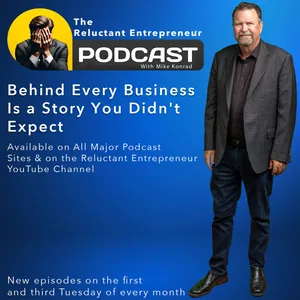
The Reluctant Entrepreneur Podcast: Daily Summaries Delivered
by Mike Konrad
I’m your host, Mike Konrad, the author of The Reluctant Entrepreneur - Anatomy of a Business Start-Up - From Uncertainty to Unstoppable, available on Amazon as a paperback, e-book, and an audible book, and I’m excited to share real stories that reveal the many paths people take to build their own businesses. Whether you stumbled into entrepreneurship or you’ve always known it was your calling, this podcast is for you.Let’s start with what it means to be a reluctant entrepreneur. Many entrepreneurs don’t set out with a grand plan to build a business. Maybe you worked for a company that didn’t value your vision, and one day you thought, “I could do this myself”, that was my story. Or maybe life pushed you in an unexpected direction—losing a job, facing a personal crisis, or discovering a passion that grew into a business. Reluctant entrepreneurs often find themselves starting a business not because they always dreamed of it, but because it was the best—or only—option available. And then there are intentional entrepreneurs. These are the people who’ve known from the start that they were meant to create something of their own. They may have planned meticulously, crafted their vision, and followed a well-laid path to build a business. Intentional entrepreneurs are often seen as risk-takers, those with a drive to innovate, disrupt, and lead in their industries. But even with all the planning in the world, intentional entrepreneurs face their own share of unexpected challenges, setbacks, and doubts.On The Reluctant Entrepreneur podcast, we celebrate both types of entrepreneurs—the ones who jump in with both feet, and the ones who tiptoe cautiously into the water. So, join me as we explore the many ways people navigate the complex and rewarding world of entrepreneurship. Whether you’re here for inspiration, advice, or just a great story, I hope you find something valuable in every episode of The Reluctant Entrepreneur Podcast.
Latest Episodes
The most recent episodes — sign up to get AI-powered summaries of each one.
- Today55 min
When the Founder Becomes the Bottleneck - Charlie Birch on Building a Brand That Can Grow Beyond You
For many entrepreneurs, the business starts as an extension of the founder.Their instincts.Their values.Their voice.Their judgment.Their way of making decisions.And in the early days, that can be one of the company’s greatest strengths.The founder sees things others do not see. The founder protects the customer experience. The founder knows what feels right, what feels wrong, and what the brand is supposed to stand for.But what happens when the business starts to grow?What happens when the team expands, the decisions multiply, and every important question still has to run through the founder? At some point, the very thing that helped launch the company can become the thing that limits its growth.Today, we’re talking about founder dependency, brand identity, and how entrepreneurs can build companies that remain human, authentic, and aligned without requiring the founder to personally hold every piece together.My guest today is Charlie Birch, founder of Humaniz Collective. Charlie helps founder-led businesses turn instinct into clarity, personality into purpose, and founder vision into a brand that can be understood, shared, and protected by the entire organization.https://www.humanizcollective.com
- Yesterday48 min
More Content Is Not Always the Answer - Rachel Allen on the Copy That Actually Builds Connection
Most entrepreneurs think their marketing problem is a visibility problem. They believe they need more posts, more emails, more funnels, more content, more noise.But what if the real problem is not that people do not know you exist? What if the real problem is that your words are not building enough trust?Today, I’m joined by Rachel Allen, founder of Bolt from the Blue Copywriting. Rachel describes her work as “data-driven, human-centered marketing for good people doing hard work that matters.” She has run a marketing business for 16 years, worked with clients in more than 21 countries, and written for businesses ranging from major names in entrepreneurship to brick-and-mortar companies, influencers, and nonprofits. Today, we’ll talk about her entrepreneurial journey, what it takes to build a marketing business over the long term, and why authentic, human-centered communication may matter more than ever in an increasingly automated world.https://www.boltfromthebluecopywriting.com
- 2 days ago1h 1m
The Alignment Problem That Slows Down Companies - Fixing What's Beneath the Surface with Carly Pepin
There’s a common belief in business that if something isn’t working, the answer is to change the strategy. Adjust the plan. Work harder. Push faster. But what if the real problem isn’t the strategy at all?What if the bottleneck… is the person leading it?Today’s guest, Carly Pepin, works at the intersection of business growth and human behavior. She helps founders and leadership teams scale their companies, not just by improving systems and processes, but by addressing the underlying patterns in decision-making, communication, and alignment that often determine whether a business moves forward… or stalls out.In the first part of the conversation, we’ll explore Carly’s journey. How she got into this space, the challenges she faced early on, and the moments that shaped her perspective on leadership and growth.In the second part, we’ll dig into her work. What alignment really means inside an organization, why so many scaling efforts break down, and what leaders may be overlooking when they try to take their business to the next level.If you’ve ever felt like your business should be further along than it is… this conversation may challenge how you think about why. https://www.westcoastgrowthadvisors.com
- 3 weeks ago1h 4m
Tanya Brody on How to Think Like Your Customer Before You Write a Single Word - Episode 84
Let me start with a simple question. Why do so many businesses create content… and still fail to generate real demand? Because content alone doesn’t convert. Messaging does.Today’s guest, Tanya Brody, has built her career around understanding exactly what makes people take action. She’s a persuasive web and SEO copywriter, a conversion specialist, and a marketing consultant who has worked with both major companies and small businesses to turn words into measurable results. But her path wasn’t linear. From performing as a professional musician to losing a traditional job and launching her own freelance business, Tanya’s journey is a real-world example of what happens when necessity meets opportunity. In the first part of our conversation, we’ll explore that journey… the risks, the pivots, and what she learned making the leap into entrepreneurship.In the second half, we’ll dig into her expertise in copywriting and conversion… what businesses get wrong, and how to fix it.Tanya's website:https://tanyabrodycopywriter.com
- 3 weeks ago59 min
Chris Anderson on Turning Listeners Into Leads - A Smarter Approach to Podcasting - Episode 83
Most entrepreneurs believe that if they just create enough content, something good will eventually happen• More posts• More videos• More podcastsBut for many, nothing actually changes• No new clients• No meaningful growth• No real return on the time investedSo the question becomes "What if the problem isn’t how much content you’re creating, but why you’re creating it in the first place?"What if content, by itself, isn’t the strategy?What if the real objective isn’t content at all, but demand?Today’s guest, Chris Anderson, has built his business around that exact ideaChris is the founder and CEO of Elevate Media Group, where he works with entrepreneurs to turn podcasting and content into a client acquisition engine.In the first segment of the episode, we’ll explore Chris’s entrepreneurial journeyWhat led him to start his business, the challenges he faced early on, and what he learned along the way.In the second part of the show, we’ll dive into the real topic at hand:Why most content fails to deliver results and how to shift from simply creating content… to actually creating demand. Because in the end, content doesn’t build a business, demand does. Chris's Company:Elevate Mediahttps://elevate-media-group.comChris'sElevate Media Podcast:https://www.youtube.com/@UCP61IwNOb5WWUYAp7ypc49A
- 3 weeks ago57 min
Rocky Lalvani: Why So Many Businesses Run Out of Cash. Profit on Paper Doesn't Mean Cash in the Bank - Episode 82
Most people assume that if your business is growing, you’re winning. But the reality is, growth without profit can quietly destroy even the most promising companies.Today’s guest, Rocky Lalvani, has built his career helping business owners solve one of the most common and misunderstood problems in entrepreneurship: cash flow.Rocky is the founder of Profit Comes First and serves as a Chief Profitability Advisor, helping business owners rethink the way they manage money and prioritize profit. In the first half of this episode, we’ll explore Rocky’s entrepreneurial journey, including the lessons he learned along the way.In the second half, we’ll dig into the Profit First philosophy and how business owners can take control of their finances, improve cash flow, and actually keep what they earn.Rocky's Company:Profit Comes First:https://profitcomesfirst.comRocky recommended the following book:Islands of Profit in a Sea of Red Ink: Why 40 Percent of Your Business Is Unprofitable and How to Fix Ithttps://tinyurl.com/3z2febkrRocky is offering a free copy of his book:The Profit Blueprinthttps://tinyurl.com/yc4jz342
- 3 weeks ago1h 0m
Building a Brand Without Big Retail: Kate Assaraf's Main Street Strategy - Episode 80
Let me start with a question.If you were building a consumer brand today and someone told you that the fastest way to grow was to sell on Amazon, partner with big retailers, and pour money into influencer marketing, would you do it?Most founders would say yes. In fact, many would say those steps are almost unavoidable. But what if you decided to do the exact opposite?My guest today did exactly that.Kate Assaraf is the founder and CEO of DIP, a sustainable haircare brand that has grown into a seven-figure business built primarily through Shopify and a loyal community of customers. But what makes Kate’s story so interesting is not just the growth of the company. It is the path she chose to take to get there.Kate made the intentional decision not to sell on Amazon, not to rely on venture capital, and not to chase the typical influencer-driven growth strategies that dominate the direct-to-consumer world.Instead, she built a brand centered on values, storytelling, and something that many ecommerce founders overlook: the survival of small, local retailers.In fact, Kate sometimes directs customers away from her own website and toward independent refill shops and neighborhood boutiques across the country. Her belief is that the future of retail is not either ecommerce or Main Street. It is both working together.Kate has been recognized as NJ Mompreneur of the Year, is a member of the Forbes Business Council, and her brand DIP has been recognized by Oprah as Curly Hair Brand of the Year.Today, she’s becoming a leading voice in a growing conversation among founders: how to build a successful business without selling out your mission, your margins, or your values. And how do you do that? Stick around, we’ll find out together.DIP:https://dipalready.com
- 3 weeks ago1h 2m
Growing the Founder: Andrew Poles on the Leadership Gap in Entrepreneurship - Episode 79
Many people believe that the hardest part of starting and growing a business is coming up with the right idea, finding customers, or raising capital. But according to today’s guest, the most difficult challenge entrepreneurs face may be something far more personal: becoming the leader their company needs them to be.Decisions become more complex. Teams get larger. The stakes get higher. And the skills that helped someone start the business are often not the same skills required to lead it at scale.My guest today, Andrew Poles, has spent more than two decades working with entrepreneurs and executives who are navigating exactly that challenge. As an executive coach and multi-time founder, Andrew focuses on helping leaders grow into the role their companies demand of them. He has worked with thousands of founders and executives to help them manage the pressure of leadership, build stronger teams, and scale their businesses without sacrificing their health, their relationships, or their sanity.Today we’re going to talk about the leadership gap many founders encounter, the pressure that comes with scaling a business, and why growing yourself may be the most important part of growing your company.Andrew's Website:'https://andrewpoles.comLinkedIn:https://www.linkedin.com/in/andrewpoles/
About The Reluctant Entrepreneur Podcast
I’m your host, Mike Konrad, the author of The Reluctant Entrepreneur - Anatomy of a Business Start-Up - From Uncertainty to Unstoppable, available on Amazon as a paperback, e-book, and an audible book, and I’m excited to share real stories that reveal the many paths people take to build their own businesses. Whether you stumbled into entrepreneurship or you’ve always known it was your calling, this podcast is for you.Let’s start with what it means to be a reluctant entrepreneur. Many entrepreneurs don’t set out with a grand plan to build a business. Maybe you worked for a company that didn’t value your vision, and one day you thought, “I could do this myself”, that was my story. Or maybe life pushed you in an unexpected direction—losing a job, facing a personal crisis, or discovering a passion that grew into a business. Reluctant entrepreneurs often find themselves starting a business not because they always dreamed of it, but because it was the best—or only—option available. And then there are intentional entrepreneurs. These are the people who’ve known from the start that they were meant to create something of their own. They may have planned meticulously, crafted their vision, and followed a well-laid path to build a business. Intentional entrepreneurs are often seen as risk-takers, those with a drive to innovate, disrupt, and lead in their industries. But even with all the planning in the world, intentional entrepreneurs face their own share of unexpected challenges, setbacks, and doubts.On The Reluctant Entrepreneur podcast, we celebrate both types of entrepreneurs—the ones who jump in with both feet, and the ones who tiptoe cautiously into the water. So, join me as we explore the many ways people navigate the complex and rewarding world of entrepreneurship. Whether you’re here for inspiration, advice, or just a great story, I hope you find something valuable in every episode of The Reluctant Entrepreneur Podcast.
Customized Recaps
AI-powered recaps with compact key takeaways, quotes, and insights.
Straight to Your Inbox
Get key takeaways from The Reluctant Entrepreneur Podcast in a 5-minute read.
Save Hours Every Week
Stay current on your favorite podcasts without falling behind.
Frequently Asked Questions
What is Podzilla's The Reluctant Entrepreneur Podcast daily summary?
It's a free AI-powered email that summarizes new episodes of The Reluctant Entrepreneur Podcast as soon as they're published. You get the key takeaways, notable quotes, and links & mentions — all in a quick read.
How does the The Reluctant Entrepreneur Podcast podcast summary work?
When a new episode drops, our AI transcribes and analyzes it, then generates a personalized summary tailored to your interests and profession. It's delivered to your inbox every morning.
Is this an official The Reluctant Entrepreneur Podcast product?
No. Podzilla is an independent service that summarizes publicly available podcast content. We're not affiliated with or endorsed by Mike Konrad.
Can I get summaries of other podcasts too?
Absolutely! The free plan covers up to 3 podcasts. Upgrade to Pro for 15, or Premium for 50. Browse our full catalog at /podcasts.
How often does The Reluctant Entrepreneur Podcast release new episodes?
The Reluctant Entrepreneur Podcast publishes daily. Our AI generates a summary within hours of each new episode.
What topics does The Reluctant Entrepreneur Podcast cover?
The Reluctant Entrepreneur Podcast covers topics including Business, Marketing, Entrepreneurship. Our AI identifies the specific themes in each episode and highlights what matters most to you.
Start getting The Reluctant Entrepreneur Podcast summaries tomorrow morning.
Free forever for up to 3 podcasts. No credit card required.
Free forever for up to 3 podcasts. No credit card required.