Free Daily Podcast Summary
Travelers In The Night: Daily Summaries Delivered
by Albert D. Grauer
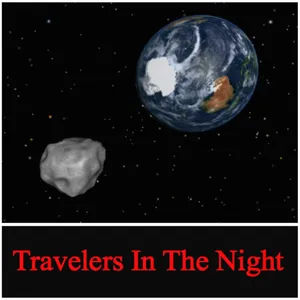
A real "Science Snack" for anyone who is interested in the extraterrestrial. Dr. Al Grauer is a member of the Catalina Sky Survey which has led the world in near Earth asteroid discoveries for 17 of the past 19 years. The music is "Eternity" by John Lyell.
Latest Episodes
The most recent episodes — sign up to get AI-powered summaries of each one.
- Yesterday2 min
409E-450-Saint Patrick's Day Comet
On Saint Patrick's Day, while searching for Earth approaching asteroids with the Catalina Sky Survey's 60 inch telescope on Mt. Lemmon, Arizona I spotted a slightly enlarged star like object with a tiny tail moving through the constellation of Virgo. After checking to see that it was not a known comet, I sent my discovery observations along with a description of it's coma and tail to the Minor Planet Center. Turns out that it had been observed as a moving point of light, but not noticed to be a comet, by the PanSTARRS group in Hawaii 3 month's earlier. Given the PanSTARRS historical observations along with those from other observatories around the world it only took scientists at the Minor Planet Center 2 days of additional observations to verify it to be a newly discovered comet. Since the naming rules state that a comet should be named after the first observer that identified it to be a comet it was given the C/2018 F1 (Grauer). In December of 2018 and July of 2019 Comet C/2018 F1 (Grauer), which I share with my wife Annie Grauer, will be closest to Earth on it's 5,555 year orbital path about our Sun. Unfortunately it is not likely to be visible to the unaided eye, appearing only as faint moving comet in the night sky on electronic camera images, leaving us to speculate on the condition of humanity when Comet C/2018 F1 (Grauer) returns in the year 7573 AD.
- 5 days ago2 min
919-Automatic Detection Of An Impactor
Recently a pair of JPL SynTrack Robotic automated telescopes located at a high altitude low light pollution site in California provided 4 tracking data points taken less than 30 minutes apart which indicated that a small space rock with a diameter smaller the height of a human being was on a collision course with Earth.
- 1 weeks ago2 min
408E-449-Cloud 7
To give you an idea of the asteroid traffic in our neighborhood, on a mostly cloudy night, through holes in the clouds, in a space of less than 2 hours, my Catalina Sky Survey teammate Richard Kowalski posted 7 new close approaching asteroid discoveries on the Minor Planet Center's Near Earth Object Confirmation Page
- 1 weeks ago2 min
918-Auroras from Space
The northern lights or Aurora Borealis have fascinated humans throughout the ages. Today aurora watching is a multimillion dollar industry in places like Alaska, Canada, Norway, Sweden, Finland, Greenland, and Iceland. Auroras are manifestations of the interaction between the solar wind, radiation, and our atmosphere we call space weather.
- 2 weeks ago2 min
407E-448-Two PHA's
The large dangerous asteroids that we don't know about are what keep asteroid hunters going to the telescope.
- 2 weeks ago2 min
917-Space Dust
As the Earth orbits the Sun at 18.5 mi/s it sweeps up about 100 tons of micrometeorites and space dust every day of which some 14 tons eventually makes it to the ground. You can even find some of these particles of space dust by using a magnet on material in the rain gutters attached to your roof.
- 3 weeks ago2 min
406E-447-Nuking An Asteroid
Tonight, even though the chances are extremely slim, an asteroid hunter could find a sizable asteroid on a collision course with planet Earth. If we have decades warning, the potential impactor's arrival time could be changed by impacting the dangerous object with a high velocity mass or if we have less time we will need to nuke it which will either blow it to bits or give it a rocket like push.
- 3 weeks ago2 min
916-Past Glory
When accurately recorded historical observations do not agree with what we what we see today it is often very rewarding to find out why. In modern telescopes we see Theta Eridani to a be pair separated by about 425 times our distance from the Sun orbiting a common center of gravity. Detailed observations of the spectrum of one of these show it to be itself a pair of stars orbiting each other every 4.1 days. One of this very close pair, as it is aging, dumps matter onto its companion causing it to brightened significantly. In the past this mass transfer rate was much higher than it is today and the naked eye brightness of Theta Eridani is fainter to us than it was long ago.
Get Travelers In The Night summaries in your inbox
Free AI-powered daily recaps. Key takeaways, quotes, and mentions — in a 5-minute read.
Get Free Summaries →Free forever for up to 3 podcasts. No credit card required.
You Might Also Like
Listeners also like.

Ask a Spaceman!
An astrophysicist answers listener questions about space, time, and the universe.
SpaceTime with Stuart Gary
Weekly explorations of astronomy, space, and science news with insights from a veteran science journalist and industry experts.
The 365 Days of Astronomy
A daily podcast featuring diverse voices exploring astronomy and space science topics.
Planetary Radio: Space Exploration, Astronomy and Science
Explores space exploration, astronomy, and science through conversations with experts and advocates shaping humanity's journey beyond Earth.

That UFO Podcast
Covers global UFO, UAP, and related phenomena through news updates and interviews with experts and witnesses.

Wanderer Chronicles Radio
A sentient starship's archivist narrates philosophical science fiction parables from across the cosmos.

Unobtainium Podcast
A Hollywood writer-producer and an astrophysicist analyze the science behind sci-fi films, separating fact from cinematic fiction.

Dear People of Earth Science and Physics- The UFO Podcast - Disclosure - Aliens - UAP
Explores UFO and UAP phenomena through scientific analysis, physics, and expert discussions on credible sightings and cosmic mysteries.

The Grimerica Show
Casual conversations with fringe thinkers on spirituality, alternative history, and UFOs.

Galactic Horrors
Dark science fiction tales set in isolated space environments, exploring technological failure, secrecy, and human vulnerability.

The Micah Hanks Program
Examines scientific mysteries and fringe topics like UFOs, ancient history, AI, and cryptozoology through critical discussion and guest interviews.

PBS Space Time
An astrophysicist explains cosmic phenomena like black holes and galaxy evolution through accessible, science-driven discussions.
About Travelers In The Night
A real "Science Snack" for anyone who is interested in the extraterrestrial. Dr. Al Grauer is a member of the Catalina Sky Survey which has led the world in near Earth asteroid discoveries for 17 of the past 19 years. The music is "Eternity" by John Lyell.
Customized Recaps
AI-powered recaps with compact key takeaways, quotes, and insights.
Straight to Your Inbox
Get key takeaways from Travelers In The Night in a 5-minute read.
Save Hours Every Week
Stay current on your favorite podcasts without falling behind.
Frequently Asked Questions
What is Podzilla's Travelers In The Night daily summary?
It's a free AI-powered email that summarizes new episodes of Travelers In The Night as soon as they're published. You get the key takeaways, notable quotes, and links & mentions — all in a quick read.
How does the Travelers In The Night podcast summary work?
When a new episode drops, our AI transcribes and analyzes it, then generates a personalized summary tailored to your interests and profession. It's delivered to your inbox every morning.
Is this an official Travelers In The Night product?
No. Podzilla is an independent service that summarizes publicly available podcast content. We're not affiliated with or endorsed by Albert D. Grauer.
Can I get summaries of other podcasts too?
Absolutely! The free plan covers up to 3 podcasts. Upgrade to Pro for 15, or Premium for 50. Browse our full catalog at /podcasts.
How often does Travelers In The Night release new episodes?
Travelers In The Night publishes 2x weekly. Our AI generates a summary within hours of each new episode.
What topics does Travelers In The Night cover?
Travelers In The Night covers topics including Science, Astronomy. Our AI identifies the specific themes in each episode and highlights what matters most to you.
Start getting Travelers In The Night summaries tomorrow morning.
Free forever for up to 3 podcasts. No credit card required.
Free forever for up to 3 podcasts. No credit card required.