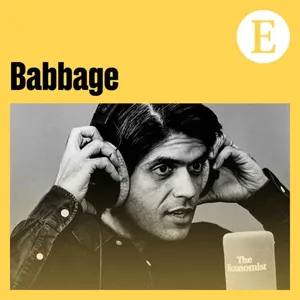
Free Daily Podcast Summary
Babbage from The Economist: Daily Summaries Delivered
by The Economist
Babbage is The Economist’s weekly podcast on science and technology—named after Charles Babbage, the grandfather of computing. Explore the science changing the way we live from AI to genetics, particle physics and space travel with Alok Jha. This award-winning podcast features in-depth interviews with top scientists and special episodes investigating wellness trends.
Latest Episodes
The most recent episodes — sign up to get AI-powered summaries of each one.
- Jun 23, 20263 min
Trailer: Tocqueville Road Trip
When Alexis de Tocqueville visited America from France in 1831 he saw a new kind of society. Not just a country, but an idea that would change the world. His book “Democracy in America” was a big influence on later generations of writers and thinkers, including The Economist’s US Editor John Prideaux. Now, 250 years after its birth, the vitality of that democracy is under question. In this series, John retraces the route Tocqueville took to find out how much of what inspired Tocqueville about America remains—and how worried we should be about what’s changed.Out nowFind the show here: https://econ.st/4esGGXw Hosted on Acast. See acast.com/privacy for more information.
- Jul 16, 202544 min
The bomb (part 1): were nuclear weapons inevitable?
Where did the world’s most devastating weapon come from? In a four-part series, we go behind the scenes at America's nuclear laboratories to understand how a scientific-mystery story about the ingredients of matter led to a world-changing (and second-world-war-ending) bomb less than five decades later. Nuclear weapons have been central to geopolitical power ever since. Now America is seeking to modernise its stockpile and, in doing so, its scientists are pushing the frontiers of extreme physics, materials science and computing. In episode one, we look at the birth of nuclear physics—the science that emerged early in the 20th century to answer a mystery: what is an atom actually made of? Host: Alok Jha, The Economist’s science and technology editor. Contributors: Frank Close, a physicist and author of “Destroyer of Worlds”, a history of the birth of nuclear physics; Cheryl Rofer, a chemist who used to work at the Los Alamos National Laboratory (LANL); and Nicholas Lewis, a historian at LANL. This episode features archive from the Atomic Heritage Foundation. Listen to episode two here. Transcripts of our podcasts are available via economist.com/podcasts. This is a free episode. To continue listening to “The Bomb”, you’ll need to subscribe. Listen to what matters most, from global politics and business to science and technology—subscribe to Economist Podcasts+. For more information about how to access Economist Podcasts+, please visit our FAQs page or watch our video explaining how to link your account. Hosted on Acast. See acast.com/privacy for more information.
- May 22, 202445 min
AI and health part one: DrGPT will see you now
Artificial intelligence is already making its mark in health care—but new, bigger, models promise to improve how patients access services, help doctors spot diseases faster and transform how medical research is done. In the first of two episodes on the potential of AI in health care, we ask: how will patients benefit from the technology behind ChatGPT? Host: Alok Jha, The Economist’s science and technology editor. Contributors: Natasha Loder, The Economist's health editor; Gerald Lip of NHS Grampian; Peter Kecskemethy of Kheiron Medical; Pranav Rajpurkar of Harvard Medical School; Hugh Harvey of Hardian Health. Want to learn more about generative artificial intelligence? Listen to our series on the science that built the AI revolution. Transcripts of our podcasts are available via economist.com/podcasts. Get a world of insights for 50% off—subscribe to Economist Podcasts+ For more information about how to access Economist Podcasts+, please visit our FAQs page or watch our video explaining how to link your account. Hosted on Acast. See acast.com/privacy for more information.
- May 1, 202442 min
Babbage: Teens and their screens
Ever since there have been smartphones and social media, there have been concerns about how they might be affecting children. Over the past decade, doctors have seen a decline in mental health in the young in much of the rich world. But whether that rise can be attributed to technology is still a matter of fierce debate. Nevertheless, demands are growing to proactively restrict teenagers’ access to phones and social media, just in case. How concerned should parents and teachers be? Or is this just another moral panic? Host: Alok Jha, The Economist’s science and technology editor. Contributors: Tom Wainwright, The Economist's technology and media editor; Clare Fernyhough, co-founder of Smartphone Free Childhood; Carol Vidal of Johns Hopkins University; Pete Etchells, a psychologist at Bath Spa University and the author of “Unlocked: The Real Science of Screen Time”. Listen to what matters most, from global politics and business to science and technology—subscribe to Economist Podcasts+ For more information about how to access Economist Podcasts+, please visit our FAQs page or watch our video explaining how to link your account. Hosted on Acast. See acast.com/privacy for more information.
- Mar 6, 202442 min
Babbage: The science that built the AI revolution—part one
What is intelligence? In the middle of the 20th century, the inner workings of the human brain inspired computer scientists to build the first “thinking machines”. But how does human intelligence actually relate to the artificial kind? This is the first episode in a four-part series on the evolution of modern generative AI. What were the scientific and technological developments that took the very first, clunky artificial neurons and ended up with the astonishingly powerful large language models that power apps such as ChatGPT? Host: Alok Jha, The Economist’s science and technology editor. Contributors: Ainslie Johnstone, The Economist’s data journalist and science correspondent; Dawood Dassu and Steve Garratt of UK Biobank; Daniel Glaser, a neuroscientist at London’s Institute of Philosophy; Daniela Rus, director of MIT’s Computer Science and Artificial Intelligence Laboratory; Yoshua Bengio of the University of Montréal, who is known as one of the “godfathers” of modern AI. On Thursday April 4th, we’re hosting a live event where we’ll answer as many of your questions on AI as possible, following this Babbage series. If you’re a subscriber, you can submit your question and find out more at economist.com/aievent. Get a world of insights for 50% off—subscribe to Economist Podcasts+ If you’re already a subscriber to The Economist, you’ll have full access to all our shows as part of your subscription. For more information about how to access Economist Podcasts+, please visit our FAQs page or watch our video explaining how to link your account. Hosted on Acast. See acast.com/privacy for more information.
- Feb 21, 202443 min
Babbage: The hunt for dark matter
Dark matter is thought to make up around a quarter of the universe, but so far it has eluded detection by all scientific instruments. Scientists know it must exist because of the ways galaxies move and it also explains the large-scale structure of the modern universe. But no-one knows what dark matter actually is. Scientists have been hunting for dark matter particles for decades, but have so far had no luck. At the annual meeting of the American Association for the Advancement of Science, held recently in Denver, a new generation of researchers presented their latest tools, techniques and ideas to step up the search for this mysterious substance. Will they finally detect the undetectable? Host: Alok Jha, The Economist’s science and technology editor. Contributors: Don Lincoln, senior scientist at Fermi National Accelerator Laboratory; Christopher Karwin, a fellow at NASA’s Goddard Space Flight Center; Josef Aschbacher, boss of the European Space Agency; Michael Murra of Columbia University; Jodi Cooley, executive director of SNOLAB; Deborah Pinna of University of Wisconsin and CERN. Get a world of insights for 50% off—subscribe to Economist Podcasts+ If you’re already a subscriber to The Economist, you’ll have full access to all our shows as part of your subscription. For more information about how to access Economist Podcasts+, please visit our FAQs page or watch our video explaining how to link your account. Hosted on Acast. See acast.com/privacy for more information.
- Jan 24, 202445 min
Babbage: Sam Altman and Satya Nadella on their vision for AI
OpenAI and Microsoft are leaders in generative artificial intelligence (AI). OpenAI has built GPT-4, one of the world’s most sophisticated large language models (LLMs) and Microsoft is injecting those algorithms into its products, from Word to Windows. At the World Economic Forum in Davos last week, Zanny Minton Beddoes, The Economist’s editor-in-chief, interviewed Sam Altman and Satya Nadella, who run OpenAI and Microsoft respectively. They explained their vision for humanity’s future with AI and addressed some thorny questions looming over the field, such as how AI that is better than humans at doing tasks might affect productivity and how to ensure that the technology doesn’t pose existential risks to society. Host: Alok Jha, The Economist's science and technology editor. Contributors: Zanny Minton Beddoes, editor-in-chief of The Economist; Ludwig Siegele, The Economist’s senior editor, AI initiatives; Sam Altman, chief executive of OpenAI; Satya Nadella, chief executive of Microsoft. If you subscribe to The Economist, you can watch the full interview on our website or app. Essential listening, from our archive: “Daniel Dennett on intelligence, both human and artificial”, December 27th 2023 “Fei-Fei Li on how to really think about the future of AI”, November 22nd 2023 “Mustafa Suleyman on how to prepare for the age of AI”, September 13th 2023 “Vint Cerf on how to wisely regulate AI”, July 5th 2023 “Is GPT-4 the dawn of true artificial intelligence?”, with Gary Marcus, March 22nd 2023 Sign up for a free trial of Economist Podcasts+. If you’re already a subscriber to The Economist, you’ll have full access to all our shows as part of your subscription. For more information about how to access Economist Podcasts+, please visit our FAQs page or watch our video explaining how to link your account. Hosted on Acast. See acast.com/privacy for more information.
- Dec 20, 202342 min
Babbage: Science book club
Books are the original medium for communicating science to the masses. In a holiday special, producer Kunal Patel asks Babbage’s family of correspondents about the books that have inspired them in their careers as science journalists. Host: Alok Jha, The Economist’s science and technology editor. Contributors: Rachel Dobbs, The Economist’s climate correspondent; Kenneth Cukier, our deputy executive editor; The Economist’s Emilie Steinmark; Geoff Carr, our senior editor for science and technology; and Abby Bertics, The Economist’s science correspondent. Reading list: “The Periodic Table” by Primo Levi; “When We Cease to Understand the World” by Benjamín Labatut; “A Theory of Everyone” by Michael Muthukrishna; “Madame Curie” by Ève Curie; “Sociobiology” by E. O. Wilson; “The Selfish Gene” by Richard Dawkins; “Why Fish Don't Exist” by Lulu Miller; and “How Far the Light Reaches” by Sabrina Imbler. Sign up for a free trial of Economist Podcasts+. If you’re already a subscriber to The Economist, you’ll have full access to all our shows as part of your subscription. For more information about how to access Economist Podcasts+, please visit our FAQs page or watch our video explaining how to link your account. Hosted on Acast. See acast.com/privacy for more information.
Get Babbage from The Economist summaries in your inbox
Free AI-powered daily recaps. Key takeaways, quotes, and mentions — in a 5-minute read.
Get Free Summaries →Free forever for up to 3 podcasts. No credit card required.
You Might Also Like
Listeners also like.
Economist Podcasts
Daily global news analysis from correspondents on major international stories.
Everybody's Business
A weekly look at business news from Wall Street to unusual ventures, with insights from Bloomberg Businessweek journalists.
The Most Interesting Thing in AI
Conversations with leading thinkers on the ethical, economic, and social impacts of artificial intelligence.

The Best One Yet
A daily 20-minute podcast breaking down the three key business stories with sharp, accessible takes.
The World, the Universe and Us
Explores big scientific questions about life, consciousness, climate, and the cosmos with expert scientists and New Scientist journalists.

Bloomberg Tech
Daily news and analysis on global tech companies, innovation, and the future of business.

Science Magazine Podcast
Weekly episodes covering original scientific research, global science news, and expert commentary.

OpenAI Podcast
Conversations with OpenAI researchers and builders exploring how frontier AI models are developed and used in practice.
BBC Inside Science
Explores the latest scientific discoveries and debates shaping our understanding of the world.
"The Cognitive Revolution"
Explores the transformative impact of artificial intelligence through interviews with innovators shaping its future.

Better Offline
Ed Zitron and guests explore how the tech industry’s power players shape society, for better or worse.
Smart Talks with IBM
Conversations with leaders leveraging AI, quantum computing, and emerging technologies to transform global businesses.
About Babbage from The Economist
Babbage is The Economist’s weekly podcast on science and technology—named after Charles Babbage, the grandfather of computing. Explore the science changing the way we live from AI to genetics, particle physics and space travel with Alok Jha. This award-winning podcast features in-depth interviews with top scientists and special episodes investigating wellness trends.
Customized Recaps
AI-powered recaps with compact key takeaways, quotes, and insights.
Straight to Your Inbox
Get key takeaways from Babbage from The Economist in a 5-minute read.
Save Hours Every Week
Stay current on your favorite podcasts without falling behind.
Frequently Asked Questions
What is Podzilla's Babbage from The Economist daily summary?
It's a free AI-powered email that summarizes new episodes of Babbage from The Economist as soon as they're published. You get the key takeaways, notable quotes, and links & mentions — all in a quick read.
How does the Babbage from The Economist podcast summary work?
When a new episode drops, our AI transcribes and analyzes it, then generates a personalized summary tailored to your interests and profession. It's delivered to your inbox every morning.
Is this an official Babbage from The Economist product?
No. Podzilla is an independent service that summarizes publicly available podcast content. We're not affiliated with or endorsed by The Economist.
Can I get summaries of other podcasts too?
Absolutely! The free plan covers up to 3 podcasts. Upgrade to Pro for 15, or Premium for 50. Browse our full catalog at /podcasts.
How often does Babbage from The Economist release new episodes?
Babbage from The Economist publishes monthly. Our AI generates a summary within hours of each new episode.
What topics does Babbage from The Economist cover?
Babbage from The Economist covers topics including Science, Technology. Our AI identifies the specific themes in each episode and highlights what matters most to you.
Start getting Babbage from The Economist summaries tomorrow morning.
Free forever for up to 3 podcasts. No credit card required.
Free forever for up to 3 podcasts. No credit card required.