Free Daily Podcast Summary
Better Offline: Daily Summaries Delivered
by Cool Zone Media and iHeartPodcasts
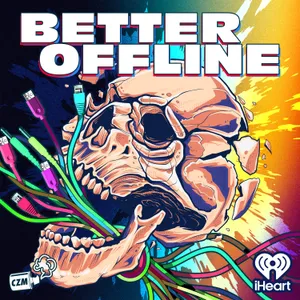
Better Offline is a weekly show exploring the tech industry’s influence and manipulation of society - and interrogating the growth-at-all-costs future that tech’s elite wants to build. Combining narrative-form storytelling, one-on-one interviews and panel-based discussions, Better Offline cuts through the buzzwords and obfuscation of the tech industry, investigating and evaluating the schemes and scams of everyone from cryptocurrency scumbags to the greediest of the venture capital elite. Tech industry veteran Ed Zitron and a dynamic coterie of guests will help listeners understand the who, how and why of how tech’s most powerful players are changing the world - for better or for worse.
Latest Episodes
The most recent episodes — sign up to get AI-powered summaries of each one.
- Yesterdaynarrative6 min4-min read
Monologue: Anthropic's $413bn Burden
The episode reveals alarming financial commitments by AI lab Anthropic, including $413 billion in non-cancelable compute contracts, exposing a fragile funding model reliant on massive debt and vendor financing that threatens broader financial markets. Host Ed Zitron argues this unsustainable structure, mirrored across the AI industry, will collapse under its own weight, with real economic consequences.
- 3 days agosolo7 min4-min read
Monologue: Anthropic Lost $8bn In 2025, Was A Worse Business Than OpenAI
Anthropic’s 2025 financials, leaked to Reuters, reveal a deeply unprofitable business that lost over $8 billion on $4.6 billion in revenue, spending $2.75 to make each dollar—worse than OpenAI’s already poor economics. Despite claims of profitability in 2026, the evidence suggests continued economic decay, with misleading run-rate metrics obscuring reality. The company’s leadership, including CEO Dario Amadei and CFO Krishna Rao, is accused of deliberate obfuscation, while its core infrastructure relies heavily on Google TPUs and AWS Inferentia chips, driving unsustainable compute costs.
- 1 weeks agosolo10 min5-min read
Monologue: The AI Data Center Overbuild
Despite widespread belief in an AI compute boom, the vast majority of AI hardware—potentially 50% or more—is sitting unpowered in warehouses or incomplete data centers, with hyperscalers like Microsoft having activated only a fraction of their purchased capacity. The illusion of insatiable demand is driven almost entirely by OpenAI and Anthropic, whose outsized contracts distort the market, while real AI capacity comes online at a fraction of the reported rate. This creates a dangerous misalignment between capital investment and actual utilization, setting the stage for a systemic collapse in the AI infrastructure economy.
- 1 weeks agoconversational54 min6-min read
The Hidden Recession Beneath The AI Bubble w/ Paul Kedrosky
AI-driven capital expenditures (AI CapEx) are distorting global economic systems in unprecedented ways, influencing sovereign debt markets, inflation metrics, global trade flows, and even geopolitical decisions. Economist Paul Kedrosky argues that the scale of AI investment—now approaching $1 trillion, mostly debt-financed—is so massive that it's creating systemic risks, including a potential balance sheet recession akin to Japan’s lost decades.
- 2 weeks agosolo8 min4-min read
Monologue: Shut The F*ck Up Dario!
Ed Zitron delivers a blistering, profanity-laden takedown of Dario Amodei and Sam Altman, accusing them of hypocrisy, financial obfuscation, and weaponizing AI safety rhetoric to mask their companies’ unprofitable, unreliable cloud software businesses. He argues that their claims of existential risk are performative, designed to distract from exploitative business practices and a lack of real safety action, while rushing to IPO on the backs of misleading metrics and media credulity.
- 2 weeks agoroundtable1h 5m6-min read
Stopping The AI Safety Cult ft. Adam Becker & Cal Newport
The current AI safety discourse is heavily shaped not by technical evidence but by a fringe philosophical movement—rationalism and effective altruism—that originated in 1990s transhumanist online communities. This ideology, rooted in speculative thought experiments rather than empirical science, now disproportionately influences major AI labs like OpenAI, Anthropic, and DeepMind, leading to reckless experimentation under the guise of existential risk mitigation. The movement’s core belief—that superintelligent AI is both inevitable and an existential threat—was established decades before modern LLMs existed, through the writings of self-taught thinkers like Eliezer Yudkowsky, and has since been amplified by vast infusions of tech wealth. Today, this blend of apocalyptic futurism and hyper-rationalist self-mythologizing distorts public understanding, policy debates, and corporate strategy, making it imperative to disentangle genuine technical progress from ideological theater.
- 3 weeks agosolo16 min5-min read
Monologue: Jacob Coxon and the AI Safety Grift
Ed Zitron delivers a scathing critique of Jacob Coxon and Evan Hubinger of Anthropic for claiming AI poses a greater than 10% chance of human extinction in the next decade, arguing their warnings are not only unsubstantiated but serve as cynical attention-seeking behavior that distracts from real, present harms caused by AI labs. He condemns the media for uncritically amplifying these claims and accuses companies like Anthropic and OpenAI of engaging in reckless, potentially illegal hacking under the guise of AI experimentation.
- 3 weeks agosolo17 min4-min read
Managing The Situation
Society consistently manages systemic crises rather than solving them, preserving the status quo at the expense of real progress. This pattern now extends to the AI industry, where unsustainable financial commitments, circular funding, and media complicity are setting the stage for a collapse far greater than the dot-com bubble.
Get Better Offline summaries in your inbox
Free AI-powered daily recaps. Key takeaways, quotes, and mentions — in a 5-minute read.
Get Free Summaries →Free forever for up to 3 podcasts. No credit card required.
You Might Also Like
Listeners also like.

All-In with Chamath, Jason, Sacks & Friedberg
Four tech investors discuss technology, markets, politics, and poker with candid, in-depth analysis.

Offline with Jon Favreau
Jon Favreau explores pressing issues of the day, from democracy and technology to parenting, through candid weekly conversations.

Hard Fork
A weekly exploration of the latest developments in technology by New York Times journalists.

On with Kara Swisher
Kara Swisher conducts candid, in-depth interviews with influential figures in tech, business, media, and politics.

The AI XR Podcast.
Industry insiders interview top founders and executives on AI, spatial computing, VR/AR, and synthetic media.

Solutions with Henry Blodget
Henry Blodget interviews experts in business, tech, and politics about practical solutions for building a better future.

The Best One Yet
Daily business news explained through sharp analysis and witty commentary, delivered in concise 20-minute episodes.

Possible
Explores optimistic, realistic futures through in-depth conversations with innovators in AI, science, health, and global affairs.
Tech Won't Save Us
A critical look at the tech industry’s influence on society and the political consequences of its promises.

The a16z Show
Explores technology and cultural shifts shaping the future through conversations with industry leaders and innovators.

Let's Talk Offline
Two career experts discuss real talk on work-life balance, pay negotiation, and office relationships for early-career professionals.

Reply All
A podcast that explores the internet and its impact on modern life through investigative stories and personal narratives.
Mentions
Most frequently mentioned across all episodes.
People
Companies
About Better Offline
Better Offline is a weekly show exploring the tech industry’s influence and manipulation of society - and interrogating the growth-at-all-costs future that tech’s elite wants to build. Combining narrative-form storytelling, one-on-one interviews and panel-based discussions, Better Offline cuts through the buzzwords and obfuscation of the tech industry, investigating and evaluating the schemes and scams of everyone from cryptocurrency scumbags to the greediest of the venture capital elite. Tech industry veteran Ed Zitron and a dynamic coterie of guests will help listeners understand the who, how and why of how tech’s most powerful players are changing the world - for better or for worse.
Customized Recaps
AI-powered recaps with compact key takeaways, quotes, and insights.
Straight to Your Inbox
Get key takeaways from Better Offline in a 5-minute read.
Save Hours Every Week
Stay current on your favorite podcasts without falling behind.
Frequently Asked Questions
What is Podzilla's Better Offline daily summary?
It's a free AI-powered email that summarizes new episodes of Better Offline as soon as they're published. You get the key takeaways, notable quotes, and links & mentions — all in a quick read.
How does the Better Offline podcast summary work?
When a new episode drops, our AI transcribes and analyzes it, then generates a personalized summary tailored to your interests and profession. It's delivered to your inbox every morning.
Is this an official Better Offline product?
No. Podzilla is an independent service that summarizes publicly available podcast content. We're not affiliated with or endorsed by Cool Zone Media and iHeartPodcasts.
Can I get summaries of other podcasts too?
Absolutely! The free plan covers up to 3 podcasts. Upgrade to Pro for 15, or Premium for 50. Browse our full catalog at /podcasts.
How often does Better Offline release new episodes?
Better Offline publishes every few days. Our AI generates a summary within hours of each new episode.
What topics does Better Offline cover?
Better Offline covers topics including Technology. Our AI identifies the specific themes in each episode and highlights what matters most to you.
Start getting Better Offline summaries tomorrow morning.
Free forever for up to 3 podcasts. No credit card required.
Free forever for up to 3 podcasts. No credit card required.