Free Daily Podcast Summary
Beyond The Prompt - How to use AI in your company: Daily Summaries Delivered
by Jeremy Utley & Henrik Werdelin
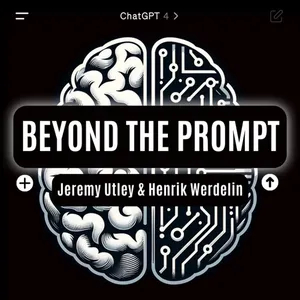
Beyond the Prompt dives deep into the world of AI and its expanding impact on business and daily work. Hosted by Jeremy Utley of Stanford's d.school, alongside Henrik Werdelin, an entrepreneur known for starting BarkBox, prehype and other startups, each episode features conversations with innovators and leaders to uncover pragmatic stories of how organizations leverage AI to accelerate success. Learn creative strategies and actionable tactics you can apply right away as AI capabilities advance exponentially.
Latest Episodes
The most recent episodes — sign up to get AI-powered summaries of each one.
- 1 weeks agoconversational1h 4m5-min read
What Will You Do With the Time AI Gives Back to You? - with Alex Kuilman, Founder of The Practice
The conversation explores why AI adoption in organizations stalls despite its potential, arguing that the core issue isn’t technical but psychological: a lack of psychological safety and widespread corporate numbing that prevents people from engaging authentically with change. The real bottleneck is human, not technological.
- 3 weeks agointerview1h 2m6-min read
How Do You Run a Company When You Can’t See Six Months Ahead? - with Axios CEO Jim VandeHei
Jim VandeHei, CEO of Axios, believes AI will soon grant everyone Einstein-level intelligence across any topic, but the real challenge lies not in the technology itself, but in organizational imagination and leadership. He argues that companies must proactively adapt by automating repetitive tasks, empowering employees through AI enablement, and reimagining their business models for a future where content is consumed via LLMs and social platforms.
- Sep 2, 2026interview1h 13m7-min read
From Knowledge Worker to Intelligence Worker: Why Human Judgment Matters More With AI - with OpenAI’s Brice Challamel
Bryce Chalamel, now head of AI strategy and adoption at OpenAI, argues that AI is transforming knowledge workers into intelligence workers by elevating the cognitive surface of work—comparable to the shift from writing to printing. The real challenge isn’t the technology, but the human mindset: trust must be earned, not dictated, and success hinges on emotional readiness, not just technical capability.
- Aug 19, 2026interview1h 5m6-min read
What Happens When AI Adoption Actually Works? - with Eric Porres, Chief AI Officer of Logitech
At Logitech, AI adoption has evolved from isolated experiments to a deeply embedded cultural and operational shift, driven by workflow integration, leadership modeling, and tools like the Build Advisor and Board Advisor gems that democratize access and learning. The real breakthrough isn’t just in creation, but in cultivating disciplined deletion—letting go of outdated processes to make space for innovation.
- Aug 5, 2026roundtable43 min4-min read
Why Companies That Are Great at Innovation Still Fail - with Stanford Professor Charles O'Reilly
The core challenge facing modern organizations is balancing exploitation of existing successful models with exploration of new innovations, especially in the age of AI. While many companies focus on efficiency (exploitation), long-term survival requires deliberate investment in exploration, cultural adaptability, and structural separation of new ventures — as exemplified by Amazon and Microsoft’s transformations. The average life expectancy of an S&P 500 company is now projected to drop to just 12 years, signaling a systemic failure in organizational adaptability. True resilience comes not from predicting the future but from designing systems that can discover it through experimentation, scaling, and cultural reinforcement of risk-taking.
- Jul 22, 2026conversational50 min5-min read
What You Can Learn From Asking AI for Brutal Honesty About Yourself - with Bestselling Author Daniel Pink
In a candid and introspective conversation, author Dan Pink shares how he uses AI as a brutally honest advisor to uncover personal blind spots, confront the risk of irrelevance, and strengthen self-awareness. Joined by hosts Jeremy Utley and Henrik Werdelin, the discussion expands into intellectual humility, the nature of agency, and the importance of taste in an AI-driven world where execution is easy but discernment is scarce.
- Jul 8, 2026conversational53 min5-min read
Are You Qualified to Challenge Your Team on AI? - with Geoff Woods, Author of The AI-Driven Leader
Geoff Woods, author of The AI-Driven Leader, returns to discuss how leaders must personally engage with AI to lead effectively, emphasizing that AI adoption is not about tools but about elevating human thinking and strategy. The conversation centers on the gap between leaders who delegate AI initiatives and those who embody them, with a focus on using AI as a thought partner to unlock deeper insight, alignment, and innovation.
- Jun 24, 2026conversational53 min5-min read
The Unexpected Economics of AGI - with Christian Catalini, Tech Founder and Co-Creator of Libra
Christian Catalini, a tech founder and former academic, discusses his recent paper on the economic implications of approaching artificial general intelligence (AGI), arguing that while intelligence is becoming commodified and cheap, the critical bottleneck for humans will be verification—the ability to judge whether AI-generated outputs meet a standard of quality, accuracy, or intent. He emphasizes that this shift demands individuals and organizations to rethink their roles, not as producers of intelligence, but as verifiers, directors, and orchestrators of AI systems.
Get Beyond The Prompt - How to use AI in your company summaries in your inbox
Free AI-powered daily recaps. Key takeaways, quotes, and mentions — in a 5-minute read.
Get Free Summaries →Free forever for up to 3 podcasts. No credit card required.
You Might Also Like
Listeners also like.

How I AI
A practical guide to using AI tools in work and life, featuring guests who share specific, actionable techniques and workflows.
The AI Daily Brief: Artificial Intelligence News and Analysis
A daily analysis of artificial intelligence news, exploring its creative potential, industry impacts, and ethical challenges.

Right About Now - Legendary Business Advice
Raw business insights from founders and industry leaders, revealing real wins, failures, and actionable strategies without the fluff.

Me, Myself, and AI
Leaders from top companies share real-world strategies for turning artificial intelligence into measurable business results.

Expert Intelligence with Paul Estes
Explores the intersection of human expertise and AI in shaping the future of work through interviews with industry leaders and innovators.

Possible with Reid Hoffman
Explores optimistic, realistic futures through in-depth conversations with innovators in AI, science, health, and global affairs.

Everyday AI Podcast – An AI and ChatGPT Podcast
Covers practical uses of AI tools like ChatGPT and Midjourney to help people work more efficiently and advance their careers.
"The Cognitive Revolution"
Explores the transformative impact of artificial intelligence through interviews with innovators shaping its future.

No Priors: Artificial Intelligence | Technology | Startups
Discusses AI advancements and implications with researchers, engineers, and founders shaping the future of artificial intelligence.

AI For Humans: Weekly AI News, Tools & Trends
A weekly breakdown of major AI news, tools, and breakthroughs for both newcomers and seasoned enthusiasts.

Artificial Intelligence Masterclass
Examines the philosophical and ethical dimensions of artificial intelligence and its impact on society, meaning, and the future of work.

The Most Interesting Thing in AI
Conversations with leading thinkers on the ethical, economic, and social impacts of artificial intelligence.
Mentions
Most frequently mentioned across all episodes.
People
Books
Companies
Products & Tools
About Beyond The Prompt - How to use AI in your company
Beyond the Prompt dives deep into the world of AI and its expanding impact on business and daily work. Hosted by Jeremy Utley of Stanford's d.school, alongside Henrik Werdelin, an entrepreneur known for starting BarkBox, prehype and other startups, each episode features conversations with innovators and leaders to uncover pragmatic stories of how organizations leverage AI to accelerate success. Learn creative strategies and actionable tactics you can apply right away as AI capabilities advance exponentially.
Customized Recaps
AI-powered recaps with compact key takeaways, quotes, and insights.
Straight to Your Inbox
Get key takeaways from Beyond The Prompt - How to use AI in your company in a 5-minute read.
Save Hours Every Week
Stay current on your favorite podcasts without falling behind.
Frequently Asked Questions
What is Podzilla's Beyond The Prompt - How to use AI in your company daily summary?
It's a free AI-powered email that summarizes new episodes of Beyond The Prompt - How to use AI in your company as soon as they're published. You get the key takeaways, notable quotes, and links & mentions — all in a quick read.
How does the Beyond The Prompt - How to use AI in your company podcast summary work?
When a new episode drops, our AI transcribes and analyzes it, then generates a personalized summary tailored to your interests and profession. It's delivered to your inbox every morning.
Is this an official Beyond The Prompt - How to use AI in your company product?
No. Podzilla is an independent service that summarizes publicly available podcast content. We're not affiliated with or endorsed by Jeremy Utley & Henrik Werdelin.
Can I get summaries of other podcasts too?
Absolutely! The free plan covers up to 3 podcasts. Upgrade to Pro for 15, or Premium for 50. Browse our full catalog at /podcasts.
How often does Beyond The Prompt - How to use AI in your company release new episodes?
Beyond The Prompt - How to use AI in your company publishes biweekly. Our AI generates a summary within hours of each new episode.
What topics does Beyond The Prompt - How to use AI in your company cover?
Beyond The Prompt - How to use AI in your company covers topics including Education, Business, Management, Entrepreneurship, How To. Our AI identifies the specific themes in each episode and highlights what matters most to you.
Start getting Beyond The Prompt - How to use AI in your company summaries tomorrow morning.
Free forever for up to 3 podcasts. No credit card required.
Free forever for up to 3 podcasts. No credit card required.