Free Daily Podcast Summary
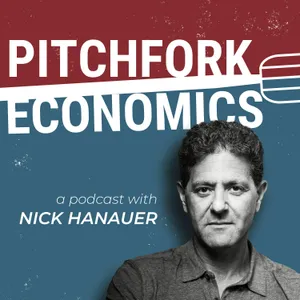
Pitchfork Economics with Nick Hanauer: Daily Summaries Delivered
by Civic Ventures
We are living through a paradigm shift from trickle-down neoliberalism to middle-out economics — a new understanding of who gets what and why. Join zillionaire class-traitor Nick Hanauer and some of the world’s leading economic and political thinkers as they explore the latest thinking on how the economy actually works.
Latest Episodes
The most recent episodes — sign up to get AI-powered summaries of each one.
- 2 days ago35 min
Who Is Industrial Policy Really For? (with Isabel Estevez)
Industrial policy is back at the center of the economic debate. But tariffs, factories, and reshoring are only part of the story. In this 2023 conversation, development economist Isabel Estevez joins Nick and Goldy to argue that industrial policy is ultimately about choices: what we produce, how we produce it, and who benefits. She explains why a smart industrial strategy has to look beyond manufacturing output to workers, communities, climate, public investment, and the broader public good. Because the real debate isn’t whether the government shapes markets. It already does. The question is what—and who—we’re shaping them for. This episode originally aired August 1, 2023. Isabel Estevez is an institutional and development economist and Co-Executive Director of i3T—Industry, Infrastructures and Innovation for Strategic Transformation. She previously served as Deputy Director of Industrial Policy and Trade at the Roosevelt Institute and as a Senior Policy Advisor at the Sierra Club. Further reading: Using Industrial Policy for Productive Transformation: Three Lessons from Development Economics for US Industrial Strategy How Can (Green) Industrial Policy Serve Human and Natural Flourishing? Global Green Industrial Policy: Navigating Power Dynamics for a Pro-Working-Class, Pro-Development Green Transformation The New Economics of Industrial Policy Social Media: @isabel_estevez_ isaestevez.com Website: http://pitchforkeconomics.com Facebook: Pitchfork Economics Podcast Bluesky: @pitchforkeconomics.bsky.social Instagram: @pitchforkeconomics Threads: pitchforkeconomics TikTok: @pitchfork_econ YouTube: @pitchforkeconomics LinkedIn: Pitchfork Economics Twitter: @PitchforkEcon, @NickHanauer Substack: The Pitch Nick’s Substack: NickHanauer.Substack.com
- 1 weeks ago31 min
When Companies Run the Courts: How Corporate Power Becomes Legal Power (with Brendan Ballou)
We like to think that if a company cheats us, steals our wages, or breaks the law, we can take them to court. Unfortunately, there’s a good chance you’ve already signed that right away. This week, Brendan Ballou returns to the podcast to explain how forced arbitration created what he calls America’s secret justice system—and why this is as much an economic story as a legal one. He joins Paul and Goldy to unpack how corporations use economic power to weaken workers’ and consumers’ legal power, why the myth of the “voluntary contract” falls apart when every option comes with the same fine print, and how making corporate misconduct harder to challenge changes the incentives that shape the entire market. Brendan Ballou is the founder of the Public Integrity Project, a nonprofit anti-corruption law firm, and the author of When Companies Run the Courts: How Forced Arbitration Became America’s Secret Justice System. Further reading: When Companies Run the Courts: How Forced Arbitration Became America’s Secret Justice System Plunder: Private Equity’s Plan to Pillage America Pitchfork Economics: Stop the Steal: Revisiting Private Equity’s Plan to Pillage America (with Brendan Ballou) Public Integrity Project Social Media: @brendanballou.bsky.social Instagram: @brendanballou Substack: @brendanballou @brendanballou Ask Pitchfork: Have a question for Nick, Goldy, or the show? Leave it in the comments on YouTube or Spotify with #askpitchfork. Website: http://pitchforkeconomics.com Facebook: Pitchfork Economics Podcast Bluesky: @pitchforkeconomics.bsky.social Instagram: @pitchforkeconomics Threads: pitchforkeconomics TikTok: @pitchfork_econ YouTube: @pitchforkeconomics LinkedIn: Pitchfork Economics Twitter: @PitchforkEcon, @NickHanauer Substack: The Pitch Nick’s Substack: NickHanauer.Substack.com
- 2 weeks ago46 min
Gouged: How Big Tech Reinvented the Rip-Off (with Lindsay Owens)
For 150 years, the price tag made a simple and universal promise: the price you saw was the price everyone saw. Now, that promise is disappearing. This week, Lindsay Owens, President and CEO of the Groundwork Collaborative returns to discuss her new book, Gouged: The End of a Fair Price — And What That Means for Your Wallet. She explains how corporations are using algorithms, personal data, and AI to figure out not what something costs, but how much you personally are willing to pay. From Instacart’s grocery experiments to the coming world of AI shopping agents, the conversation asks a basic question: If nobody knows what the real price is, can markets actually work the way we’re told they do? Lindsay Owens, PhD, is the President and CEO of Groundwork Collaborative, an economic policy think tank focused on corporate power, prices, and an economy that works for workers and families. She is also the author of Gouged: The End of a Fair Price — And What That Means for Your Wallet. Social Media: @lindsayowens.bsky.social @groundwork.bsky.social @lindsayowensphd @groundworkcollab @owenslindsay1 @Groundwork Further reading: Gouged: The End of a Fair Price—and What That Means for Your Wallet “Same Cart, Different Price: Instacart’s Price Experiments Cost Families at Checkout” When the Invisible Hand Becomes An Algorithm with Lindsay Owens How Outsized Corporate Profits Raised Prices with Lindsay Owens Website: http://pitchforkeconomics.com Facebook: Pitchfork Economics Podcast Bluesky: @pitchforkeconomics.bsky.social Instagram: @pitchforkeconomics Threads: pitchforkeconomics TikTok: @pitchfork_econ YouTube: @pitchforkeconomics LinkedIn: Pitchfork Economics Twitter: @PitchforkEcon, @NickHanauer Substack: The Pitch Nick’s Substack: NickHanauer.Substack.com
- 3 weeks ago42 min
Can We Build a Common Good Economy? (with Mariana Mazzucato)
Economics teaches us to think of markets as natural forces, and government as something that should only intervene when they fail. In her new book, The Common Good Economy: How to Make Capitalism Work for Us All, economist Mariana Mazzucato argues that story is backward. She joins Nick and Goldy to ask what changes when we recognize that markets are choices — shaped by rules, institutions, public investment, and power — and what that means for the kind of economy we could build instead. If we designed this system, can we redesign it? Mariana Mazzucato is a Professor in the Economics of Innovation and Public Value at University College London (UCL) and founding director of the UCL Institute for Innovation and Public Purpose. She is the author of several acclaimed books, including The Entrepreneurial State, The Value of Everything, Mission Economy, The Big Con, and most recently, The Common Good Economy: How to Make Capitalism Work for Us All. Social Media: @mazzucatom.bsky.social @MazzucatoM @mazzucatom Further reading: The Common Good Economy: How to Make Capitalism Work for Us All UCL Institute for Innovation and Public Purpose The Entrepreneurial State Mission Economy: A Moonshot Guide to Changing Capitalism The Big Con The Great Transformation by Karl Polanyi A Mission-Oriented Approach to School Meals Mission-Oriented Public-Private Partnerships: Lessons from the Oxford–AstraZeneca COVID-19 Vaccine Website: http://pitchforkeconomics.com Facebook: Pitchfork Economics Podcast Bluesky: @pitchforkeconomics.bsky.social Instagram: @pitchforkeconomics Threads: pitchforkeconomics TikTok: @pitchfork_econ YouTube: @pitchforkeconomics LinkedIn: Pitchfork Economics Twitter: @PitchforkEcon, @NickHanauer Substack: The Pitch Nick’s Substack: NickHanauer.Substack.com
- Sep 8, 202633 min
The $29 Trillion Social Security Crisis We Already Know How to Fix ( with Rey Fuentes)
Americans are told Social Security is in trouble because there are more retirees and fewer workers to support them. But that story leaves out a major part of the problem: how much income now sits outside the system that funds Social Security. Roosevelt Institute’s Rey Fuentes joins Nick and Goldy to explain how rising inequality, stagnant wages, and an outdated payroll-tax structure helped create Social Security’s looming shortfall — and why benefit cuts are far from inevitable. Plus, Nick puts forward a different way to think about fixing the system — one that starts with a basic question: why should some kinds of income count toward Social Security while others don’t? Rey Fuentes is Director of Strategic Initiatives at the Roosevelt Institute. The $29 trillion figure in this episode’s title refers to Social Security’s projected 75-year unfunded obligation. According to the 2026 Social Security Trustees Report, the combined retirement, survivor, and disability programs are projected to have a $29.3 trillion financing shortfall, measured in present-value dollars, between 2026 and 2100. That is not $29 trillion that comes due when the retirement trust fund is projected to deplete its reserves in 2032. Read the 2026 Social Security Trustees Report Summary Social Media: @rooseveltinstitute.org @rooseveltinst @therooseveltinstitute Further reading: Social Security Doesn’t Need Cuts. The Fiscal Panic Is Missing Where the Money Is 1983 v. 2032: The Economics of the Last and Next Social Security Reform What’s Actually Behind Social Security’s Trust Fund Shortfall “Will Social Security Run Out?” Is the Wrong Question: How Lawmakers Can Protect Beneficiaries and Strengthen OASI “Sound, Needy, and Patriotic Legislation”: Preserving the Fundamental Promises of the Social Security System Website: http://pitchforkeconomics.com Facebook: Pitchfork Economics Podcast Bluesky: @pitchforkeconomics.bsky.social Instagram: @pitchforkeconomics Threads: pitchforkeconomics TikTok: @pitchfork_econ YouTube: @pitchforkeconomics LinkedIn: Pitchfork Economics Twitter: @PitchforkEcon, @NickHanauer Substack: The Pitch Nick’s Substack: NickHanauer.Substack.com
- Sep 1, 202639 min
Profit, Power, and the Crisis of the Common Good (with Sen. Chris Murphy)
Why do so many Americans feel powerless, lonely, and disconnected — and what does that have to do with our economy? Senator Chris Murphy joins Nick and Goldy to discuss his new book, Crisis of the Common Good, which makes the case that America’s political crisis is inseparable from a deeper collapse of power, connection, and shared purpose. They dig into the “cult of profit,” Market Humanism, AI, scarcity, corruption, and the limits of an economy organized around efficiency and extraction. It’s a conversation about what happens when profit becomes the highest measure of success, and what it would mean to build an economy rooted in dignity, connection, and the common good. Senator Chris Murphy is the junior United States Senator for Connecticut Social Media: @chrismurphyct.bsky.social @ChrisMurphyCT Further reading: Crisis of the Common Good: The Fight for Meaning and Connection in a Broken America Watch Nick Debate Obama Admin Economist Jason Furman: NickHanauer.Substack.com Website: http://pitchforkeconomics.com Facebook: Pitchfork Economics Podcast Bluesky: @pitchforkeconomics.bsky.social Instagram: @pitchforkeconomics Threads: pitchforkeconomics YouTube: @pitchforkeconomics LinkedIn: Pitchfork Economics Twitter: @PitchforkEcon, @NickHanauer Substack: The Pitch Nick’s Substack: NickHanauer.Substack.com
- Aug 25, 202642 min
Chains of Command: How Franchising Turned Control Without Responsibility Into a Business Model (with Brian Callaci)
When you walk into a McDonald’s, it looks like one company. But legally, the person making your fries probably doesn’t work for McDonald’s at all. Brian Callaci, Chief Economist at the Open Markets Institute and author of Chains of Command, joins Nick and Goldy to explain how franchising became a blueprint for corporate control without responsibility — shifting risk, liability, and labor costs onto franchisees and workers while profits flow upward. Brian Callaci is the chief economist at the Open Markets Institute and author of Chains of Command: The Rise and Cruel Reign of the Franchise Economy. Social Media: @briancallaci.bsky.social @brian_callaci briancallaci.com Further reading: Chains of Command: The Rise and Cruel Reign of the Franchise Economy Franchise: The Golden Arches in Black America by Marcia Chatelain Sectoral bargaining FAQ: Collective bargaining, sectoral wage and standards boards, and worker power The Founder (2016) Continental T.V., Inc. v. GTE Sylvania, Inc., 433 U.S. 36 (1977) Senate Subcommittee on Antitrust & Monopoly Hearing on Distribution problems affecting small business. Part 1: franchising agreements, March (1965) Website: http://pitchforkeconomics.com Facebook: Pitchfork Economics Podcast Bluesky: @pitchforkeconomics.bsky.social Instagram: @pitchforkeconomics Threads: pitchforkeconomics TikTok: @pitchfork_econ YouTube: @pitchforkeconomics LinkedIn: Pitchfork Economics Twitter: @PitchforkEcon, @NickHanauer Substack: The Pitch
- Aug 18, 202641 min
The Joy of Money (with Carrie Joy Grimes)
Most personal finance advice starts with the same basic premise: you’re doing money wrong. But Carrie Joy Grimes, founder of WorkMoney and author of The Joy of Money, says that misses half the story. Yes, people need real tools to budget, save, pay down debt, and plan for the future. But no amount of discipline can fix an economy where wages are too low, costs are too high, and working people have lost power over the rules that shape their lives. This week, Nick and Goldy talk with Grimes about why money is “math and feelings,” how shame keeps people stuck, why so much financial advice is written for people who already have money, and why the best thing we can do is not teach people to be better at being poor — but build an economy where fewer people are poor in the first place. Carrie Joy Grimes is the founder and CEO of WorkMoney and author of The Joy of Money. Before founding WorkMoney, she spent two decades as a union organizer fighting for higher wages, better benefits, and stronger worker power. Social Media: Carrie Joy Grimes Instagram TikTok YouTube Work Money Instagram TikTok YouTube Twitter Further reading: The Joy of Money: How to Do More With and Feel Better About Your Money—No Matter How Much You Have WorkMoney - Provides free tools, tips, and resources to help people lower their living costs, find financial assistance, and increase their overall income. MoneyFinder - A bill-negotiation service launched by WorkMoney. Website: http://pitchforkeconomics.com Facebook: Pitchfork Economics Podcast Bluesky: @pitchforkeconomics.bsky.social Instagram: @pitchforkeconomics Threads: pitchforkeconomics TikTok: @pitchfork_econ YouTube: @pitchforkeconomics LinkedIn: Pitchfork Economics Twitter: @PitchforkEcon, @NickHanauer Substack: The Pitch
Get Pitchfork Economics with Nick Hanauer summaries in your inbox
Free AI-powered daily recaps. Key takeaways, quotes, and mentions — in a 5-minute read.
Get Free Summaries →Free forever for up to 3 podcasts. No credit card required.
You Might Also Like
Listeners also like.
Capitalisn't
Examines the flaws in modern capitalism and explores solutions with insights from economics and business journalism.
Platypus Economics with Justin Wolfers
Economics applied to global events and daily life, explained clearly and engagingly.

Capital Record
David Bahnsen discusses free markets and capitalism with business leaders and economists.
Optimist Economy
Economists analyze U.S. economic challenges like housing, healthcare, and retirement, pairing data and history with practical solutions.

All-In with Chamath, Jason, Sacks & Friedberg
Four tech investors discuss technology, markets, politics, and poker with candid, in-depth analysis.
It's The Economy
A weekly breakdown of economic concepts and their real-world impact, explained by experts in short, accessible episodes.

The Ezra Klein Show
Conversations on pressing political, social, and cultural issues with experts and thinkers.

EconTalk
Long-form conversations on economics, philosophy, history, and human behavior with experts from diverse fields.
Planet Money
Explains how economic forces influence everyday life and global events through storytelling and deep dives into surprising topics.

The Prof G Pod with Scott Galloway
A no-holds-barred take on business, tech, culture, and life from a professor, author, and entrepreneur.

Conversations with Tyler
Discussions with intellectuals and experts on ideas, culture, and global issues.
Impolitic with John Heilemann
Candid interviews with figures in politics, media, tech, and culture exploring power, influence, and societal change.
About Pitchfork Economics with Nick Hanauer
We are living through a paradigm shift from trickle-down neoliberalism to middle-out economics — a new understanding of who gets what and why. Join zillionaire class-traitor Nick Hanauer and some of the world’s leading economic and political thinkers as they explore the latest thinking on how the economy actually works.
Customized Recaps
AI-powered recaps with compact key takeaways, quotes, and insights.
Straight to Your Inbox
Get key takeaways from Pitchfork Economics with Nick Hanauer in a 5-minute read.
Save Hours Every Week
Stay current on your favorite podcasts without falling behind.
Frequently Asked Questions
What is Podzilla's Pitchfork Economics with Nick Hanauer daily summary?
It's a free AI-powered email that summarizes new episodes of Pitchfork Economics with Nick Hanauer as soon as they're published. You get the key takeaways, notable quotes, and links & mentions — all in a quick read.
How does the Pitchfork Economics with Nick Hanauer podcast summary work?
When a new episode drops, our AI transcribes and analyzes it, then generates a personalized summary tailored to your interests and profession. It's delivered to your inbox every morning.
Is this an official Pitchfork Economics with Nick Hanauer product?
No. Podzilla is an independent service that summarizes publicly available podcast content. We're not affiliated with or endorsed by Civic Ventures.
Can I get summaries of other podcasts too?
Absolutely! The free plan covers up to 3 podcasts. Upgrade to Pro for 15, or Premium for 50. Browse our full catalog at /podcasts.
How often does Pitchfork Economics with Nick Hanauer release new episodes?
Pitchfork Economics with Nick Hanauer publishes weekly. Our AI generates a summary within hours of each new episode.
What topics does Pitchfork Economics with Nick Hanauer cover?
Pitchfork Economics with Nick Hanauer covers topics including News, Business, Government, Arts, Books, Politics. Our AI identifies the specific themes in each episode and highlights what matters most to you.
Start getting Pitchfork Economics with Nick Hanauer summaries tomorrow morning.
Free forever for up to 3 podcasts. No credit card required.
Free forever for up to 3 podcasts. No credit card required.