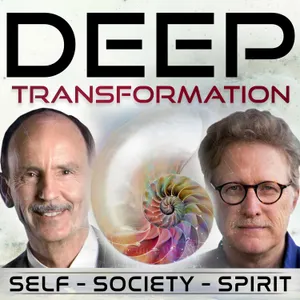
Free Daily Podcast Summary
Deep Transformation: Daily Summaries Delivered
by Roger Walsh and John Dupuy
Deep Transformation offers dialogues with cutting-edge thinkers, artists, contemplatives, and activists who combine big-picture, integrative perspectives with profound, contemplative depths. With these remarkable people, we explore the great questions of our time, such as how best to live, and how best to heal, learn, create, and contribute in our era of unprecedented challenges and opportunities.
Latest Episodes
The most recent episodes — sign up to get AI-powered summaries of each one.
- 4 days ago1h 25m
What We Can Do for Our Brains: Practical Ways to Cultivate Healthy, Agile Minds & Also Reduce the Risk of Dementia
Ep. 243 | In this outstandingly useful and timely conversation, Dr. Roger Walsh (more often the co-host of the Deep Transformation podcast) is our expert guest, sharing his passion for brain health and his knowledge about what we can do to keep our brains active, high-functioning, and well. With a Ph.D. in neuroscience and several awards for brain research, Roger was also on the first research team to discover the older brain’s neuroplasticity, and he has been excited about the possibilities and developmental implications of this ever since. Whether we’re talking about the body’s physical capabilities or the brain’s cognitive ones, Roger explains that a lot of what we thought was “normal” aging is actually “disuse atrophy”—in other words, use it or lose it—and beyond that, cultivate it and enhance it! Roger would like to write a book on all the helpful information he has learned about brain health, but with people he cares for beginning to acknowledge they are wrestling with cognitive decline, he decided it’s time to get this information out now.After establishing the brain’s inherent potential for growth, Roger dives into the practicalities—outlining actions we can take that research shows will make a significant difference in either enhancing our cognitive functioning, increasing our longevity, reducing the risk of dementia, supporting a life of physical and mental well-being, or all of the above. From the startlingly beneficial effects of green tea to the harmful effects of plastics, pesticides, and wildfire smoke, Roger covers all the bases: exercise and diet, supplements and sleep, environmental risks and medical interventions, friendships and nature, meditation and service—in a way that feels inspiring and doable. This is brain health for everyone in a comprehensive nutshell, presented with Roger’s signature clarity, astuteness, warmth, and humor. Listen and reap the benefits. Recorded September 3, 2026.The information about brain care in this dialogue is not meant to constitute personal medical advice for any individual. Rather, it is information that listeners can take to their personal physician to discuss and assess with the physician.“If you’ve got to pick one thing, exercise is probably the best thing we’ve got for maintaining the brain and the body.”Topics & Time StampsIntroducing Roger Walsh, an MD with a PhD in neuroscience, several awards for brain research, author & professor emeritus of psychiatry, philosophy & anthropology What we thought of as normal aging is actually “disuse atrophy” What’s good for the body is good for the brain Changing our cultural stereotype of aging What affects us most: lifestyle choices + the genes we are born with Neuroplasticity is the context our potential swims in Care & maintenance of the brain falls into 5 major categories Meditation’s significant benefits are both physical & mental Therapeutic Lifestyle Changes: first comes exercise For depression, exercise is both prophylactic & about as effective as antidepressants Initiating new habits is the hardest part The importance of friendships The effects of our continuously fragmented attention Sleep clears toxins—including plaques & tangles that can cause Alzheimer’s The bad effects of light pollution Purpose, service & contribution: people who serve live longer, happier, healthier lives Being in nature cleanses psychic toxins: we are biophilic Fluid intake has immediate as well as long-term benefits Following the 3 main principles of diet Environmental risks: we live in a chemical soup Inhaling wildfire smoke particles moves them right into our brains The overwhelming amount of plastic everywhere—including in our brains Pesticides should be banned Coffee, alcohol & the enormous benefits of green tea Supplements: lithium, magnesium L-threonate & fish oils Get regular medical work-ups! And correct any hearing loss or visual loss Vaccin
- 2 weeks ago1h 3m
Midwifing the Diamond Approach: How the Teaching Found and Transformed Hameed Ali & Karen Johnson
Ep. 242 | What a gift to have Karen Johnson and A. H. Almaas (Hameed Ali) together in conversation to explore their extraordinary journeys of awakening and share the remarkable ways presence found to transform their hearts and minds—all of which culminated in the contemporary spiritual path known as the Diamond Approach. Karen’s book, The Jeweled Path (the basis for this Jeweled Path Series), chronicles Karen and Hameed’s spiritual adventures from the beginning: what happened in their childhoods, how they first met, the emerging realization that what they were experiencing was shaping into a unique path of awakening that others could follow and benefit from also, through the establishment of the Ridhwan School, home of the Diamond Approach. In this dialogue, Karen tells how incredible spiritual experiences would come to them right in the midst of life—in the grocery store, on the way to work, in a bar… And we hear the resonant story of when Hameed poured a life-changing transmission of presence into her hand. Karen and Hameed’s vivid descriptions of what they experienced—“explosions of consciousness,” “streams of awakening,” “becoming a body of light, fullness, and presence, nowness embodied”—are awakening transmissions in their own right. And the point they drive home—that they were not the founders of the Diamond Approach, rather the teaching found them—has the magical effect of opening us to see reality in a different way. Listening to Karen and Hameed discuss their experiences, insights, and the emergence of the Diamond Path is simply an amazing experience on its own. Recorded August 13, 2026.“The interesting thing about presence is, if you talk about it when it’s not there, it’s just an idea—because presence is only now.”Topics & Time StampsIntroducing Karen Johnson, co-founder of the Diamond Approach, who joins Hameed Ali in The Jeweled Path Series which focuses on her book The Jeweled Path: The Biography of the Diamond Approach to Inner Realization How did it come about that Karen & Hameed were able to found a spiritual path together? The personal element in the Diamond Approach allows for the spiritual possibilities of relationship Hameed & Karen’s conversations evolved into the student/teacher practice of inquiry so essential to the Diamond Approach How Hameed switched from training to be a scientist to investigating the nature of reality Hameed kept disciplined notes which allowed them to track their experiences, make sense of them over time, and realize this teaching was for others too For Hameed, it wasn’t one awakening but a stream of awakenings If Hameed talked about an experience, Karen would start to feel it Karen’s experience of Hameed pouring a transmission into her hand For some an awakening flushes out blocks & barriers, for others not Hameed was able to collect presence in his hand and then give it away For Karen, the transmission wasn’t just an experience, it was realizing: this is what you are When a bubble of pure awareness came to Karen & Hameed in a bar What is a transmission? How Hameed’s motorcycle accident brought in the diamond structure This is a spiritual path of felt understanding, not merely intellectual understanding A teacher isn’t just transmitting all the goodies, they’re also transmitting all the grit Hameed would receive transmissions from other teachings encompassing their whole path Hameed & Karen were sure they would find explanations for their experiences in other teachings Other twosome spiritual relationships: Aurobindo & the Mother, the founders of A Course in Miracles, Rumi & Shams, and more Resources & ReferencesA. H. Almaas (Hameed Ali) and Karen Johnson, co-founders of The Ridhwan School<a href="https://online.diamondapproach.org/?ref=15&utm_source=aff
- Sep 3, 20261h 19m
Transmuting Life’s Inevitable Pains: Embracing a Post-Tragic Perspective
Ep. 241 | A deeply engaging conversation in which Alexander Love, adult development expert and coach, and author of the soon-to-be-published trilogy Evolutionary Gestures, introduces us to the post-tragic perspective, with all of its potential to nourish, ground, and open us to a world of possibilities. Alexander explains that post-tragic is not a developmental stage per se, but a dimension available to anyone willing to do the work. It’s part of a triad—pre-tragic innocence, tragic disillusionment, and post-tragic possibilities—encountered in every wisdom tradition, the hero’s journey, and every good story. Post-tragic is not about leaving the tragedy (trauma, pain, loss) behind, but about turning toward it and dropping into a dimension of being that can interface with it in a new way, from a place that isn’t divided or broken. It’s also about asking, what happens next, after the tragedy? How does the story proceed?Shattering our certainty, a tragic event in our lives makes our world more diaphanous, Alexander continues, opening the way for us to lean further into the mystery. Here we encounter the vastness of possibility, the mystery being the first imagined wholeness, the seed of all potentiality, and we begin to see the sacred and the beauty in everything. Though the healing notion of facing our trauma and working through it is not new, Alexander’s pre-tragic, tragic, and post-tragic framework (deeply informed by his own experience) is compelling. With it, he has painted in the entire landscape around the core tragedy or trauma, giving us the full picture, the before and after, and connected us with a dimension of compassion and forgiveness that is liberating and full of promise. A wise, gentle, intense, warm, humble conversation. Recorded April 23, 2026.“It’s not forgive and forget… It’s remember deeply. Become so intimate with what happened, feel every aspect of it, and let it be transformed by love.”Topics & Time StampsIntroducing Alexander Love, adult development expert, coach, acupuncturist & founder of eos, an organization focused on deep transformation What brought Alexander to the field of adult development? The sacred gap: the space between knower and known The alternative to uncertainty and chaos is leaning into the mystery Turning away from our traumas deepens our sense of separation Meeting with his father’s murderer: an infinite degree of forgiveness is available What is forgiveness? How do we get closer to our pain? Pre-tragic, tragic & post-tragic: innocence, disillusionment, possibility Protecting children so they can internalize a sense of fundamental goodness With tragic disillusionment our meaning becomes shattered Both pre-tragic innocence & tragic disillusionment are within us Orienting towards tragedy from an unbroken dimension of being; transmuting our pain by developing relationship The arc of transformation requires going beyond awareness of our patterns to embracing them The first 3 phases of transformation: fusion, differentiation, relationship The post-tragic architecture includes finding sacred beauty in the world Primordial purity: even with all the suffering, there is perfection The tragic fracturing of meaning makes the world more diaphanous Post-tragic possibility is a depth dimension, it’s not just “growing up” Compassion is embracing another’s suffering with a quality of loving presence that transmutes the suffering The Mystery is the first imagined wholeness, the seed of potentiality An invitation to be curious, to ask how we are using our capacity to witness Alexander’s book-in-progress, The Evolutionary Gestures Trilogy We need a new chapter in history to address the complexity and the horrors of this time Resources & ReferencesAlexander Love, facilitator, developmental coach, acupuncturist, senior faculty at the <a href="https://newfieldnetwork.com/
- Aug 20, 20261h 12m
Many Truths, Many Teachings: Why Spiritual Paths Unveil Reality Differently
Ep. 240 | Co-host Roger Walsh found the novel concepts that A. H. Almaas presents in The Inner Journey Home’s Appendix G so intriguing, he asked Hameed for one last discussion to complete Deep Transformation’s systematic exploration of Hameed’s magnum opus. In Appendix G (and in this conversation), Hameed says that while there are many valid paths of awakening, different paths do not culminate in the same realization or experience. In other words, the Chinese proverb that says there are many ways to the top of the mountain, but the view is always the same is not accurate. Each spiritual teaching has its own logos, Hameed explains, its own “logic of experience and logic of practice that will naturally unfold the consciousness to open up to the secrets of reality and the depth of it, according to that particular logos.” This makes it possible for all different types of people, also from very different cultures, to “open to the perfection of reality in a way that liberates and makes sense to them.”The logos of a spiritual teaching is not created by anyone, Hameed continues. This is reality practicing its intelligent, creative, and loving magic by manifesting through an individual or community to provide us with different ways of realizing true nature. When we find the right path, the teaching will “click,” Hameed says, and with time and practice, we may crack the code of the logos of our chosen path and fulfill our spiritual destiny. The conversation weaves in and out of the fascinating implications of Hameed’s teaching, clarifying why Eastern and Western spiritual teachings are so different, and what differentiates the logos of the Diamond Approach. In wrapping up, Roger and John acknowledge that their intensive study of The Inner Journey Home provided them with a transmission—and a transformation. Hameed agrees; by deeply contemplating this book, he says, we open ourselves to the transmission, to the understanding and experiencing of what is presented. Recorded July 16, 2026.“Each path takes a human being deeper, vaster, bigger places… each particular logos can be seen as an expression of the optimizing force of the universe and logos.”Topics & Time StampsIntroducing dialogue #20 in the A. H. Almaas Wisdom Series, focusing on Appendix G of The Inner Journey Home: “Logoi of Teachings” Defining “logos”: reality has an order to it, it’s not haphazard Each teaching has its own logos, its own order & logic Comparing the goals of Mahayana Buddhism & Advaita Vedanta: clarity & emptiness versus beingness Getting beyond the idea of the “transcendental unity of religions” For the logos to reveal the mystery of the teaching, you have to crack the code The optimizing force of the logos: some are aligned with it, most people are not Why are Eastern traditions very different from Western traditions? Most masters don’t explore other teachings Matching the teaching to the student The challenge is to find the wisdom path that speaks to you so you can fulfill your spiritual destiny Krishnamurti and the pathless path The logos manifests through an individual or community; it’s not created by anyone The logos of the Diamond Approach does not cloak reality by calling it illusion The absolute: the dimension of mystery Different traditions emphasize different spiritual qualities; some don’t even mention qualities The logos of the shamanic realm What differentiates the Diamond Approach’s logos from other traditions? Contemplating The Inner Journey Home deeply, it becomes a transmission The Deep Transformation journey with Hameed will continue Resources & ReferencesA. H. Almaas (Hameed Ali), founder of The Ridhwan School, home of <a href="https://online.diamondapproach.org/catalog/?ref=56&utm_source=affiliate&%20utm_campaign=d
- Aug 6, 202650 min
From Lifespan to Joyspan: Embracing a Growth Mindset for Aging
Ep. 239 | Renowned gerontologist and author Dr. Kerry Burnight is passionate about changing the way we think about aging. Growing older isn’t a bad thing, she emphasizes, let’s look at what gets better as we get older! Early in Dr. Kerry’s career, she marveled at how elderly people with the same degree of physical health could be absolutely miserable or happily engaged with life, and she dug into finding out why. Her research revealed four pillars of aging that together make all the difference in the quality of our well-being. Kerry urges us to adopt these practices as soon as we can, because just like with cardiovascular training, the earlier we start, the more benefit we accrue. In fact, the evidence is clear: research shows that people who have a “decline mindset” about aging die an average of seven years earlier than their counterparts with a “growth mindset.” It seems our beliefs about aging can easily become self-fulfilling prophecies.Finding joy in the second half of life involves not only cultivating connection and growth among other things, but also, very importantly, countering our own internalized ageism. Dr. Kerry gives some telling examples of common derogatory thoughts we have about ourselves as we age, and shows us how we can turn this around and step into our power as older people. In a moving testament to the special beauty and authenticity of the elderly, Kerry expresses gratitude for her opportunities as a gerontologist to be infused with the presence of her patients, in all their humility and greater appreciation of friendships, nature, music, art—of life itself. A poignant, lovely, illuminating, and inspiring conversation with someone who lives her talk and is making a meaningful difference in a culture that has lost its way in its approach to aging and caring for elders. Recorded September 18, 2025.“When we step into our power, we can revolutionize longevity.”Topics & Time StampsIntroducing “America’s gerontologist,” Dr. Kerry Burnight, author of Joyspan, The Art and Science of Thriving in Life’s Second Half What is missing in the field of gerontology in America? Lifespan, healthspan…what does “joyspan” signify? The multibillion dollar anti-aging industry works on fear Stepping into our internalized ageism From revering elders for their wisdom to depending on youth to help us with technology How is AI dividing us? Kerry’s 4 pillars of aging: grow, connect, adapt, give The psychological & physical benefits of service & the ripple effects of joy Differentiating joy from happiness: practicing soul-centric activities Beliefs about aging become self-fulfilling prophecies: the decline mindset vs the growth mindset What gets better with aging? How to get this research out to people? Elder abuse, neglect & exploitation: the critical need to protect elders’ access to healthcare & housing World wide poverty and the future for elders Leaning into the older version of ourselves We will all face tough stuff on this journey… but there are things that get better as we age Counter your internalized ageist thoughts! When we step into our power, we can revolutionize longevity Resources & ReferencesDr. Kerry’s website: https://drkerryburnight.com/Dr. Kerry Burnight, Joyspan: The Art and Science of Thriving in Life’s Second HalfRoger Walsh, Essential Spirituality: The 7 Central Practices to Awaken Heart and MindDr. Laura Mosqueda at UC Irvine (Dr. Kerry’s partner in aging research)M. T. Connolly, The Measure of Our Age:
- Jul 23, 202659 min
Meeting the Pain of the World: A Path to Collective Healing
Ep. 238 | In this brilliantly articulated and illuminating conversation, renowned international facilitator Thomas Hübl shares his deep understanding of the dynamics of collective trauma as well as practical wisdom about how we can heal the large, often inherited, wounds we carry. Thomas conveys the magnitude of problems created by shoving our collective wounds out of sight and mind, perhaps the worst consequence of which is when we do this, we are destined to repeat the same horrors over again. What we need, Thomas explains, is to develop an architecture that would provide a healing space to deal with our wounds (racism, genocide, and immigration, to name a few). Meeting our collective pain in this way would allow us to mature to a level of forgiveness where we could collaborate globally on urgent issues like AI and climate change. Without this healing, Thomas says, the energy that can forgive remains frozen in the wound.The dialogue becomes profoundly hopeful as Thomas describes someone who has met their pain and healed themselves of individual and collective trauma. Listening is like receiving a transmission—for a moment we feel ourselves to be this person: integrated, authentic, vulnerable, fully attuned to our reality, at peace with both the beauty and the difficulties, free of false hopes and unrealistic dreams. If we could embrace the power of collective healing that Thomas has witnessed again and again in his work, and “melt the permafrost of our collective trauma,” we could step out of the never-ending cycle of violence, cruelty, and misunderstanding that will otherwise continue to haunt us. This conversation goes right to the heart of things: if we recognize our interrelatedness and find a way to practice interdependence, we can grow beyond our individual and collective pain into a tremendously more hopeful future. Recorded October 30, 2025.“Unconscious information is destiny. Conscious information has a choice, has a future.”Topics & Time StampsIntroducing teacher, author & facilitator Thomas Hübl, who offers a deep understanding of collective trauma—and collective healing How is Thomas able to stay attuned and hold this large field he works with? Attunement is another way to say interdependence A grounded spiritual practice helps to hold the space & learn from the process, rather than direct the process How does Thomas understand the healing process? Bringing awareness to a collective wound allows it to give its gift Has Thomas found a way of working with the Israel/Gaza situation? Hot trauma is different from historical or ancestral trauma Without processes to deal with large wounds, the repetition compulsion will keep happening How to deal with authoritarian regimes whitewashing history? Huge trauma wounds in the U.S.: racism, genocide, and now immigration We need a collective healing space; everybody who is alive has been born into this legacy and it has become normalized In this global village, there is no “them” anymore Cultural amnesia allows us to live with violence; nonviolence is a natural consequence of realizing interdependence Ethics and health are inherently interrelated You cannot erase history; it’s a felt experience in our bodies The exaggeration of separation & self-righteousness by social media The reality we create with each other is painful; hope lies in a sense of agency How can we forgive horrific violations of life? Melting the permafrost of our collective trauma What does a person look like who has faced these deep issues and healed? The power of healing collectives is very hopeful for accelerating social transformation Resources & ReferencesThomas Hübl’s website: https://thomashuebl.com/Thomas Hübl’s podcast: Point of RelationThomas Hübl, <a href="https://www.barnesandnoble.com/w/healing-collective-trauma-thomas-hubl/1136012551?ean=9781649630544" rel="noopener noref
- Jul 9, 20261h 9m
When Soul, World & God Became Separate: The Loss, the Paradox & the Promise of Integration
Ep. 237 | In the 19th dialogue of the A. H. Almaas Wisdom Series, an exploration of the final chapter of The Inner Journey Home, Hameed Ali looks at the evolution of Western culture and how it happened that soul, world, and God became divided as the culture developed. Hameed explains this was a necessary evolutionary step, an inherent part of our development, and though we lost our spiritual footing in the process (with secularization came a “gaping emptiness, meaninglessness, a lack of true fulfillment”), the separation of science and Church freed science and later psychology to take off on their own trajectories, leading to great strides in our understanding of our physical world and psychological make-up. The secularization of society turned out to have plenty of benefits, including improving the physical and economic well-being of many. But where does that leave us now, and what does the future hold? Will there be an integration of these disparate parts, where spiritual ground becomes a foundational piece of our next stage of evolution? Can the scientific perspective, with its precision and clarity of mind, be brought to bear on our inner life of spiritual inquiry as well as the outer nature of reality? In realizing that our soul needs life’s encounters to mature—meditation alone is not enough—will we find the lost “pearl beyond price” individually and possibly collectively or in small groups? Hameed concludes by telling us that the Diamond Approach is about redeeming the mind: integrating the diamond clarity of the intellect with spiritual depth. He shares his vision of fully realized scientists merging a spiritual perspective with precise and penetrating inquiry, and ends with the wish for all human beings to know: “People who are listening… it’s possible for you.” Recorded June 11, 2026.“The spiritual ground that science doesn’t deal with is needed to complete the story.”Topics & Time StampsIntroducing dialogue #19 in the A. H. Almaas Wisdom Series, in which Hameed Ali explores the final chapter of The Inner Journey Home The development of Western culture & the idea that soul, God, and world are separate The separation of God, soul & world was a necessary evolutionary step This secularization of society allowed the scientific point of view to develop The bifurcation happened also in the field of psychology, especially with the influence of Freud Our inherent spirit of inquiry came to be applied to the outer world instead of the inner; with secularism, the spiritual perspective was left behind With secularization came meaninglessness; capitalism & communism focused on economics Will integration happen? Can secularization find its spiritual depth? What does the future hold? Hameed thinks humanity’s enlightenment is a LONG way off Valuing autonomy is an outer reflection of the valuing of the uniqueness of the individual, the pearl beyond price Gurdjieff thought humans don’t live long enough to grow spiritually Finding the lost pearl: the soul matures through encounters in life—not just in meditation The complete pearl integrates the compassion, love & intelligence of boundless awareness: the personalization of the absolute What are the possibilities of developing a cultural pearl or a species pearl? The Fermi paradox, the future, AI, and the importance of personal experience Can we teach AI to make truth the #1 priority? Roger reads the epilogue of The Inner Journey Home, a beautiful distillation of the soul’s journey Having a few spiritual individuals living their true nature is what keeps humanity alive Redeeming the mind: this teaching integrates the diamond clarity of the intellect with spiritual depth Hameed’s wish for all human beings Resources & ReferencesA. H. Almaas (Hameed Ali), founder of The Ridhwan School<a href="https://online.diamondapproach.org/?ref=15&utm_source=affiliate&%20utm_campaign=iawake" rel="noope
- Jun 25, 20261h 30m
The Call of the Cosmos: Aligning with Cosmic Evolution & Its Creative Impulse
Ep. 236 | In The Call of the Cosmos, cosmologist and astronomer Stephan Martin brings a new and revelatory perspective into play on Deep Transformation, sharing his profound knowledge of the evolving cosmos and its relationship with consciousness. To cover the immensity of the mystery we are involved in, Steve explains, we need to look at both the inner dimension—consciousness—and the outer mystery, the cosmos. Steve does a remarkable job of explaining the psychological, spiritual, and ethical implications of living in an evolving universe, and draws fascinating parallels between cosmic evolution and human evolution, and the manifestation of being and cosmos. Steve teaches that we can expand the concept of self from separate, small self to ecological self to planetary self, and beyond—to cosmic self.Steve says the fundamental essence of the universe is creativity, and invites us to heed the call of the cosmos and align ourselves with cosmic creativity by expressing the whole through our individual modes of being. “What is the causal cosmic chain that leads to our allurement to do a certain thing?” he asks, adding, “13.8 billion years of cosmic evolution have led to this moment.” The universe is participatory, Steve has discovered, and we live in a relational reality. Put on your paradigm shifting hat for this lively, wise, and impassioned conversation. Your relationship with the cosmos will be illuminated for sure, and quite possibly entirely transformed. Steve is also a gifted author; you can explore more in his books Cosmic Conversations, This Playful Universe, Becoming the Change, and soon, Traveling in the Shadow of the Moon. Recorded August 21, 2025.“If you look at the universe through telescopes, you see stars and galaxies… However, if you engage in a relationship with the universe through, say, devotional or contemplative practices, you discover other qualities.”Topics & Time StampsIntroducing astronomer & cosmologist Stephan Martin, author of Cosmic Conversations and This Playful Universe The relationship between cosmos and consciousness What does it mean to be part of an evolving, dynamic universe? Einstein’s “greatest blunder” The emergence of complexity theory & the idea of the self-determining universe Thomas Berry’s 1st universal dynamic: differentiation; every being is a unique mode of the universe Is consciousness an emergent part of the universe? Thomas Berry’s 2nd dynamic: subjectivity The universe is participatory What quantum theory brings crashing down is the idea of a static universe; reality is relational Cosmic leadership: the intuitive callings we feel… do they come from the universe? The earth is what’s in charge here and, by extension, the cosmos is what’s in charge What is the causal cosmic chain that leads to a creative impulse? Expanding the concept of self to a cosmic dimension The fundamental essence of the universe is creativity; the cosmic imperative is aligning with that Are ethics a mind-made construction, or are they tied with something deeper? Thomas Berry’s third dynamic: the principle of communion The concept of ego is Newtonian static cosmology internalized The manifestation of being parallels the manifestation of the cosmos Are we living in a multiverse? What does the universe desire? Are we living in an AI simulation? Is our universe a hologram? Is there life on other planets? What types of “life” haven’t we considered yet? Looking for other humans to talk to: the era of cosmic loneliness What is the current edge for cosmologists? Stephan’s new books: Becoming the Change with Carol Kilby & Traveling in the Shadow of the Moon (available for pre-order) Resources & ReferencesStephan Martin, director of the Deeptime Leadership ProgramStephan Martin, <a href="htt
Get Deep Transformation summaries in your inbox
Free AI-powered daily recaps. Key takeaways, quotes, and mentions — in a 5-minute read.
Get Free Summaries →Free forever for up to 3 podcasts. No credit card required.
You Might Also Like
Listeners also like.
Deepak Chopra’s Infinite Potential
Deepak Chopra explores consciousness, identity, and human potential through conversations with thought leaders and experts.
Know Thyself
Examines self-awareness, consciousness, and personal growth through interviews with experts in spirituality, science, and creativity.

The Balanced, Beautiful and Abundant Show - Rebecca Whitman
A coach helps high-achieving women overcome burnout using a framework centered on spiritual, emotional, physical, and financial well-being.
Being Well with Forrest Hanson and Dr. Rick Hanson
Explores the science of lasting well-being through psychology, neuroscience, and mindfulness with expert guests.
The Dr. Lee Warren Podcast
A neurosurgeon explores how faith and neuroscience combine to rewire the brain for focus, resilience, and hope.
Good Life Project
Deep conversations about building a meaningful life through midlife reinventions, grounded in science and human experience.

The One You Feed | Personal Growth, Emotional Resilience & Purpose
Conversations with thought leaders explore personal growth, emotional resilience, and living with purpose through small, consistent actions.

Makes Sense - with Dr. JC Doornick
Explores everyday mysteries and thought-provoking questions about human behavior and reality.
Becoming UnDone with Dr. Toby Brooks
Explores how high-achievers rebuild after hitting rock bottom, facing burnout, or losing their identity.

The Drop the Needle Podcast
Interviews exploring spirituality, mindset, and music, featuring healers, artists, and teachers discussing personal growth and meaningful songs.
Your Thoughts Your Reality
A podcast exploring how veterans can overcome psychological challenges like fear and self-doubt through neuroencoding science.
The Deep End w/Taylor Welch
Explores taboo and controversial topics through in-depth conversations that challenge long-held beliefs.
About Deep Transformation
Deep Transformation offers dialogues with cutting-edge thinkers, artists, contemplatives, and activists who combine big-picture, integrative perspectives with profound, contemplative depths. With these remarkable people, we explore the great questions of our time, such as how best to live, and how best to heal, learn, create, and contribute in our era of unprecedented challenges and opportunities.
Customized Recaps
AI-powered recaps with compact key takeaways, quotes, and insights.
Straight to Your Inbox
Get key takeaways from Deep Transformation in a 5-minute read.
Save Hours Every Week
Stay current on your favorite podcasts without falling behind.
Frequently Asked Questions
What is Podzilla's Deep Transformation daily summary?
It's a free AI-powered email that summarizes new episodes of Deep Transformation as soon as they're published. You get the key takeaways, notable quotes, and links & mentions — all in a quick read.
How does the Deep Transformation podcast summary work?
When a new episode drops, our AI transcribes and analyzes it, then generates a personalized summary tailored to your interests and profession. It's delivered to your inbox every morning.
Is this an official Deep Transformation product?
No. Podzilla is an independent service that summarizes publicly available podcast content. We're not affiliated with or endorsed by Roger Walsh and John Dupuy.
Can I get summaries of other podcasts too?
Absolutely! The free plan covers up to 3 podcasts. Upgrade to Pro for 15, or Premium for 50. Browse our full catalog at /podcasts.
How often does Deep Transformation release new episodes?
Deep Transformation publishes biweekly. Our AI generates a summary within hours of each new episode.
What topics does Deep Transformation cover?
Deep Transformation covers topics including Education, Religion & Spirituality, Spirituality, Philosophy, Culture, Society & Culture, Self-Improvement. Our AI identifies the specific themes in each episode and highlights what matters most to you.
Start getting Deep Transformation summaries tomorrow morning.
Free forever for up to 3 podcasts. No credit card required.
Free forever for up to 3 podcasts. No credit card required.