Free Daily Podcast Summary
How I Work: Daily Summaries Delivered
by Amantha Imber
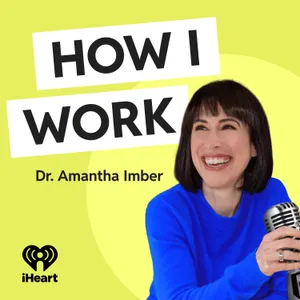
Organisational psychologist Dr Amantha Imber gets world‑class achievers to spill their secrets — the daily strategies behind their success through to life hacks and productivity hacks they’d rather keep to themselves. We’re talking practical tips for boosting your output (including clever AI tools and shortcuts that’ll make you look like a genius), managing overwhelm without losing your mind, and optimising both work and wellbeing. No motivational fluff. Just battle‑tested tactics from people who’ve cracked the code.
Latest Episodes
The most recent episodes — sign up to get AI-powered summaries of each one.
- 2 days ago35 min
What watching 20,000 auditions teaches you about getting attention, with Big Brother and The X Factor creator Maz Farrelly
Most professionals are terrible at talking about themselves. Not because they lack substance, but because no one ever taught them that being interesting is a skill, and that skill can be learned. Maz Farrelly has spent decades on the other side of that problem. As the executive producer behind Big Brother, The X Factor, and Celebrity Apprentice, she has auditioned over 20,000 people, had her content watched more than eight billion times, and once broke Twitter deliberately. In this episode, I sit down with Maz to unpack what the TV industry understands about attention that most professionals never learn, and how to bring that same thinking into the way you pitch yourself and show up in any room. Maz and I discuss: Why you have about 10 seconds to earn someone's attention, and what TV producers do with that window that most professionals don't The one word missing from almost every professional pitch ("so that") Why adapting your introduction for every room you walk into isn't being fake — it's understanding your audience How to share your credentials and achievements without sounding like you're bragging The case Maz makes against performed humility on LinkedIn, and better alternatives that actually build trust Why Maz banned email entirely on Dancing with the Stars UK, replaced it with two 10-minute standing meetings a day, and had only four phone calls across 100 shows What Gogglebox taught Maz about the power of doing the exact opposite of what everyone else in your industry is doing Key quotes "If you can help people, you need to show off. Because I need to be able to buy you, and I can't buy you if I don't know you exist." "The first line's job is to make me read the second. It's so obvious, and hardly anyone does it."
- 2 days ago10 min
(BONUS) The psychology of the pitch: what TV producers know that salespeople don't, with Maz Farrelly
We put someone on the moon in 1969. We didn't put wheels on suitcases until 1972. The problem was: Nobody had stopped to notice the problem existed in the first place. That gap - between the problems people will tell you about, the ones they'll only admit after a drink, and the ones they don't even know they have - is exactly where Maz Farrelly operates. In this bonus conversation with the executive producer behind Big Brother, The X Factor, and Celebrity Apprentice, we get into the practical mechanics of walking into a meeting and already having the room on your side before you've said a single word. If you have a pitch coming up - for an idea, a budget, or yourself - this episode has something useful in it for you. Maz and I discuss: The "warming up the room" technique Maz uses at the start of every pitch meeting, and why it works How she used reverse psychology to make network executives desperate for the idea she told them she wasn't going to pitch Why the smartest operators don't sell — they make themselves buyable The three layers of problems your clients have, and why cracking the third layer is where the real opportunity lives The suitcase story: why solving problems people don't know they have is the most valuable thing you can do in any industry Why Maz brought too much cake to a Microsoft meeting, and how it made her go viral inside the building without spending a cent on advertising What "sticky information" is, and why it determines whether anything you said in a meeting actually matters Key quotes "The smart money doesn't sell. The smart money is bought." "Hope is not a strategy." And if you haven't listened to the main episode with Maz yet, start t
- 5 days ago14 min
How I AI: The agent that Neo uses every single day
**Join the AI Agent Bootcamp here: https://www.inventium.ai/learnvirtually-agents** You type a research question into your AI tool, get back a perfectly serviceable answer, and still feel like something's missing. The output isn't wrong, exactly. It just didn't quite hit the mark. The culprit, more often than not, is the prompt you started with. The good news: there's a smarter way to approach this, and it doesn't involve becoming a prompt engineering expert. In this How I AI episode, Neo and I walk through the agent Neo reaches for more than any other he has built: the Research Prompt Builder. We get into how it works, when to use it with a thinking model instead of deep research, and how pairing it with NotebookLM can get you genuinely well-briefed in a fraction of the usual time. How I AI is a special series within How I Work, where Neo and I explore how high performers are using AI at work to boost productivity, make better decisions and reduce overwhelm. What you'll learn in this episode: Why your research prompt matters more than the tool you use How Neo's Research Prompt Builder actually works before any research begins When a thinking model is a better choice than deep research How to go from a raw research output to a proper briefing using NotebookLM Practical AI tools for productivity and focus Real-world AI workflows used by high performers How to use AI at work without burning out <li aria-setsize="-1" data-leveltext="" data-font="Symbol" data-listid="4" data-list-defn-props="{"335552541":1,"335559685":720,"335559991":360,"469769226":"Symbol","469769242":[8226],"469777803":&q
- 1 weeks ago29 min
The Work Edit: Everyone is using AI to apply for jobs. Here's how to stand out.
Knowing how hiring works does not prepare you for what job hunting actually feels like right now. Today’s guest, Nicole, found that out the hard way. She has spent 30 years on the hiring side of the table. She has interviewed hundreds of candidates, read thousands of applications, and knows exactly what good looks like. So when she re-entered the job market after a six-month sabbatical, she found herself starting from scratch. Nicole, a senior executive, knew how the game used to work. What she didn't know was how much it had changed. AI-generated resumes flooding inboxes. Applicant tracking systems filtering on past performance. Three or four hundred applications for every role, most of them indistinguishable from one another. The playbook she had built over decades wasn't quite fitting the game anymore. This episode is part of The Work Edit, a new format on How I Work where I sit down with someone facing a real professional challenge and we work through it together. Nicole came to me wanting help with the part of job hunting that was giving her the most trouble: getting from application to shortlist. We get practical about what actually works right now, from why a written application might be the weakest version of your pitch, to how to use AI to run your own mock interview and genuinely sharpen your performance in ways most people never bother doing. If you are currently in the job market, or know someone who is, this one is worth sharing. We discuss: Why the job market has shifted so dramatically in the last few years, and what that means for experienced candidates re-entering the workforce How applicant tracking systems work and why they tend to filter out people with non-linear careers or future-focused skills The case for treating your job search as a sales role, and what that reframe actually changes about how you show up Why a short video pitch cuts through in a way that a written application simply cannot right now, and what makes the difference between a video that opens doors and one that falls flat What AI fluency actually looks like in a resume or cover letter, and how to find and remove the tells that signal lazy prompting to any recruiter paying attention <li aria-setsize="-1" data-leveltext="" data-font="Symbol" data-listid="2" data-list-defn-props="{"335552541":1,"335559685":720,"335559991":360,"469769226":"Symbol","469769242":[8226],"469777803":"left","469777804":"","469777815":"hybridMultilevel"}" data-a
- 1 weeks ago14 min
How I AI: The three agents every knowledge worker should have
**Join the AI Agent Bootcamp here: https://www.inventium.ai/learnvirtually-agents** You sit down to research something for work, open a few tabs, type a vague query into AI, and get back something that feels… fine. Technically an answer. Not quite useful. Meanwhile, that report you've been working on probably needs another set of eyes, but getting real feedback takes time you don't have, so you send it anyway and hope for the best. There's a better way. In this How I AI episode, Neo and I walk through three agents we think every knowledge worker genuinely needs, including two we're giving away for free. How I AI, a special series within How I Work where Neo and I explore how high performers are using AI at work to boost productivity, make better decisions and reduce overwhelm. What you'll learn in this episode: Why a basic AI research query often isn't enough, and what to do instead What a critical thinking agent actually checks for, and when it earns its place What a cross-functional advisory board agent is, and who it's built for How long it really takes to build agents that work reliably Practical AI tools for productivity and focus Real-world AI workflows used by high performers How to use AI at work without burning out Smart shortcuts for managing time and mental load &n
- 2 weeks ago1h 11m
What I told Lael Stone about my worst year
**This week I'm sharing a crossover episode from the Humans, being. podcast with the wonderful Lael Stone. It's one of the more personal chats I've done in a while. We talk about my burnout year, the tiny experiments that brought me back, AI and where I think it's headed, and the uncomfortable question of whether being ordinary might actually be enough. I hope you love it as much as I loved having it. You can find the original episode on Humans Being here.** Amantha calls her AI 'Sunny'. She talks to it on the drive to the gym, like she's chatting to a friend. And it has quietly changed how she works, how she writes, and how she gets the thinking out of her own head. Dr. Amantha Imber is one of the sharpest, most generous humans I know. An organisational psychologist, the founder of Inventium, host of How I Work, the first Australian to win a Thinkers50 Innovation Award, the author of four bestselling books, and her brand new one, The Energy Game, lands in July. In this episode, we discuss Amantha's burnout year and the tiny experiments that crawled her back, the ones she calls boosts, rest, and protect. Why "fake rest" (Netflix while you scroll) won't fill the bucket. And we talk about the childhood praise imprint that drives so many of us: what if the goal isn't to be more, but to be okay with being ordinary? We explore: The pressure we accept being human and thinking we must do it all The hit-by-a-bus fantasy and what it tells us about how women carry stress AI as a thought partner, and how Amantha uses it without losing the human bit What we want for our daughters, and the thinking skills we don't want to outsource Connect with Humans, being™: Web: humansbeing.au YouTube: @humansbeingwithlaelstone My latest book The Energy Game is out on July 7, 2026. You can order a copy here: https://amzn.to/48ID29M Connect with me on the socials: Linkedin (https://www.linkedin.com/in/amanthaimber) Instagram (https://www.instagram.com/amanthai) If you are looking for more tips to improve the way you work and live, I write a weekly newsletter where I share practical and simple to apply tips to improve your life. You can sign up for that at https://amantha.substack.com/ Visit https://www.amantha.com/podcast for full show notes from all episodes. Get in touch at amantha@inventium.com.au Credits: Host: Amantha Imber Sound Engineer: Martin ImberSee omnystudio.com/listener for privacy information.
- 2 weeks ago10 min
How I AI: How to Build a Knowledge Agent That Answers Every 101 Question - So You Don't Have To
**Join the AI Agent Bootcamp here: https://www.inventium.ai/learnvirtually-agents** There's a question you've answered a hundred times before. You know the one. Someone pings you, you stop what you're doing, dig through a document or two, and type out the same response you've typed a dozen times this month. It doesn't feel catastrophic in the moment, but across a week it quietly eats hours. A knowledge agent is built for exactly this problem. It holds the information so you don't have to be the one constantly retrieving it. In this How I AI episode, Neo and I unpack what a knowledge agent is, how it works, and how to build one that actually saves you time, whether you're fielding questions solo or trying to help a whole team self-serve. How I AI is a special series within How I Work where Neo and I explore how high performers are using AI at work to boost productivity, make better decisions and reduce overwhelm. What you'll learn: What a knowledge agent actually is and how it differs from other agents The kinds of questions and roles that benefit most from one How to share a knowledge agent across a team without creating problems What makes knowledge good (or bad) for an agent to work from The three things you need to set up a knowledge agent properly Practical AI tools for productivity and focus Real-world AI workflows used by high performers <li aria-setsize="-1" data-leveltext="" data-font="Symbol" data-listid="1" data-list-defn-props="{"335552541":1,"335559685":720,"335559991":360,"469769226":"Symbol","469769242":[8226],"469777803":"l
- 3 weeks ago30 min
I asked a LinkedIn insider how to actually stand out on LinkedIn in 2026
There's a moment a lot of professionals know well. You put real thought into a LinkedIn post, hit publish, and watch the likes trickle in. Five. Maybe six. One comment from a colleague you personally recruited into the thread. Meanwhile, your feed has started to look like it was written by the same person. Polished, vaguely inspirational, and somehow saying nothing at all. In this episode, I sit down with Jessi Hempel, senior editor-at-large at LinkedIn and host of the award-winning podcast Hello Monday, to get inside what's actually happening on the platform right now. Jessi has spent 25 years in tech journalism and eight years at LinkedIn, and she has a front-row seat to how AI is reshaping what it means to have a voice, both on the platform and in your career more broadly. We talk about why your LinkedIn profile is doing more heavy lifting than any post you'll ever write, how to approach content in a way that builds real conversation rather than chasing reach, and what the rise of AI-generated posts actually means for anyone trying to show up as themselves online. If you've been feeling like something's off with how your content is landing lately, this conversation will give you some much-needed clarity. Jessi and I discuss: The part of your LinkedIn profile that matters far more than your posts (and that most people ignore) Why Jessi's posting advice runs counter to what most social media gurus will tell you The one habit that has made the biggest difference to how Jessi's own posts find reach What AI-generated content is doing to trust on LinkedIn, and where Jessi thinks it's all heading The creator who has built one of the most engaged communities on the platform, and what makes her strategy work Why Jessi thinks a major career shift is becoming the smarter move for mid-career professionals right now <li aria-setsize="-1" data-leveltext="" data-font="Symbol" data-listid="3" data-list-defn-props="{"335552541":1,"335559685":720,"335559991":360,"469769226":"Symbol","469769242":[8226],"469777803":"left","469777804":"","469777815":"hybridMultilevel&
Get How I Work summaries in your inbox
Free AI-powered daily recaps. Key takeaways, quotes, and mentions — in a 5-minute read.
Get Free Summaries →Free forever for up to 3 podcasts. No credit card required.
You Might Also Like
Listeners also like.

How I AI
A practical guide to using AI tools in work and life, featuring guests who share specific, actionable techniques and workflows.

Truth, Lies and Work
Explores workplace culture and human behavior using psychology and real-world insights to help leaders manage teams effectively.

The Knowledge Project
Explore timeless principles and deep insights from experts across disciplines to improve decision-making and master essential life skills.

Expert Intelligence with Paul Estes
Examines how AI and human expertise are reshaping work, freelancing, and workplace dynamics through expert conversations.
Me, Myself, and AI
AI leaders from top companies share real-world strategies for turning artificial intelligence into measurable business results.

Working Hard with Grace Beverley
Conversations with diverse achievers reveal raw insights on redefining success, balancing ambition, and learning from failure.

Influence Anyone
Explores the psychology of influence through expert interviews on persuasion, mindset, and decision-making.

AI and I
Interviews with professionals who use AI tools in their work, exploring how AI affects creativity, thinking, and daily life through live demonstrations.

As We Work
Practical career advice and workplace strategies from WSJ reporters and experts.

Silicon Valley Girl: AI, Tech and Career Growth
Explores how AI, technology, and entrepreneurship can accelerate career growth, build wealth, and create a purpose-driven life.

The Tim Ferriss Show
Deconstructs world-class performers across diverse fields to uncover practical tools and tactics for self-improvement.

Everyday AI Podcast – An AI and ChatGPT Podcast
Practical AI and ChatGPT tips for professionals to improve productivity and grow their careers.
About How I Work
Organisational psychologist Dr Amantha Imber gets world‑class achievers to spill their secrets — the daily strategies behind their success through to life hacks and productivity hacks they’d rather keep to themselves. We’re talking practical tips for boosting your output (including clever AI tools and shortcuts that’ll make you look like a genius), managing overwhelm without losing your mind, and optimising both work and wellbeing. No motivational fluff. Just battle‑tested tactics from people who’ve cracked the code.
Customized Recaps
AI-powered recaps with compact key takeaways, quotes, and insights.
Straight to Your Inbox
Get key takeaways from How I Work in a 5-minute read.
Save Hours Every Week
Stay current on your favorite podcasts without falling behind.
Frequently Asked Questions
What is Podzilla's How I Work daily summary?
It's a free AI-powered email that summarizes new episodes of How I Work as soon as they're published. You get the key takeaways, notable quotes, and links & mentions — all in a quick read.
How does the How I Work podcast summary work?
When a new episode drops, our AI transcribes and analyzes it, then generates a personalized summary tailored to your interests and profession. It's delivered to your inbox every morning.
Is this an official How I Work product?
No. Podzilla is an independent service that summarizes publicly available podcast content. We're not affiliated with or endorsed by Amantha Imber.
Can I get summaries of other podcasts too?
Absolutely! The free plan covers up to 3 podcasts. Upgrade to Pro for 15, or Premium for 50. Browse our full catalog at /podcasts.
How often does How I Work release new episodes?
How I Work publishes every few days. Our AI generates a summary within hours of each new episode.
What topics does How I Work cover?
How I Work covers topics including Education, Business, Careers. Our AI identifies the specific themes in each episode and highlights what matters most to you.
Start getting How I Work summaries tomorrow morning.
Free forever for up to 3 podcasts. No credit card required.
Free forever for up to 3 podcasts. No credit card required.