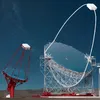
Tiling the Sky: A New Strategy for Finding Elusive GRBs
In this episode, we dive into the intense and fast-paced world of **Gamma-ray bursts (GRBs)—the most luminous and rapidly evolving transients in the Universe**. While space-based instruments like the Fermi Gamma-ray Space Monitor (GBM) trigger on hundreds of these events every year, they often provide poor sky localization, sometimes spanning tens to hundreds of square degrees. This makes it incredibly difficult for ground-based telescopes to find and observe the very-high-energy (TeV) afterglows before they rapidly fade away. Today, we discuss a groundbreaking paper that proposes a solution: **an optimized follow-up strategy based on the rapid tiling of large sky regions**. By creating a synthetic population of GRBs informed by over 15 years of observational data, researchers have tested how next-generation Imaging Atmospheric Cherenkov Telescopes (IACTs)—like ASTRI, LACT, and CTAO—can use this rapid scanning method to catch these elusive bursts. Tune in to find out how **this new approach could double the detection rates for certain telescopes**, potentially allowing facilities like CTAO to capture up to four very-high-energy GRB events per year. **Article Reference:*** Macera, S., Banerjee, B., Seglar-Arroyo, M., Green, J., et al. **"Detection of TeV emission during early afterglow from poorly localized GRBs with ground based IACTs."** *Astronomy & Astrophysics* manuscript no. arxiv_03042026, April 10, 2026.Acknowledements: Podcast prepared with Google/NotebookLM. Illustration credits: CTAO
Podzilla Summary coming soon
Sign up to get notified when the full AI-powered summary is ready.
Free forever for up to 3 podcasts. No credit card required.
Listen to This Episode
More from Multi-messenger astrophysics
Record-Breaker: Catching Gamma Rays from the Distant Quasar OP 313
Ripples in Spacetime: Unpacking the GWTC-5.0 Catalog
SN 2017egm : Fermi-LAT's Breakthrough Gamma-Ray Detection
Supernovae on the RISE: Why Dead Stars Wake Up Decades Later
Get summaries like this every morning.
Free AI-powered recaps of Multi-messenger astrophysics and your other favorite podcasts, delivered to your inbox.
Free forever for up to 3 podcasts. No credit card required.