Free Daily Podcast Summary
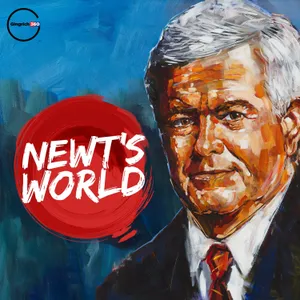
Newt's World: Daily Summaries Delivered
by Gingrich 360
Join Newt Gingrich, former U.S. Speaker of the House and Ph.D. historian, for the most diverse, informative, and entertaining podcast available. Every episode is an education.
Latest Episodes
The most recent episodes — sign up to get AI-powered summaries of each one.
- Today35 min
Episode 1049: The Exhausted Majority — Who Independents Really Are and Why They'll Decide 2026
Nearly half of American voters now call themselves independents, but Adam Brandon argues they are far more than a mushy middle ground between the two parties. In his new book, The Exhausted Majority: Building a Home for the Politically Homeless, Brandon profiles a coherent, center-right bloc of Americans tired of hyper-partisanship who simply want to see Washington get things done. Brandon served as president of FreedomWorks for over a decade and helped lead the Tea Party movement. Now he has co-founded the Independent Leadership Council with former Senator Joe Manchin, backing independent candidates in the 2026 midterms. Newt talks with Brandon to discuss why both parties keep losing ground, who the exhausted majority really is, and whether independents can become the force that finally changes how Washington works.See omnystudio.com/listener for privacy information.
- 3 days ago35 min
Episode 1048: Drones, AI, and the Future of War — How Artificial Intelligence Is Remaking the Battlefield
Ukraine has become the most innovative military power in the world, building drones by the millions, fielding ground robots, and wiring the battlefield together with software. Russia is racing to match it. Iran has used $35,000 drones to force the United States to fire interceptors costing millions. And yet, only 8% of Americans are aware that AI is being used in modern warfare. Newt sits down with Jonathan Guyer, program director at the Institute for Global Affairs at the Eurasia Group, to discuss how drones and artificial intelligence are remaking warfare in real time. Drawing on his new report, War President: The Iran Trap, Guyer breaks down what the technology revolution on today's battlefields means for American strategy, public oversight, and whether Washington is paying close enough attention.See omnystudio.com/listener for privacy information.
- 1 weeks ago42 min
Episode 1047: Trace Gallagher — Life Lessons, Lucky Breaks, and Three Decades at Fox News
Before Trace Gallagher became one of Fox News's most recognizable faces, he was a professional water skier at Six Flags Marine World, where he once taught Jimmy Buffett to ski. A knee injury ended that career and sent him on an unexpected path through announcing, local television, and eventually Fox News, where he has been a fixture since the network's launch in 1996. In his new memoir, Turns Out They Were Right All Along: Life Lessons I Learned Eventually, Gallagher reflects on the detours, setbacks, and unlikely breaks that shaped his life and career. Newt sits down with Gallagher to explore the wisdom that only comes from living it, the moments that tested him, and what three decades in breaking news have taught him about perseverance, purpose, and getting it right.See omnystudio.com/listener for privacy information.
- 1 weeks ago41 min
Episode 1046: Inside DOGE — The Waste Was Real and the Resistance Was Fierce
In January 2025, Tyler Hassen was running a diversified energy business in Houston. Weeks later, he was inside the West Wing as a DOGE senior insider, named Acting Assistant Secretary of Policy, Management, and Budget at the Department of the Interior with authority over $35 billion in spending and 8,000 federal employees. Now he's written the first book-length account of DOGE from someone who actually executed the work. Hassen joins Newt to discuss Inside DOGE: The Real Story from a Senior Insider — part memoir, part management autopsy. He describes late-night West Wing meetings, an $830 million contract request he says he could have designed in high school, a California water crisis that became an international media firestorm, and the personal cost his family paid. His verdict: the waste was real, the resistance was fierce, and the work is far from finished.See omnystudio.com/listener for privacy information.
- 2 weeks ago29 min
Episode 1045 The $17 Billion Meta Settlement — and What It Means for Your Kids
Last month, a bipartisan coalition of 51 attorneys general announced what may be the largest consumer protection settlement in American history: a $17 billion dollar agreement with Meta, the parent company of Facebook and Instagram. California Attorney General Rob Bonta led the fight, accusing Meta of deliberately designing features to drive compulsive use among children and teens while lying to the public about the harm. AG Bonta joins Newt to explain how the coalition built its case, why Meta settled less than two weeks into trial, and what the agreement actually changes: two-hour default time limits for minors, overnight and school-hour blocks, a ban on cosmetic surgery filters, removal of “like” counts on children's posts, and an independent auditor to enforce it all. He also explains why this settlement is just the beginning, with TikTok, YouTube, and Snap still in his sights.See omnystudio.com/listener for privacy information.
- 2 weeks ago40 min
Episode 1044 Charlie Kirk — Faith, Free Speech, and a Legacy That Lives On
One year after Charlie Kirk was assassinated at Utah Valley University, his friend and longtime confidant Christy Edwards Lawton joins Newt to discuss her new memorial photo book, Charlie Kirk: In His Own Words. Built entirely from Charlie's own posts on X, never-before-seen photographs, and tributes written the day he died by Melania Trump, Elon Musk, Ivanka Trump, and others, the book is organized around the causes Charlie cared about most: faith, free speech, family, immigration, and Gen Z. Christy shares intimate memories from eleven years of friendship — from the lanky 22-year-old she met at a Trump fundraiser to the husband, father, and movement leader he became. She reflects on what it means to "live like Charlie," and why every net dollar from the book goes to Carry the Torch, a nonprofit dedicated to finding and funding the next generation of young conservative leaders.See omnystudio.com/listener for privacy information.
- 2 weeks ago36 min
Episode 1043: Alzheimer's Disease Breakthrough New Blood Tests, New Treatments, and What Congress Must Do Now
More than seven million Americans live with Alzheimer's disease today, a number projected to nearly double by 2060. It already consumes 20% of all Medicare spending and costs the economy close to half a trillion dollars annually. But the science is finally catching up. Newt is joined by former CDC Director Dr. Robert Redfield and Dr. Brent Beasley, a retired internist who was diagnosed with Alzheimer's at age 57, for a conversation about new blood tests that detect the disease early and what treatments are being developed. Dr. Redfield draws on his decades leading America's response to the HIV/AIDS epidemic to argue that Alzheimer's disease demands the same sense of urgency. Dr. Beasley shares his remarkable personal journey: how an early blood test and a new monoclonal antibody treatment reversed his decline. Together, they lay out the five policy changes needed now, from routine blood testing for everyone over 50 to removing CMS barriers blocking access to approved treatments, including passage of the bipartisan ASAP Act, which would create a Medicare pathway for FDA-cleared blood-based Alzheimer's biomarker tests.See omnystudio.com/listener for privacy information.
- 3 weeks ago41 min
Episode 1042: Burn It Down — What the Polls Say Young Americans Really Want
Most political analysts say Generation Z is quietly turning conservative. Rich Baris says the data tells a completely different story. The director of Big Data Poll and the most accurate national pollster of both 2016 and 2024 joins Newt to discuss his new book, Burn It Down: What the Polls Say Young Americans Really Want. Baris argues that young Americans aren't becoming more conservative; they're becoming more radical and revolutionary, convinced the system can't be reformed, only replaced. He and Newt dig into the staggering affordability numbers driving that anger (home prices up 230% since 2000, real wages up just 13%), the rise of "ledger politics" and left-wing populism, why two-thirds of Democratic primary voters now identify as socialists, and the urgent warning Baris has for Republicans heading into 2026: you can't out-resent the left. You have to out-deliver them.See omnystudio.com/listener for privacy information.
Get Newt's World summaries in your inbox
Free AI-powered daily recaps. Key takeaways, quotes, and mentions — in a 5-minute read.
Get Free Summaries →Free forever for up to 3 podcasts. No credit card required.
You Might Also Like
Listeners also like.
Outloud with Gianno Caldwell
A conservative political commentator explores news and culture by challenging prevailing orthodoxies and advocating for free expression.

The Tom Woods Show
A daily podcast exploring libertarian perspectives on politics, economics, and culture with author Tom Woods and expert guests.
Steve Deace Show
Daily commentary on principled conservatism with a snarky tone.

The Ezra Klein Show
Conversations on pressing political, social, and cultural issues with experts and thinkers.
DINESH Podcast
Dinesh D'Souza hosts conversations on politics, history, philosophy, and literature.

The Erick Erickson Show
Daily political and cultural commentary from a conservative Christian perspective, focusing on accountability and traditional values.

The Megyn Kelly Show
Provocative conversations with influential figures in politics, law, and culture, featuring candid and fearless dialogue.

The Mark Thompson Show
The Mark Thompson Show
This is Gavin Newsom
A political podcast featuring conversations with people across the ideological spectrum on pressing issues, emphasizing civil discourse.
Pivot
Sharp, unfiltered analysis of tech, business, and politics with bold predictions and lively debate.
Impolitic with John Heilemann
Candid interviews with figures in politics, media, tech, and culture exploring power, influence, and societal change.

Breaking Points with Krystal and Saagar
Political analysis and interviews challenging mainstream narratives and holding power to account.
Customized Recaps
AI-powered recaps with compact key takeaways, quotes, and insights.
Straight to Your Inbox
Get key takeaways from Newt's World in a 5-minute read.
Save Hours Every Week
Stay current on your favorite podcasts without falling behind.
Frequently Asked Questions
What is Podzilla's Newt's World daily summary?
It's a free AI-powered email that summarizes new episodes of Newt's World as soon as they're published. You get the key takeaways, notable quotes, and links & mentions — all in a quick read.
How does the Newt's World podcast summary work?
When a new episode drops, our AI transcribes and analyzes it, then generates a personalized summary tailored to your interests and profession. It's delivered to your inbox every morning.
Is this an official Newt's World product?
No. Podzilla is an independent service that summarizes publicly available podcast content. We're not affiliated with or endorsed by Gingrich 360.
Can I get summaries of other podcasts too?
Absolutely! The free plan covers up to 3 podcasts. Upgrade to Pro for 15, or Premium for 50. Browse our full catalog at /podcasts.
How often does Newt's World release new episodes?
Newt's World publishes every few days. Our AI generates a summary within hours of each new episode.
What topics does Newt's World cover?
Newt's World covers topics including News, Politics. Our AI identifies the specific themes in each episode and highlights what matters most to you.
Start getting Newt's World summaries tomorrow morning.
Free forever for up to 3 podcasts. No credit card required.
Free forever for up to 3 podcasts. No credit card required.