Free Daily Podcast Summary
Parenting With Psychology: Daily Summaries Delivered
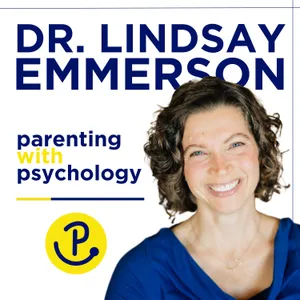
by Dr. Lindsay Emmerson
Ever wished you had a supportive and helpful parenting coach whispering tips in your ear during those trickiest parenting moments? Welcome to Parenting With Psychology, the podcast hosted by Dr. Lindsay Emmerson, a clinical psychologist and devoted mother of four. Dr. Lindsay's expertise lies in transforming core psychology principles into actionable parenting tips, designed to simplify your days and create a happier family life. Join us to embrace intentional parenting and discover why countless busy and overwhelmed parents turn to Dr. Lindsay for guidance on raising children of all ages. Gain inspiration from Dr. Lindsay's 5 C's to amazing parenting framework and receive a new, actionable psychology-based parenting tool each week, providing invaluable guidance on your remarkable parenting journey. If you're craving bite-sized nuggets of parenting gold, tune in to Parenting With Psychology for support in nurturing your children and fostering strong family bonds.
Latest Episodes
The most recent episodes — sign up to get AI-powered summaries of each one.
- 5 days ago11 min
How to Respond When School Calls About Behavior
Is your child misbehaving at school and you don't know how to respond when the call comes in? When your child is misbehaving at school, the call itself is often the hardest part, the instant defensiveness, embarrassment, or panic that hits before you even know the full story. This video walks through a simple 3-step method for responding to a school behavior report in a way that actually changes things, instead of just discharging your own stress onto your child.Most parents decide the punishment before they've even heard what really happened — and that reaction is usually about the parent's own feelings, not the child's behavior. A calmer, more curious response gets better information and better outcomes.Parents' own emotional state at the moment of a discipline decision directly organizes how they respond to their child — when that emotion is too strong or mismatched to the moment, it undermines the quality of the response, which is exactly why the first step in this method isn't about your child at all.In this podcast: → Why the call itself triggers a punishment decided in the wrong state of mind → The Check, Ask, Choose Method - 3 steps for responding to any school behavior report → The one question that gets the real story instead of shutting your child down → How to pick one consequence instead of stacking a second punishment on top of the school's → What changes, and by when, once you consistently respond this wayGrab my free Better Behavior Guide 👉 https://www.drlindsayemmerson.com/better
- 1 weeks ago11 min
Stop the Rescue Reflex, Build Real Confidence
Learning how to build confidence in kids starts with a hard truth: the instinct to jump in and help isn't just harmless, it can quietly teach your child that they can't handle hard things alone. If your child refuses the puzzle above their level, hides when it's their turn, or gives up the second something gets tricky, this is the pattern behind it.Confidence for kids doesn't come from praise or from things going smoothly, it comes from tolerated struggle. In this video, I break down exactly what's happening in the moment you rescue, why it backfires, and the specific low-stakes practice that rebuilds a child's willingness to try.Research on self-efficacy shows that a child's belief in their own capability is built primarily through mastery experiences — actually doing the hard thing, not through being told they're capable.In this episode: → Why "he won't try" is fear of failure, not laziness and why it's often tied to a label → The Rescue Reflex: the parenting instinct that feels like love but teaches "you can't handle this" → The exact phrase to say instead of stepping in → What this looks like with a toddler vs. a big kid, start to finish → How long it takes before you see your child attempt something without checking your face firstGrab my free Better Behavior Guide 👉 https://www.drlindsayemmerson.com/better
- 2 weeks ago10 min
Stop the Amygdala Hijack Before You Yell
You've asked your child to do something for the fifth time, you're already late, and something in your chest goes hot before you've even decided how to respond. That's the amygdala hijack and it's the reason you sometimes hear yourself yell something you didn't plan to say.This podcast walks through exactly what's happening in your brain in that moment, why the instinct to raise your voice louder makes it worse, and the exact three-step method I use myself to stop the hijack before it turns into yelling, in about 90 seconds.UCLA researchers found that simply naming an emotion measurably calms amygdala activity in the brain, the same region driving the hijack. This isn't a willpower problem. It's a brain problem, and once you can see it happening, you can actually stop it.In this podcast: → Why the instinct to raise your voice makes the hijack worse, not better → What's actually happening in your brain in the seconds before you yell → The 90-Second Reset — the exact three-step method, in real time → What to expect in the first week, and when it actually starts to stick → The one thing your child learns every time you catch it instead of losing itReserve your seat in my free workshop 👉 https://www.drlindsayemmerson.com/workshop
- 3 weeks ago11 min
The Real Risk of Posting Your Kids Online
Posting your kids online feels harmless — a cute photo, a proud caption, gone in the time it takes your thumb to move from camera roll to send. But most parents are moving faster than they realize, and the research on what that actually creates for your child might surprise you.This podcast breaks down exactly what's happening every time you hit post, why the instinct behind it is a good one even when the follow-through isn't, and the one three-second habit that turns posting from a reflex into a real family decision.A 2024 study of 228 parents published in the Italian Journal of Pediatrics found that 93% had no idea there was legislation or real risk tied to sharing their child's content online, most parents genuinely don't know what they don't know.In this podcast: → The reflexive thoughts that feel harmless but move faster than the thinking → What's actually happening to your child's digital footprint every time you post → The one specific question that fixes this in three seconds → What it looks like in real life, at two different ages → What changes for your family once this becomes a habit💬 Comment ASK below if you're going to try the three-second question next time you go to post.Grab my free Family Meeting Guide 👉 https://www.drlindsayemmerson.com/meeting
- Sep 2, 202610 min
Which Parenting Style Works Best?
There are four recognized parenting styles, and most parents have never been told which one they default to, or what the research actually shows happens to kids raised inside each one. This video breaks down all four, in plain language, with no shame attached.You'll learn the difference between rules that build respect and rules that just build compliance, why "being the fun parent" can quietly backfire, and the one style researchers consistently find produces the best outcomes for kids on every measure that matters.Researchers followed adolescents raised in all four styles and found one pattern stands out clearly above the rest, and it's not the one most parents assume.In this podcast: → The strict style that gets obedience but not always trust → Why being the "fun parent" can work against you long-term → Where "gentle parenting" actually lands and why it's not always what parents think → The style almost no parent means to fall into → The one style the research consistently points to as the winner (and what gentle parenting looks like when it's done right) → The one shift that moves you toward it, starting todayReserve your seat in my free workshop 👉 https://www.drlindsayemmerson.com/workshop
- Aug 27, 202611 min
Why "Who Do You Want Tonight?" Backfires
When your child prefers one parent, that stretch where they suddenly only want one of you — it's one of the most common and most misunderstood phases in early parenting. Most parents respond by accidentally gamifying it, and that's the exact thing that makes it worse.In this podcast, a licensed clinical psychologist breaks down why treating "who do you want tonight?" like a contest backfires, and what to say and do instead so both parents feel valued, and your child learns that love isn't something you win.Research on infant-parent attachment shows preference patterns are a normal, temporary part of development, but how parents respond to them determines whether the pattern fades or gets reinforced.In this video: → The bedtime habit that's accidentally training your child to pick favorites → Why cheering for the "winner" makes preference worse, not better → The Interchangeable Parent Rule, and the exact words to use tonight → What to do when your child protests the parent they didn't pick → How this connects to raising a child who thrives long-termGrab my free Better Behavior Guide 👉 https://www.drlindsayemmerson.com/better
- Aug 19, 20269 min
How to Respond When Another Child Hits Your Toddler
When another child hits your toddler, the instinct to snap at the other kid — or tell your own child to hit back — is completely understandable. Neither one teaches your child what actually helps. This video walks through what to do instead, including the honest answer to the question almost every parent asks at some point: should you ever teach your child to hit back?Physical aggression in toddlers peaks around age 2 to 2.5 before declining — the child who hit yours is very likely going through the same developmental stage most toddlers pass through, not something uniquely wrong with them (Tremblay et al., 2004).In this podcast: → The 3 A's Method, applied to the moment your child gets hit → The honest answer to "should I teach my child to hit back?" → How to manage your own protective anger in the moment → What to do when it's the same child hitting yours, over and over → The exact words to use with your child afterward
- Aug 12, 202611 min
How to Respond When Another Kid Takes Your Toddler's Toy
Another child takes your toddler's toy, and you freeze or you feel your blood pressure spike at the other parent standing right there, not stepping in. This video walks through exactly what to say and do, whether or not the other parent gets involved.Toddlers as young as 20 months already actively assert ownership, and by 30 months they're standing their ground against a peer's attempts to take what's theirs, which is part of why these moments feel so constant and so charged (Ross, 2013).In this podcast: → The 3 A's Method: Acknowledge, Anchor, Alternative → What to say when it's clearly your child's toy or turn → Exactly what to do when the other parent doesn't step in → Why freezing teaches the opposite of what you want your child to learn → The one line that speaks up for your child without starting a parent-to-parent conflict
Get Parenting With Psychology summaries in your inbox
Free AI-powered daily recaps. Key takeaways, quotes, and mentions — in a 5-minute read.
Get Free Summaries →Free forever for up to 3 podcasts. No credit card required.
You Might Also Like
Listeners also like.

Dysregulated Kids: Science-Backed Parenting Help for Behavior, Anxiety, ADHD and More
A therapist explains the brain science behind children's behavioral and emotional challenges and offers research-based parenting strategies.

Good Inside with Dr. Becky
A clinical psychologist provides practical guidance for handling common parenting challenges and improving parent-child relationships.

Respectful Parenting: Janet Lansbury Unruffled
Addresses common parenting challenges with a focus on respectful, trust-based approaches to raising infants and toddlers.

Calm Parenting Podcast
Practical strategies for managing strong-willed, defiant, or neurodivergent children without power struggles or yelling.

Ask Lisa: Untangling Family Life
Psychologist Lisa Damour answers parents' questions about raising tweens and teens with evidence-based advice on mental health, behavior, and family dynamics.

Raising Good Humans
A developmental psychologist discusses evidence-based parenting approaches with experts and parents to support raising resilient, empathetic children.

The Whinypaluza Podcast
A parenting podcast offering advice and support through expert interviews on raising children, marriage, and family life.

Raising Parents with Emily Oster
An economist examines data-driven approaches to modern parenting challenges, from child independence to teen mental health.
Life Kit: Parenting
Practical parenting advice based on science and expert insights to help navigate challenges of raising children.

After Bedtime with Big Little Feelings
Honest conversations about modern parenting challenges with practical advice and emotional support from experienced guides.

Psychiatry & Psychotherapy Podcast
Explores psychiatry and psychotherapy through interviews with experts, trainees, and individuals sharing lived mental health experiences.

Two Parents & A Podcast
Two parents navigate raising kids, building a relationship, and tackling topics from entrepreneurship to dental industry critiques.
About Parenting With Psychology
Ever wished you had a supportive and helpful parenting coach whispering tips in your ear during those trickiest parenting moments? Welcome to Parenting With Psychology, the podcast hosted by Dr. Lindsay Emmerson, a clinical psychologist and devoted mother of four. Dr. Lindsay's expertise lies in transforming core psychology principles into actionable parenting tips, designed to simplify your days and create a happier family life. Join us to embrace intentional parenting and discover why countless busy and overwhelmed parents turn to Dr. Lindsay for guidance on raising children of all ages. Gain inspiration from Dr. Lindsay's 5 C's to amazing parenting framework and receive a new, actionable psychology-based parenting tool each week, providing invaluable guidance on your remarkable parenting journey. If you're craving bite-sized nuggets of parenting gold, tune in to Parenting With Psychology for support in nurturing your children and fostering strong family bonds.
Customized Recaps
AI-powered recaps with compact key takeaways, quotes, and insights.
Straight to Your Inbox
Get key takeaways from Parenting With Psychology in a 5-minute read.
Save Hours Every Week
Stay current on your favorite podcasts without falling behind.
Frequently Asked Questions
What is Podzilla's Parenting With Psychology daily summary?
It's a free AI-powered email that summarizes new episodes of Parenting With Psychology as soon as they're published. You get the key takeaways, notable quotes, and links & mentions — all in a quick read.
How does the Parenting With Psychology podcast summary work?
When a new episode drops, our AI transcribes and analyzes it, then generates a personalized summary tailored to your interests and profession. It's delivered to your inbox every morning.
Is this an official Parenting With Psychology product?
No. Podzilla is an independent service that summarizes publicly available podcast content. We're not affiliated with or endorsed by Dr. Lindsay Emmerson.
Can I get summaries of other podcasts too?
Absolutely! The free plan covers up to 3 podcasts. Upgrade to Pro for 15, or Premium for 50. Browse our full catalog at /podcasts.
How often does Parenting With Psychology release new episodes?
Parenting With Psychology publishes weekly. Our AI generates a summary within hours of each new episode.
What topics does Parenting With Psychology cover?
Parenting With Psychology covers topics including Parenting, Kids & Family, Family. Our AI identifies the specific themes in each episode and highlights what matters most to you.
Start getting Parenting With Psychology summaries tomorrow morning.
Free forever for up to 3 podcasts. No credit card required.
Free forever for up to 3 podcasts. No credit card required.