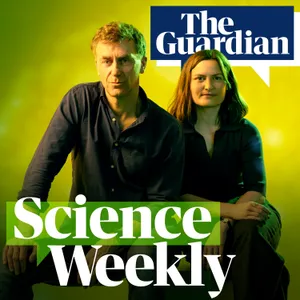
Free Daily Podcast Summary
Science Weekly: Daily Summaries Delivered
by The Guardian
Twice a week, the Guardian brings you the latest science and environment news
Latest Episodes
The most recent episodes — sign up to get AI-powered summaries of each one.
- 2 days ago20 min
The incredible science of memory manipulation
Madeleine Finlay hears from Steve Ramirez, an associate professor of psychological and brain sciences at Boston University, whose book How to Change a Memory was shortlisted for this year’s Royal Society Trivedi science book prize. He explains how scientists have been able to locate memories in the brains of rodents, trigger them artificially and even remove them, and reveals what the practical applications of this science could one day be for humans.. Help support our independent journalism at theguardian.com/sciencepod
- 4 days ago17 min
Are household cleaning products damaging our health?
Our use of cleaning products has increased since the pandemic, but do we understand what they could be doing to our health? The journalist Rebecca Seal recently wrote for the Guardian about the potential impacts of the many chemicals we now use in our homes. She tells Madeleine Finlay how social media has also played a role in transforming our cleaning habits, why the impact of indoor air pollution is so hard to study, and what the current evidence is that cleaning products may be causing harm. Help support our independent journalism at theguardian.com/sciencepod
- 1 weeks ago22 min
Are baby girls more sociable? Super El Niño, meningitis outbreak explained
Madeleine Finlay sits down with her co-host and Guardian science editor, Ian Sample, to discuss three science stories from the week, including a study that offers a clue in the age-old debate about whether sex differences are present from birth or a product of socialisation. Also on the agenda is the super El Niño, which is predicted to lead to 450,000 deaths in the next six months, and an answer to why the UK’s meningitis outbreak earlier this year was so big.. Help support our independent journalism at theguardian.com/sciencepod
- 1 weeks ago17 min
From paleo to intermittent fasting: are any diets actually good for us?
As diet trends proliferate on social media, it can be hard to work out which are backed by science and which should be ignored. From paleo to keto, raw food to intermittent fasting, each attracts a tribe of ardent followers. Now Daniel Lieberman, professor of biological sciences at Harvard University, has written a book to try to cut through the noise. In Fed Up, he uses his background as an evolutionary anthropologist to scrutinise the evidence, turning himself into a guinea pig in the process and trying various diets. In this podcast, he tells Ian Sample which one has remained part of his routine. Help support our independent journalism at theguardian.com/sciencepod
- 2 weeks ago15 min
The week that changed maths for ever
In early September, OpenAI announced it had solved a major mathematics problem that has stumped humans for nearly a century. The news left mathematicians reeling, and many expressed concern over what will be left for humans as AI becomes ever more adept at unravelling complex problems. Now 25 recipients of the Fields medal – often called the Nobel prize for maths – have signed an open letter expressing their fears of a ‘severe misalignment’ between AI companies and their field. To find out how AI is likely to upend maths – and how mathematicians might respond – Ian Sample speaks to Colva Roney-Dougal, professor of pure mathematics at the University of St Andrews. Help support our independent journalism at theguardian.com/sciencepod
- 2 weeks ago18 min
Is collagen all hype?
Collagen powders, gummies and pills have boomed in popularity in recent years boosted by claims that they smooth wrinkles, promote glossy hair and help with joint pain. Amid the noise it can be hard to figure out whether there’s any actual science behind the promise of looking younger for longer. Luckily Dr Xand van Tulleken has spent the past three years writing Make me well: a quest to understand the confusing world of wellness, and his chapter on collagen dives deep into the evidence. He tells Madeleine Finlay what collagen does in the body, how we can get it without splashing out on expensive supplements, and why getting to the truth behind wellness claims can be so hard. Help support our independent journalism at theguardian.com/sciencepod
- 2 weeks ago1h 22m
Live episode: how AI is reshaping our minds
In this episode of Science Weekly, recorded in front of an audience at the London podcast festival on 3 September, Ian Sample hears from Michael Safi, the host of the Guardian’s chart-topping podcast about artificial intelligence, Black Box. In series two, Black Box: the chatbots, Michael meets people who have become convinced they have made scientific breakthroughs, cured diseases or invented new technologies using AI chatbots. Ian, Michael and Science Weekly’s co-host Madeleine Finlay explore the phenomenon labelled ‘AI psychosis’ and ask what it reveals about a technology now used by more than a billion people. Help support our independent journalism at theguardian.com/sciencepod
- 3 weeks ago16 min
‘One of the biggest discoveries in science’: have scientists found dark matter?
For decades physicists have been puzzling over the enigma of dark matter. We think it makes up 85% of the matter in the universe, but the mysterious substance cannot be seen or detected, and we know about it mainly through observations of the gravitational effects it has on other things. But now scientists believe they may be a step closer to detecting it. Science editor Ian Sample explains to Madeleine Finlay why, if confirmed, the finding could completely transform our understanding of the universe. And Dr Samuel Erikson, senior research associate at the University of Bristol, and first author of the research paper, explains how the finding has been received in the physics community. Help support our independent journalism at theguardian.com/sciencepod
Get Science Weekly summaries in your inbox
Free AI-powered daily recaps. Key takeaways, quotes, and mentions — in a 5-minute read.
Get Free Summaries →Free forever for up to 3 podcasts. No credit card required.
You Might Also Like
Listeners also like.

Science Magazine Podcast
Weekly episodes covering original scientific research, global science news, and expert commentary.
The World, the Universe and Us
Explores big scientific questions about life, consciousness, climate, and the cosmos with expert scientists and New Scientist journalists.
Science In Action
The BBC covers the latest weekly developments and news in science.
BBC Inside Science
Explores the latest scientific discoveries and debates shaping our understanding of the world.
Science Quickly
A bite-sized science podcast exploring discoveries with journalists and experts.
Science Vs
A show that investigates popular topics and myths by analyzing scientific evidence to determine what’s fact, fiction, or uncertain.

Inquiring Minds
Explores the intersection of science and society through critical thinking and in-depth analysis.
CrowdScience
Explores listener-submitted questions about life, Earth, and the universe with scientists at the forefront of research.

Science Friday
Explores diverse science and technology topics, from space to microscopic life, with engaging educational stories.
The Science Show
Explores diverse scientific topics and research, from physics to politics, with a focus on Australian perspectives.
Short Wave
A daily science podcast exploring discoveries, everyday mysteries, and the stories behind scientific headlines.
Unexpected Elements
Explores hidden scientific connections behind global news and everyday phenomena.
About Science Weekly
Twice a week, the Guardian brings you the latest science and environment news
Customized Recaps
AI-powered recaps with compact key takeaways, quotes, and insights.
Straight to Your Inbox
Get key takeaways from Science Weekly in a 5-minute read.
Save Hours Every Week
Stay current on your favorite podcasts without falling behind.
Frequently Asked Questions
What is Podzilla's Science Weekly daily summary?
It's a free AI-powered email that summarizes new episodes of Science Weekly as soon as they're published. You get the key takeaways, notable quotes, and links & mentions — all in a quick read.
How does the Science Weekly podcast summary work?
When a new episode drops, our AI transcribes and analyzes it, then generates a personalized summary tailored to your interests and profession. It's delivered to your inbox every morning.
Is this an official Science Weekly product?
No. Podzilla is an independent service that summarizes publicly available podcast content. We're not affiliated with or endorsed by The Guardian.
Can I get summaries of other podcasts too?
Absolutely! The free plan covers up to 3 podcasts. Upgrade to Pro for 15, or Premium for 50. Browse our full catalog at /podcasts.
How often does Science Weekly release new episodes?
Science Weekly publishes every few days. Our AI generates a summary within hours of each new episode.
What topics does Science Weekly cover?
Science Weekly covers topics including Science. Our AI identifies the specific themes in each episode and highlights what matters most to you.
Start getting Science Weekly summaries tomorrow morning.
Free forever for up to 3 podcasts. No credit card required.
Free forever for up to 3 podcasts. No credit card required.