Free Daily Podcast Summary
The Crucible - The JRTC Experience Podcast: Daily Summaries Delivered
by JRTC CALL Cell
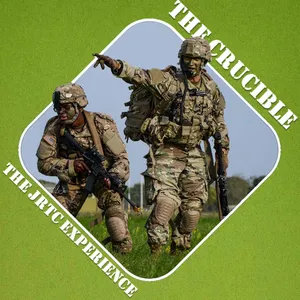
The Joint Readiness Training Center is the premier crucible training experience. We prepare units to fight and win in the most complex environments against world-class opposing forces. We are America’s leadership laboratory. This podcast isn’t an academic review of historical vignettes or political-science analysis of current events. This is a podcast about warfighting and the skillsets necessary for America’s Army to fight and win on the modern battlefield.
Latest Episodes
The most recent episodes — sign up to get AI-powered summaries of each one.
- Jul 30, 202636 min
169 S13 Ep 34 – The Battle Rhythm - Synchronizing Victory w/JRTC Subject Matter Experts
The Joint Readiness Training Center is pleased to present the one-hundredth-and-sixty-ninth episode to air on ‘The Crucible - The JRTC Experience.’ Hosted by MAJ David Pfaltzgraff, the Brigade Executive Officer Observer – Coach – Trainer and MAJ Marc Howle, the Brigade Senior Engineer / Protection OCT for the Brigade Command & Control (BDE HQ), on behalf of the Commander of Ops Group (COG). Today’s guests are subject matter experts for operational planning: MAJ Brandon Kilthau, the outgoing DIV G-3 Planner for Plans / Exercise Maneuver Control and MAJ Mike Stewart, the BDE S-3 Ops OIC OCT for BDE Command & Control (BDE HQ). This episode explores why an effective battle rhythm is the backbone of successful command and control in large-scale combat operations. Rather than treating meetings as routine calendar events, the discussion emphasizes that a disciplined battle rhythm synchronizes planning, current operations, future operations, targeting, sustainment, intelligence, and command decision-making into a continuous cycle. The hosts examine how recurring events such as CUBs, BUBs, targeting working groups, logistics synchronization meetings, and rehearsals create shared understanding across the staff, allowing commanders to make timely decisions while ensuring information flows efficiently between higher, adjacent, and subordinate headquarters. The conversation also highlights that a battle rhythm is only effective when it is deliberate, protected, and tied directly to the commander’s priorities. The panel discusses common pitfalls, including meeting overload, poor sequencing, unclear outputs, and allowing battle rhythm events to become information briefings rather than decision-making forums. Practical recommendations focus on building predictable reporting cycles, enforcing disciplined running estimates, integrating all warfighting functions, and ensuring every recurring event produces actionable decisions that enable faster planning, synchronized execution, and a more agile formation capable of maintaining operational tempo against a peer adversary. Part of S13 “Hip Pocket Training” series. For additional information and insights from this episode, please check-out our Instagram page @the_jrtc_crucible_podcast Be sure to follow us on social media to keep up with the latest warfighting TTPs learned through the crucible that is the Joint Readiness Training Center. Follow us by going to: https://linktr.ee/jrtc and then selecting your preferred podcast format. Again, we’d like to thank our guests for participating. Don’t forget to like, subscribe, and review us wherever you listen or watch your podcasts — and be sure to stay tuned for more in the near future. “The Crucible – The JRTC Experience” is a product of the Joint Readiness Training Center.
- Jul 23, 202639 min
168 S13 Ep 33 – Closing the Kill-Chain with Digital Fires w/JRTC Subject Matter Experts
The Joint Readiness Training Center is pleased to present the one-hundredth-and-sixty-eighth episode to air on ‘The Crucible - The JRTC Experience.’ Hosted by MAJ David Pfaltzgraff, the Brigade Executive Officer Observer – Coach – Trainer and MAJ Marc Howle, the Brigade Senior Engineer / Protection OCT for the Brigade Command & Control (BDE HQ), on behalf of the Commander of Ops Group (COG). Today’s guests are subject matter experts from within JRTC’s Brigade Command & Control Task Force (BDE HQ): MAJ Mike Stewart is the BDE S-3 Ops OIC OCT. MAJ Steve Yates is the BDE S-6 Signal OIC OCT. CW2 Chris Puthoff is the BDE S-6 Signal Network OCT. And SFC Aaron Breitbach is the BDE Fires OCT. This episode examines the importance of digital fires in accelerating and improving the sensor-to-shooter kill chain. The discussion traces how fire missions move from forward observers using Precision Fires-Dismounted and the Joint Effects Targeting System through company and battalion fire-support elements, AFATDS, and ultimately the firing unit. Digital transmission reduces transcription errors, incorporates automated safety checks, improves target accuracy, and can cut mission processing from more than 20 minutes over voice to only a few minutes. The episode emphasizes that this speed is essential for delivering responsive fires, maintaining valid triggers, and supporting Soldiers in close contact before the tactical situation changes. The conversation also addresses why digital fires frequently struggle despite their advantages. Effective employment requires fires and signal personnel to jointly design, resource, test, and sustain the architecture rather than treating it as the responsibility of a single warfighting function. Topics include limited network profiles, radios tied to specific IP addresses and mission plans, equipment compatibility, redundant digital pathways, PACE planning, and the consequences of late changes to the maneuver plan. The episode recommends making digital sustainment training and technical rehearsals recurring battle-rhythm events, beginning at home station and extending from the forward observer through the entire fires enterprise. Ultimately, reliable digital fires depend on disciplined repetitions, stable planning timelines, tested equipment, cross-functional integration, and an architecture proven before the formation enters the fight. Part of S13 “Hip Pocket Training” series. For additional information and insights from this episode, please check-out our Instagram page @the_jrtc_crucible_podcast Be sure to follow us on social media to keep up with the latest warfighting TTPs learned through the crucible that is the Joint Readiness Training Center. Follow us by going to: https://linktr.ee/jrtc and then selecting your preferred podcast format. Again, we’d like to thank our guests for participating. Don’t forget to like, subscribe, and review us wherever you listen or watch your podcasts — and be sure to stay tuned for more in the near future. “The Crucible – The JRTC Experience” is a product of the Joint Readiness Training Center.
- Jul 15, 202634 min
167 S03 Ep 14 – The Large Scale Combat Operations Casualty Care Problem, Pt. 2 w/JRTC Senior NCO Experts
The Joint Readiness Training Center is pleased to present the one-hundredth-and-sixty-seventh episode to air on ‘The Crucible - The JRTC Experience.’ Hosted by the Senior Enlisted Medical Advisor and Role II Observer-Coach-Trainer for the Task Force Sustainment (BSB / CSSB), MSG Timothy Sargent on behalf of the Commander of Ops Group (COG). Today’s guests are four seasoned senior NCOs within one of our infantry task forces. CSM Edwards Cumming is the TF CSM, 1SG Jeremiah Guerra is a CO Team 1SG, 1SG Mark Varley is a CO Team 1SG, and SFC William Deutsch is the Senior Medical Observer – Coach – Trainer within Task Force 3 (IN BN). This follow-on episode continues the discussion on casualty care within maneuver formations, shifting the focus from point-of-injury treatment to the realities of casualty evacuation, prolonged field care, and integrating the medical and maneuver enterprises during Large Scale Combat Operations. Leaders discuss common observations from JRTC, emphasizing that the greatest contributor to preventable casualties is often delayed evacuation caused by poor planning, ineffective communications, and a lack of understanding of CASEVAC and MEDEVAC capabilities. Topics include casualty collection points (CCPs), ambulance exchange points (AXPs), Role I and Role II care, prolonged field care, casualty triage, evacuation decision-making, and the importance of incorporating medical leaders into the planning process from the outset. A recurring theme is that casualty evacuation is a command-and-control problem as much as a medical one, requiring rehearsed PACE plans, clearly defined responsibilities, and disciplined execution to preserve combat power. The discussion also explores how units can better bridge the gap between the maneuver and medical communities through integrated training, shared understanding, and realistic repetitions. Leaders emphasize embedding medics within platoons, cross-training infantry Soldiers in lifesaving skills, developing SOPs that are understood at every echelon, and preparing junior leaders to assume greater responsibility when key personnel become casualties. Additional topics include maintaining momentum during casualty evacuation, using evacuation assets for both medical evacuation and logistical backhaul, building trust between medics and maneuver leaders, and exposing combat medics to realistic trauma training before deployment. Ultimately, the episode reinforces that casualty care in LSCO extends far beyond medical treatment—it requires disciplined planning, effective leadership, rigorous rehearsals, and a culture in which medics and maneuver leaders train together long before the first casualty occurs. Part of S03 “Lightfighter Lessons” series. For additional information and insights from this episode, please check-out our Instagram page @the_jrtc_crucible_podcast. Be sure to follow us on social media to keep up with the latest warfighting TTPs learned through the crucible that is the Joint Readiness Training Center. Follow us by going to: https://linktr.ee/jrtc and then selecting your preferred podcast format. Again, we’d like to thank our guests for participating. Don’t forget to like, subscribe, and review us wherever you listen or watch your podcasts — and be sure to stay tuned for more in the near future. “The Crucible – The JRTC Experience” is a product of the Joint Readiness Training Center.
- Jun 27, 20261h 1m
166 S03 Ep 13 – Building Hard-to-Kill Platoons and Squads w/JRTC Senior NCO Experts
The Joint Readiness Training Center is pleased to present the one-hundredth-and-sixty-sixth episode to air on ‘The Crucible - The JRTC Experience.’ Hosted by the outgoing Senior Enlisted Advisor and Command Sergeant Major for the Joint Readiness Training Center and Fort Polk, CSM Oracio Pena, Jr on behalf of the Commanding General and Commander of Ops Group (COG). CSM Pena will become the CSM for G-3 at Transformation and Training Command (T2COM). Today’s guests are four seasoned senior NCOs within one of our infantry task forces. CSM Bryan Jaragoske outgoing, acting Command Sergeant Major of Operations Group (formerly BC2 CSM). CSM Lucas Young is the TF CSM for Task Force 2 (IN BN) and CSM Edwards Cumming is the TF CSM with Task Force 3 (IN BN). And last but not least is CSM James Miller, the Command Sergeant Major of 1-509th IN (ABN) (OPFOR), known as Geronimo. This episode examines the long-term trends, strengths, and shortcomings of infantry platoons and squads observed across multiple JRTC rotations. Senior leaders discuss how the character of warfare is changing and how small units are adapting to increasingly complex operational environments shaped by drones, electronic warfare, contested communications, and peer threats. While today’s Soldiers have become increasingly proficient at integrating emerging technologies such as small unmanned aircraft systems, digital mission command tools, and other modern battlefield capabilities, the discussion emphasizes that technology alone cannot compensate for weak fundamentals. Leaders highlight recurring observations including declining fieldcraft, overreliance on digital navigation, poor security during halts and patrol bases, inconsistent priorities of work, and a tendency to neglect foundational infantry skills in favor of new technology. Throughout the conversation, the panel reinforces that lethality begins with disciplined execution of the basics, and that units which master the fundamentals are best positioned to capitalize on technological advances. The discussion also provides practical recommendations for platoon sergeants, squad leaders, and team leaders preparing for combat or a JRTC rotation. Topics include maximizing security zones, conducting reconnaissance and security patrols, integrating analog and digital mission command systems, sustaining dispersed formations, strengthening reporting and operational security, and developing initiative through disciplined home-station training. Leaders stress the value of hip-pocket training, ruthless repetition, realistic live-fire exercises, and creating leaders who can adapt when technology fails. A recurring theme is that squads should never wait to be told to execute priorities of work or prepare for the next mission. Instead, successful formations continuously train, anticipate friction, and maintain the mindset that every halt is an opportunity to improve survivability, sustain combat power, and prepare for the next fight. Ultimately, the episode argues that while the tools of war continue to evolve, disciplined leadership, tactical proficiency, and mastery of the fundamentals remain the decisive factors that separate effective infantry units from those that struggle on the modern battlefield. Part of S03 “Lightfighter Lessons” series. For additional information and insights from this episode, please check-out our Instagram page @the_jrtc_crucible_podcast. Be sure to follow us on social media to keep up with the latest warfighting TTPs learned through the crucible that is the Joint Readiness Training Center. Follow us by going to: https://linktr.ee/jrtc and then selecting your preferred podcast format. Again, we’d like to thank our guests for participating. Don’t forget to like, subscribe, and review us wherever you listen or watch your podcasts — and be sure to stay tuned for more in the near future. “The Crucible – The JRTC Experience” is a product of the Joint Readiness Training Center.<
- Jun 24, 202639 min
165 S13 Ep 32 – Getting the Fires Technical Rehearsal Right w/JRTC Subject Matter Experts
The Joint Readiness Training Center is pleased to present the one-hundredth-and-sixty-fifth episode to air on ‘The Crucible - The JRTC Experience.’ Hosted by MAJ Marc Howle, the Brigade Senior Engineer / Protection Observer – Coach – Trainer and MSG Jared Cawthon, the BDE Fires Support NCOIC OCT for the Brigade Command & Control (BDE HQ), on behalf of the Commander of Ops Group (COG). Today’s guests are subject matter experts from within JRTC’s fires support enterprise: MAJ David Nelson is the FA BN S-3 Operations Officer OCT, SFC Larry Gillispie, Jr. is the Fires Direction Center Senior OCT, and SFC Ryan Bruno is the Battery 1SG OCT for TF Fires (FA BN / DIVARTY). And MSG Austin Moss is the Senior Targeting NCOIC OCT for BC2. This episode examines the fires technical rehearsal and why it is one of the most important, yet often overlooked, events in preparing a brigade for combat. The discussion explains how the fires technical rehearsal validates the entire sensor-to-shooter kill chain, ensuring observers, fire support personnel, fire direction centers, and gun crews can execute the plan before rounds are fired in combat. Leaders emphasize that the rehearsal is far more than a communications check—it validates fire support coordination measures, target refinement, firing data, ammunition availability, primary and alternate shooters, PACE plans, and the timing required to synchronize fires with maneuver. A recurring theme is that a simple plan supported by detailed fire support products and disciplined version control enables the brigade to identify friction early and refine tactical triggers into achievable technical triggers before execution. The conversation also highlights common shortcomings observed during JRTC rotations, including conducting the first technical rehearsal only after arrival at the training center, poor transition from plans to current operations, inadequate battle rhythm integration, and failure to involve the entire fires enterprise in rehearsals. Leaders discuss the importance of digital sustainment training at home station, rehearsing degraded communications, validating ammunition requirements, conducting deliberate handovers between shifts, and continuously refining the fire plan as the tactical situation changes. The episode reinforces that technical rehearsals should become a routine battle rhythm event rather than a one-time exercise, allowing staffs to uncover problems before they become combat failures. Ultimately, the discussion argues that disciplined technical rehearsals build confidence, improve synchronization between maneuver and fires, and give commanders the information needed to execute timely, accurate, and lethal fire support on the modern battlefield. Part of S13 “Hip Pocket Training” series. For additional information and insights from this episode, please check-out our Instagram page @the_jrtc_crucible_podcast Be sure to follow us on social media to keep up with the latest warfighting TTPs learned through the crucible that is the Joint Readiness Training Center. Follow us by going to: https://linktr.ee/jrtc and then selecting your preferred podcast format. Again, we’d like to thank our guests for participating. Don’t forget to like, subscribe, and review us wherever you listen or watch your podcasts — and be sure to stay tuned for more in the near future. “The Crucible – The JRTC Experience” is a product of the Joint Readiness Training Center.
- Jun 19, 202655 min
164 S05 Ep 18 – Inside the Gator Light Sustainment Battalion – The Sustainment Backbone of an Airborne Brigade w/Gator 06, LTC van Howe
The Joint Readiness Training Center is pleased to present the one-hundredth-and-sixty-fourth episode to air on ‘The Crucible - The JRTC Experience.’ Hosted by MAJ Amy Beatty, the G-4 Senior Sustainment Planner from Plans / Exercise Maneuver Control Task Force on behalf of the Commander of Ops Group (COG). Today’s guest is the Battalion Commander for the 82nd Light Support Battalion, LTC Peter van Howe. The 82nd Light Support Battalion (LSB), formerly the 82nd Brigade Support Battalion (BSB), serves as the sustainment backbone of the 3rd Mobile Brigade Combat Team, 82nd Airborne Division, providing logistics, maintenance, medical, transportation, and distribution support to enable the brigade’s rapid deployment and expeditionary operations worldwide. Known by its Hollywood call-sign, “Gator,” the battalion has a long history of supporting airborne and contingency operations, ensuring paratroopers can seize, hold, and fight from key terrain under austere conditions. As the Army transitions from the BSB to the LSB construct, the battalion continues to evolve its sustainment capabilities to support dispersed operations, contested logistics, and prolonged combat against peer threats. The battalion’s motto, “Service to the Line,” reflects its enduring commitment to projecting, generating, and preserving combat power for the brigade, ensuring maneuver forces remain lethal, mobile, and ready to fight whenever and wherever the Nation calls. This episode explores the employment of the Light Support Battalion (LSB) and how sustainment formations are adapting to survive and sustain maneuver forces on the modern battlefield. The discussion focuses on base cluster design, command and control, survivability, distribution operations, and the constant balance between protection and sustainment throughput. Leaders examine different approaches to organizing the Brigade Support Area, emphasizing that there is no single solution and that sustainment leaders must remain flexible based on the enemy situation, terrain, mission requirements, and available resources. Topics include dispersed versus consolidated support areas, use of forward logistics elements, deception operations, engineer support, survivability positions, signature management, and the employment of decoy command posts. A recurring theme throughout the episode is that sustainment formations must think and fight like maneuver formations, continuously adapting their posture to maintain survivability while preserving the ability to project, generate, and preserve combat power for the brigade. The conversation also focuses on the critical relationship between maneuver units and the sustainment enterprise. Leaders discuss the importance of accurate LOGSTAT reporting, synchronization across echelons, understanding the roles of the S4, Support Operations Officer (SPO), G4, and G8, and ensuring sustainment is integrated into planning from the outset. Additional topics include running estimates, logistics common operating pictures, rehearsals, battle rhythm events, sustainment forecasting, and the role of NCOs in MDMP. The episode highlights how sustainment success depends on shared understanding, continuous communication, and deliberate synchronization in time and space. Ultimately, the discussion reinforces that the LSB is far more than a logistics provider—it is a combat multiplier that enables brigade operations by ensuring forces can continue to fight, move, communicate, recover, and sustain themselves throughout prolonged operations against a capable peer threat. Part of S05 “Beans, Bullets, Band-Aids, Batteries, Water, & Fuel” series. For additional information and insights from this episode, please check-out our Instagram page @the_jrtc_crucible_podcast. Be sure to follow us on social media to keep up with the latest warfighting TTPs learned through the crucible that is the Joint Readiness Training Center. Follow us by going to: https://linktr.ee/jrtc and then
- Jun 17, 202630 min
163 S13 Ep 31 – The Transition Mindset & Thinking Beyond the Next Objective w/JRTC Experts
The Joint Readiness Training Center is pleased to present the one-hundredth-and-sixty-third episode to air on ‘The Crucible - The JRTC Experience.’ Hosted by MAJ David Pfaltzgraff, the Brigade Executive Officer Observer – Coach – Trainer and MAJ Marc Howle, the Brigade Senior Engineer / Protection OCT for the Brigade Command & Control (BDE HQ), on behalf of the Commander of Ops Group (COG). Today’s guests are subject matter experts from within one of JRTC’s infantry battalion task forces: MAJ Reed Ziegler is the executive officer and CPT Michael Boster is a Rifle Co Commander OCT for TF-1 (IN BN). This episode explores the importance of transitions on the battlefield and the mindset required to execute them successfully. Leaders discuss how many units arrive at JRTC with a strong offensive mindset but often struggle when operations require a rapid transition from one tactical task to another. The conversation focuses on the difference between simply completing a mission and maintaining a continuous combat mindset that anticipates what comes next. Topics include transitioning from offense to defense, preserving combat power, recognizing decision points, identifying transition criteria during planning, and understanding when risk to force or risk to mission requires commanders to adjust their approach. A recurring theme is that successful units do not wait for instructions after achieving an objective—they immediately begin preparing for the next problem while maintaining security, momentum, and situational awareness. The discussion also examines how home-station training and planning practices often unintentionally condition leaders to think in discrete events rather than continuous operations. Leaders highlight common observations such as units seizing an objective only to become static, failing to establish hasty defenses, neglecting security, or losing initiative while awaiting guidance. Additional topics include building transition criteria into MDMP, preparing for both offensive and defensive actions simultaneously, understanding that the enemy always gets a vote, and developing the endurance required to sustain operations over extended periods. Ultimately, the episode argues that combat is not a series of separate offensive and defensive events but a continuous contest of action and reaction. The most successful formations are those that constantly ask, “What’s next?” and remain mentally prepared to transition faster than the enemy can adapt. Part of S13 “Hip Pocket Training” series. For additional information and insights from this episode, please check-out our Instagram page @the_jrtc_crucible_podcast Be sure to follow us on social media to keep up with the latest warfighting TTPs learned through the crucible that is the Joint Readiness Training Center. Follow us by going to: https://linktr.ee/jrtc and then selecting your preferred podcast format. Again, we’d like to thank our guests for participating. Don’t forget to like, subscribe, and review us wherever you listen or watch your podcasts — and be sure to stay tuned for more in the near future. “The Crucible – The JRTC Experience” is a product of the Joint Readiness Training Center.
- Jun 12, 202635 min
162 S13 Ep 30 – The Art of Command & Control Starts with the PACE Plan w/JRTC Experts
The Joint Readiness Training Center is pleased to present the one-hundredth-and-sixty-second episode to air on ‘The Crucible - The JRTC Experience.’ Hosted by MAJ David Pfaltzgraff, the Brigade Executive Officer Observer – Coach – Trainer and MAJ Marc Howle, the Brigade Senior Engineer / Protection OCT for the Brigade Command & Control (BDE HQ), on behalf of the Commander of Ops Group (COG). Today’s guests are subject matter experts across JRTC: LTC Mario Burch is the Senior Signal WfF OCT, MAJ Steve Yates is the BDE S-6 Signal OIC OCT, MAJ Mike Stewart is the BDE S-3 Ops OIC OCT, and CW2 Chris Puthoff is the BDE S-6 Signal Network OCT for BDE Command & Control (BDE HQ). And CPT Craig Muncaster is the BN S-6 Signal OIC OCT for TF Fires Support (FA BN). This episode explores the importance of developing, training, and employing effective PACE (Primary – Alternate – Contingency – Emergency) plans as a cornerstone of command and control in Large Scale Combat Operations. The discussion emphasizes that a PACE plan is not simply a communications checklist or a menu of available systems, but a deliberate framework that enables commanders to maintain decision advantage despite contested, degraded, or disrupted communications. Leaders discuss common mistakes observed at JRTC, including building PACE plans around systems that units are not proficient with, relying on multiple communication methods that share the same digital backbone, and failing to account for how enemy actions, terrain, or operational phases will impact communications. A recurring theme is that communications systems must be realistic, transport-diverse, and nested with the commander’s operational requirements rather than built solely around available technology. The conversation also focuses heavily on training and implementation, stressing that PACE plans must be rehearsed extensively at home station before arriving at a combat training center. Topics include mission command validation exercises, integrating all warfighting functions into communications training, developing phase-specific PACE plans, accounting for enemy jamming and electromagnetic threats, and ensuring commanders understand when and how to transition between communications methods. Leaders emphasize that communications plans should evolve throughout an operation based on conditions, control measures, and enemy activity rather than remaining static. Ultimately, the episode reinforces that successful command and control depends not on having the newest equipment, but on disciplined training, realistic testing, shared understanding across the staff, and a PACE plan that can survive first contact with the enemy. Part of S13 “Hip Pocket Training” series. For additional information and insights from this episode, please check-out our Instagram page @the_jrtc_crucible_podcast Be sure to follow us on social media to keep up with the latest warfighting TTPs learned through the crucible that is the Joint Readiness Training Center. Follow us by going to: https://linktr.ee/jrtc and then selecting your preferred podcast format. Again, we’d like to thank our guests for participating. Don’t forget to like, subscribe, and review us wherever you listen or watch your podcasts — and be sure to stay tuned for more in the near future. “The Crucible – The JRTC Experience” is a product of the Joint Readiness Training Center.
Get The Crucible - The JRTC Experience Podcast summaries in your inbox
Free AI-powered daily recaps. Key takeaways, quotes, and mentions — in a 5-minute read.
Get Free Summaries →Free forever for up to 3 podcasts. No credit card required.
You Might Also Like
Listeners also like.

The Jedburgh Podcast
Leaders and high performers from military, business, and athletics share strategies for elite performance, leadership, and personal growth.

Ones Ready
Air Force special operations veterans discuss training, nutrition, recovery, and mindset for aspiring elite operators.
The LOGSTAT
U.S. Army podcast discussing logistics and sustainment operations with military leaders and experts.

Cleared Hot - Powered By BRCC
A former military pilot shares stories of adventure, fitness, and leadership to explore resilience and personal growth.

The Debrief with Jon Becker
Leadership lessons from military and law enforcement commanders on teamwork, decision-making, and training in high-stakes environments.

Jocko Podcast
Retired Navy SEAL Jocko Willink and Echo Charles explore discipline and leadership in war, business, relationships, and daily life.

The Afterburn Podcast
Veterans share personal experiences from military service, covering combat missions, aircraft, and life in uniform.

SOFREP Radio
Military news and discussions with former special operations personnel.
Irregular Warfare Podcast
Examines irregular warfare through expert discussions on small wars, special operations, counterterrorism, and conflict tactics.

Your Thoughts Your Reality
A podcast exploring how veterans can overcome psychological challenges like fear and self-doubt through neuroencoding science.
Tier1 Podcast
Discussions with special operations veterans and elite performers about high-stakes missions, leadership, and real-world decision making.

The Team House
Deep-dive conversations on national security with special operations veterans, intelligence professionals, and frontline reporters.
About The Crucible - The JRTC Experience Podcast
The Joint Readiness Training Center is the premier crucible training experience. We prepare units to fight and win in the most complex environments against world-class opposing forces. We are America’s leadership laboratory. This podcast isn’t an academic review of historical vignettes or political-science analysis of current events. This is a podcast about warfighting and the skillsets necessary for America’s Army to fight and win on the modern battlefield.
Customized Recaps
AI-powered recaps with compact key takeaways, quotes, and insights.
Straight to Your Inbox
Get key takeaways from The Crucible - The JRTC Experience Podcast in a 5-minute read.
Save Hours Every Week
Stay current on your favorite podcasts without falling behind.
Frequently Asked Questions
What is Podzilla's The Crucible - The JRTC Experience Podcast daily summary?
It's a free AI-powered email that summarizes new episodes of The Crucible - The JRTC Experience Podcast as soon as they're published. You get the key takeaways, notable quotes, and links & mentions — all in a quick read.
How does the The Crucible - The JRTC Experience Podcast podcast summary work?
When a new episode drops, our AI transcribes and analyzes it, then generates a personalized summary tailored to your interests and profession. It's delivered to your inbox every morning.
Is this an official The Crucible - The JRTC Experience Podcast product?
No. Podzilla is an independent service that summarizes publicly available podcast content. We're not affiliated with or endorsed by JRTC CALL Cell.
Can I get summaries of other podcasts too?
Absolutely! The free plan covers up to 3 podcasts. Upgrade to Pro for 15, or Premium for 50. Browse our full catalog at /podcasts.
How often does The Crucible - The JRTC Experience Podcast release new episodes?
The Crucible - The JRTC Experience Podcast publishes weekly. Our AI generates a summary within hours of each new episode.
What topics does The Crucible - The JRTC Experience Podcast cover?
The Crucible - The JRTC Experience Podcast covers topics including News, History, Government. Our AI identifies the specific themes in each episode and highlights what matters most to you.
Start getting The Crucible - The JRTC Experience Podcast summaries tomorrow morning.
Free forever for up to 3 podcasts. No credit card required.
Free forever for up to 3 podcasts. No credit card required.