Free Daily Podcast Summary
The Imperfect Buddha Podcast: Daily Summaries Delivered
by The Imperfect Buddha Podcast
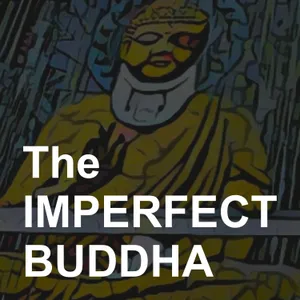
The Imperfect Buddha podcast has been addressing anti-intellectualism and ideological capture in western Buddhism and spirituality more broadly since its inception. It provides a space for dynamic conversations designed to bring out what is so often hidden and so often despised by critics and intellectuals engaging with contemporary forms of practice. Matthew O’Connell hosts the Imperfect Buddha podcast and writes at The Imperfect Buddha site. Email: imperfectbuddha@outlook.com. Twitter: @imperfectbuddha. Facebook: @imperfectbuddha. Original street art Buddha image by Bristol's Banksy.
Latest Episodes
The most recent episodes — sign up to get AI-powered summaries of each one.
- 3 days ago1h 7m
Bruce Alderman on Feeling Fully Alive
In this episode of The Imperfect Buddha Podcast, host Matthew O'Connell sits down with Bruce Alderman, educator, writer, and faculty member in the Consciousness and Transformative Studies department at JFK School of Psychology (National University), to discuss his new book, Feeling Fully Alive: An Introduction to Tibetan Yoga (Dharma Publishing). The conversation explores the intersection of somatic practice, contemplative psychology, and contemporary philosophy. Key Topics Covered :Integral Theory & Post-Metaphysical Thought: Bruce's journey through Integral Theory, and how his inquiry expanded into critical realism, speculative realism, and object-oriented ontology (OOO). Philosophy as Personal Practice: Bridging contemplative traditions with thinkers like Bruno Latour, Alfred North Whitehead, Peter Sloterdijk, and Martin Heidegger to open up new spaces for personal and reflective practice. Introduction to Kum Nye (Tibetan Yoga): The meaning of Kum Nye, focusing on the lived body and energy flow, and how its slow movements, posture, and dual-breath techniques cultivate somatic relaxation and sensory awareness. Epistemic Shifts & Sensory Awareness: How Kum Nye serves as a doorway to re-evaluating sensory experience, moving beyond conditioned patterns of perception, and fostering intersubjective, participatory engagement with the world. The accessible, non-doctrinal approach of Feeling Fully Alive for both general seekers and experienced practitioners, as well as Bruce's upcoming course hosted through Dharma College. Hosted by Simplecast, an AdsWizz company. See pcm.adswizz.com for information about our collection and use of personal data for advertising.
- Jul 6, 20261h 28m
Meditation Sickness and the Dangers of Buddhist Practice with Pierce Salguero
Pierce Salguero joins us to discuss his new co-edited volume, Meditation Sickness: A Sourcebook on the Dangers of Buddhist Practice. While modern mindfulness frames meditation purely as a wellness tool, the Buddhist tradition has long recognized its inherent psychological and physical risks. We explore multi-tradition historical texts, the anatomy of practice crises, and the ethical responsibility of teachers and app developers to provide something along the lines of informed consent. Key Discussion Points & Timeline Contrasting modern wellness marketing with historical accounts of meditative danger; the book provides a sourcebook for Dharma teachers, clinicians, and serious practitioners. Multi-Tradition Mapping throughout covers Pali, medieval Chinese, Japanese, and Tibetan sources, many of which we touch on. Traditional sources diagnose destabilization and even offer a range of physical, energetic, and lifestyle remedies to mediate crisis: whether they would be a good fit for today’s practitioner is another matter. Challenging the modern claim that adverse effects only happen to the unprepared or mentally fragile. Classical lineages show that severe physical ailments and mental destabilization can happen randomly, even to advanced practitioners. The hidden risks of unmonitored, commercialized meditation apps. Why creators have an ethical duty to move past treating meditation as a risk-free panacea and offer clear safety guardrails. How different cultures draw the line between a spiritual breakthrough and clinical pathology. The ongoing project of integrating traditional remedies with modern psychology and neuroscience. Links & Resources Mentioned The Book: Meditation Sickness: A Sourcebook on the Dangers of Buddhist Practice. Guest Website: here (Includes the book's introduction). Learn more about your ad choices. Visit megaphone.fm/adchoices
- Jun 27, 20261h 17m
Cultivating Consciousness: A Conversation with Ronald E. Purser on Mind Space (2026)
What does it mean to connect with mind and space without the typical baggage of contemporary meditation trends? In this episode of the New Books Network, Matthew Joseph O'Connell sits down with author and practitioner Ronald E. Purser to discuss his timely new book, Mind Space: Discovering Meditation Without the Meditator (Dharma Publishing, 2026). Drawing from his decades-long engagement with Tarthang Tulku’s seminal 1977 work, Time, Space, and Knowledge, Purser offers a refreshing, experimental, and surprisingly playful guide to understanding our structural realities. Rather than preaching a prescriptive self-help routine, Mind Space serves as an experiential commentary that invites readers into a radical, non-dualistic inquiry of how we inhabit our lives. Key Themes from the Episode Beyond McMindfulness: How Mind Space transitions away from corporate, present-moment-focused trends and pivots toward a deeper, more expansive territory of human freedom. The Anatomy of Mind and Space: An etymological and philosophical breakdown of mind as our generative source of knowledge, and space not as a passive, empty container, but as an active, alive, and accommodating dimension. The Myth of the Inner Manager: A critique of the reflexive, modern impulse to over-manage every facet of our internal lives, and how to cultivate a state of un-management. Digital Colonization: Confronting the psycho-physical compression, social comparisons, and anxiety induced by modern screens, and how the acceleration of time flattens our capacity for deep meaning. The Playfulness of Inquiry: Why true contemplative practice thrives on curiosity, experimentation, and humour rather than rigid, sombre discipline. "Space is not a thing. It is what permits experience to be experienced at all. When we realize space is projecting space into space, our rigid focal settings begin to thaw." — Ronald E. Purser Learn more about your ad choices. Visit megaphone.fm/adchoices
- Apr 7, 20261h 9m
Just Stare at the Damn Wall!
Welcome to the Imperfect Buddha Podcast on the New Books Network. Today, we’re stripping away the incense and serenity to look at the cold, hard wall of practice. We are joined by Mark Shinji Blacknell, author of Just Stare at the Damn Wall!. Mark isn't your typical "mindfulness guru"—he’s been a Marine, a bus driver, and an alcoholic, bringing a crude and down to Earth view of enlightenment to Zen. In this episode, we dig into the friction between Mark’s focus on simple biology and the Soto establishment he knows all too well. We’ll be asking: The Technology of the Wall: In an era of bio-hacking and apps, why choose a directive as primitive as staring at a wall? The Myth of Enlightenment: Why does Mark tell his readers to "forget enlightenment" and embrace being a "doctor of nothing"? The Shadow Side: We discuss whether "McMindfulness" ignores how meditation can make unstable people more dangerous. Raw Acceptance vs. Nihilism: How do we differentiate "accepting life as it is" from a passive, terrifying nihilism? The End of the Path: If the goal is "doing nothing for nothing," how do we even know we’re practicing? From meditating with prisoners on death row to the often dirty and frustrating reality of being a practitioner, Mark joins us to explain why the only way to fail a practice is to stop: the rest is all part of the process. Is this book just a very long way of telling us to shut up? Let’s find out. Host’s webpage: here Mark Blacknell: here Learn more about your ad choices. Visit megaphone.fm/adchoices
- Dec 13, 202546 min
Dr. Michael Uebel on Reimaging Equanimity
Michael Uebel is a psychotherapist and researcher currently based in Austin, Texas. He is recognized as a pioneer in applying psychological insights to the historical intersections of social, personal, and imaginative phenomena. He is a Research Affiliate at the University of Texas at Austin and a psychotherapist in both the public sector and in private practice. Uebel has taught literature and critical theory at several universities, including the University of Virginia, Georgetown University, and the University of Kentucky. Seeds of Equanimity: Knowing and Being ( Mimesis, 2025), is an innovative introduction to the philosophy and psychology of equanimity. Uebel challenges the popular modern view often associated with certain mindfulness practices that equanimity is a state of impartial quiescence, solidity, or inner stillness, achieved through emotional regulation. His book reanimates the concept of equanimity by drawing on its philosophical and psychological genealogy by tracing its origins and development, framing it as a dynamic, active, and flexible existential condition. Learn more about your ad choices. Visit megaphone.fm/adchoices
- Jul 29, 20251h 8m
Alexander Douglas, "Against Identity: The Wisdom of Escaping the Self" (Random House, 2025)
In Against Identity, philosopher Alexander Douglas seeks an alternative wisdom. Searching the work of three thinkers – ancient Chinese philosopher Zhuangzi, Dutch Enlightenment thinker Benedict de Spinoza, and 20th Century French theorist René Girard – he explores how identity can be a spiritual violence that leads us away from truth. Through their worlds and radically different cultures, we discover how, at moments of historical rupture, our hunger for being grows: and yet, it is exactly these times when we should make peace with our indeterminacy and discover the freedom of escaping our selves. Alexander Douglas was born in Canberra, Australia where he studied music and philosophy. He now teaches the history of philosophy and the philosophy of economics at the University of St Andrews. He has published two books on the philosophy of Benedict de Spinoza and one on the philosophy of debt. He has grown increasingly interested in combining ideas from Western and East Asian philosophy. Learn more about your ad choices. Visit megaphone.fm/adchoices
- Jun 8, 202554 min
Speaking Philosophically: Communication at the Limits of Discursive Reason
Tom joins us to discuss his book Speaking Philosophically: Communication at the Limits of Discursive Reason (Bloomsbury, 2023). Western philosophy has often claimed for itself not just a distinct sphere of knowledge, but a distinct form of communication, set against ordinary speech. For some philosophers, authentic philosophizing demands a specific manner of speaking or writing, adoption of which enables one to gesture toward truths that propositional speech will never grasp. Drawing on a variety of thinkers – Heraclitus, Plato, Kant, Fichte, Nietzsche, Kierkegaard, Weil, Foucault, and Irigaray – Sutherland argues this emphasis on the form of philosophical communication can function as an exclusionary mechanism, determining who is deemed capable of speaking philosophically. We discuss Plato, Nietzsche, Weil, Laruelle and applied philosophy in Hadot. Learn more about your ad choices. Visit megaphone.fm/adchoices
- May 21, 20251h 25m
Anne C. Klein on Becoming a Buddha & Being Human too
You’re human, but are you also a Buddha? If so, which one comes first? What does it mean to be human? What is a Buddha exactly? Is our humanity lost or superseded if we become a Buddha? Such questions might interest our more philosophical listeners. Being Human and a Buddha Too ( Wisdom Publications, 2023) by today’s guest Anne Klein explores the 7-point mind training of Longchenpa, a 14th century Tibetan Scholar and Yogi from the Nyingma school of Tibetan Buddhism. Anne is professor of religion at Rice University, a co-founder of the Dawn Mountain centre for Tibetan Buddhism in Housten, Texas, and a lama in the Nyingma tradition herself. Her key research areas are Tibet and Indian epistemology, Tibetan texts and language. We touch on the following themes and questions; How do you manage the dual roles of university academic and Nyingma Lama? Buddhism in the West has gone through a lot and very quickly since its more prominent emergence in the 1960s. Do you have any thoughts on Buddhism’s future in the west and whether it will maintain any significant presence once its key teachers from the boomer generation begin to pass away? Whether its problematic teachers, or, and perhaps more importantly, the insistence on a model that it antithetical to western modes of teacher student interaction, the Tibetan Lama, guru and core figure cannot escape a compatibility issue with Western norms. Worse for some still, there is also an increasing lack of teacher availability for those willing to embrace this model. Thoughts? What are we to do with language and the hermeneutic challenges its presents for translators of old Tibetan texts? Why this book? Why now? You have a series of events coming up, including retreats with translators in Germany, Switzerland and in Italy. Can you tell us about that and how listeners can get involved if they wish to? Learn more about your ad choices. Visit megaphone.fm/adchoices
Get The Imperfect Buddha Podcast summaries in your inbox
Free AI-powered daily recaps. Key takeaways, quotes, and mentions — in a 5-minute read.
Get Free Summaries →Free forever for up to 3 podcasts. No credit card required.
You Might Also Like
Listeners also like.
A Buddhist View
Ringu Tulku Rinpoche & Ela Crain
The 12-Step Buddhist Podcast
Explores Buddhist principles and mindfulness practices integrated with 12-step recovery to heal trauma and addiction.

Imperfect Love
A psychologist answers real-life questions on love, self-acceptance, and personal growth using a mindfulness-based approach.
Becoming Wise
On Being Studios

The Modern Good
The Modern Good
Original Buddha's Teachings
Ven. Dhammavuddho

Earth and Spirit Podcast
Earth and Spirit Center
Deepak Chopra’s Infinite Potential
Deepak Chopra explores consciousness, identity, and human potential through conversations with thought leaders and experts.
The Lion-Faced Guru Podcast - Pragmatic Explorations of Nondual Tantra, Vajrayana & Dzogchen
Amrita Mandala Sangha

The UnMute Podcast
Philosophers discuss current social and political issues with insight, humor, and a drive for change.
On Being with Krista Tippett
Deep conversations on spirituality, science, and the human condition with thinkers and spiritual leaders.

The Emerald
Explores myth, story, and imagination to reframe modern discourse on society, science, art, and the human experience.
About The Imperfect Buddha Podcast
The Imperfect Buddha podcast has been addressing anti-intellectualism and ideological capture in western Buddhism and spirituality more broadly since its inception. It provides a space for dynamic conversations designed to bring out what is so often hidden and so often despised by critics and intellectuals engaging with contemporary forms of practice. Matthew O’Connell hosts the Imperfect Buddha podcast and writes at The Imperfect Buddha site. Email: imperfectbuddha@outlook.com. Twitter: @imperfectbuddha. Facebook: @imperfectbuddha. Original street art Buddha image by Bristol's Banksy.
Customized Recaps
AI-powered recaps with compact key takeaways, quotes, and insights.
Straight to Your Inbox
Get key takeaways from The Imperfect Buddha Podcast in a 5-minute read.
Save Hours Every Week
Stay current on your favorite podcasts without falling behind.
Frequently Asked Questions
What is Podzilla's The Imperfect Buddha Podcast daily summary?
It's a free AI-powered email that summarizes new episodes of The Imperfect Buddha Podcast as soon as they're published. You get the key takeaways, notable quotes, and links & mentions — all in a quick read.
How does the The Imperfect Buddha Podcast podcast summary work?
When a new episode drops, our AI transcribes and analyzes it, then generates a personalized summary tailored to your interests and profession. It's delivered to your inbox every morning.
Is this an official The Imperfect Buddha Podcast product?
No. Podzilla is an independent service that summarizes publicly available podcast content. We're not affiliated with or endorsed by The Imperfect Buddha Podcast.
Can I get summaries of other podcasts too?
Absolutely! The free plan covers up to 3 podcasts, any in the catalog. Basic raises that to 15, Pro to 40 and Max to 100. Browse our full catalog at /podcasts.
How often does The Imperfect Buddha Podcast release new episodes?
The Imperfect Buddha Podcast publishes occasional. Our AI generates a summary within hours of each new episode.
What topics does The Imperfect Buddha Podcast cover?
The Imperfect Buddha Podcast covers topics including Religion & Spirituality, Spirituality, Buddhism. Our AI identifies the specific themes in each episode and highlights what matters most to you.
Start getting The Imperfect Buddha Podcast summaries tomorrow morning.
Free forever for up to 3 podcasts. No credit card required.
Free forever for up to 3 podcasts. No credit card required.