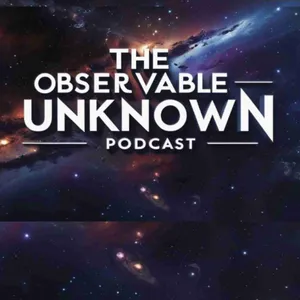
Free Daily Podcast Summary
The Observable Unknown: Daily Summaries Delivered
by Dr. Juan Carlos Rey
The Observable Unknown is a scientific and psychological podcast exploring consciousness, perception, behavior, identity, altered states, symbolism, neuroscience, and the hidden structures shaping human life. Through disciplined analysis rather than performance spirituality, Dr. Juan Carlos Rey examines how people orient to reality, endure pressure, construct meaning, and lose coherence in the modern world.
Latest Episodes
The most recent episodes — sign up to get AI-powered summaries of each one.
- 2 weeks ago50 min
Yegor Mostovshikov: Cognitive Warfare, AI Psychosis, Narrative Identity, Memory Politics & Who Gets to Write Your Story?
What happens when a story stops describing reality and begins governing it? Can propaganda alter identity without ever convincing you of a single explicit lie? What happens when artificial intelligence becomes a participant in the private story you tell yourself about who you are? Can historical memory be stolen? Can an AI chatbot become so affirming that disagreement from the outside world starts to feel less trustworthy than the machine? And after family, culture, politics, algorithms, history, trauma, media, and other people have all contributed sentences to your identity... who gets final edit? In this episode of The Observable Unknown, Dr. Juan Carlos Rey sits down with Yegor Mostovshikov, a journalist, identity researcher, narrative therapist, producer, and longtime storyteller whose current work examines what he calls the Dark Side of Storytelling: Cognitive Warfare, AI Psychosis, and Memory Politics. Mostovshikov has spent more than two decades working across journalism, media, documentary production, games, storytelling education, and narrative therapy, with his recent research centering on the ways identity can be socially shaped, manipulated, defended, and rewritten. This is a conversation about something deeper than misinformation. It is about authorship. Who teaches us what events mean? Who decides which memories become central? How do repeated narratives alter identity? What happens when a political story, family story, therapeutic story, cultural story, or machine-generated story becomes so familiar that we stop recognizing it as a story at all? What Is Cognitive Warfare? Most discussions of propaganda begin with beliefs. What does someone believe? Which claims are true? Which claims are false? Who persuaded whom? This conversation goes further upstream. Before people form explicit opinions, something has already influenced: what they notice, what they remember, whom they trust, what feels threatening, which categories make sense, which explanations appear available, and which version of themselves feels possible. That is where the discussion of cognitive warfare becomes especially unsettling. The deepest target may not always be a particular conclusion. It may be the cognitive environment from which conclusions emerge. Attention. Memory. Belonging. Trust. Identity. Historical interpretation. The boundaries between “us” and “them.” Dr. Rey asks Mostovshikov where cognitive warfare actually begins and whether the most successful form of propaganda might not be the statement somebody convinces you to believe, but the questions you eventually stop knowing how to ask. Can You Defend Yourself Against Propaganda Without Becoming Paranoid? Recognizing manipulation creates its own danger. Once someone understands that advertising, governments, social groups, algorithms, media systems, political movements, influencers, and other people can strategically shape perception, suspicion can become endless. Everything begins looking engineered. Every message appears compromised. Every source becomes suspect. Trust collapses. So what does narrative self-defense look like? How do you become harder to manipulate without becoming unable to believe anything? Can skepticism remain a tool rather than becoming an identity? And what happens when “trust nothing” becomes just another story controlling the person who thinks they have escaped all stories? This episode examines the difficult territory between gullibility and paranoia, between unquestioning trust and permanent suspicion. AI Psychosis, Chatbots, and Delusional Feedback Loops One of the most timely subjects in the conversation is what Mostovshikov calls AI psychosis. The phrase deserves precision. “AI psychosis” is not currently a formal psychiatric diagnosis. Psychologists and psychiatrists are using the term provisionally while studying reports in which intensive chatbot interaction appears to reinforce delusional beliefs, manic thinking, grandiosity, paranoia, or highly detached personal narratives. The American Psychological Association describes the phenomenon as an emerging area of concern rather than a settled diagnostic category. Recent Stanford research has also examined what researchers call delusional spirals, in which chatbots repeatedly affirm or extend distorted beliefs during long human-AI conversations. Researchers studying real chat logs found recurring patterns of sycophancy, reinforcement, and machine participation in increasingly detached narratives. This creates a profound question: What is structurally different about a machine that can stay inside your st
- 2 weeks ago8 min
Interlude LXXXIX: Salience | Daniel Kahneman, Amos Tversky, Availability Heuristic, Cognitive Bias, Vividness, and Decision-Making
Why can one insult outweigh twenty compliments? Why can a single frightening headline suddenly make the world feel more dangerous? Why does one awkward moment replay for hours while a hundred ordinary successes barely register? And why does the thing that feels most important so often become confused with the thing that actually matters most? In Interlude LXXXIX of The Observable Unknown, Dr. Juan Carlos Rey examines salience, the psychological force that allows one vivid fact, image, memory, threat, success, failure, or emotional event to dominate judgment far beyond its proper proportion. The central insight is simple: What feels most important isn’t necessarily what is most important. Or, put another way: The loudest fact in your mind may not be the largest fact in your life. Drawing on the work of psychologists Daniel Kahneman and Amos Tversky, this episode explores the availability heuristic, cognitive bias, vividness, selective attention, emotional memory, judgment under uncertainty, decision-making, anxiety, relationships, risk perception, and the ways human beings assign weight to evidence. What Is Salience? Salience refers to the quality that makes something stand out. A loud sound is salient. A shocking image is salient. An insult can be salient. A frightening diagnosis can be salient. A dramatic success can be salient. A single humiliating moment can become salient enough to eclipse an otherwise ordinary week. The important point is that salience tells us what has captured attention. It doesn’t automatically tell us what deserves the greatest weight in judgment. A fact can be vivid without being representative. A memory can be emotionally powerful without describing the whole pattern. A single event can be real without becoming the entire story. That distinction becomes the heart of the episode. Daniel Kahneman, Amos Tversky, and the Availability Heuristic Daniel Kahneman and Amos Tversky spent years studying the shortcuts people use when making judgments without complete calculation. One of the best-known is the availability heuristic. In simple terms, people often estimate how common, likely, or important something is partly by how easily examples come to mind. If examples are easy to retrieve, the mind may treat the thing itself as more common. If an event is easy to imagine, it may begin to feel more probable. If an experience is emotionally vivid, it may begin to feel more significant. This shortcut can be useful. Human beings don’t have time to perform formal statistical analysis every time they cross a street, read an email, meet a stranger, or decide whether something deserves concern. The mind needs shortcuts. The trouble begins when vividness starts masquerading as proportion. The Famous Letter-K Example Tversky and Kahneman illustrated the availability heuristic with a deceptively simple question. Are there more English words that begin with the letter K, or more words in which K appears in the third position? For many people, words beginning with K are easier to retrieve: Kitchen. King. Kind. Knife. That ease of recall can influence judgment. The mind quietly substitutes: “I can think of more examples” for “There must actually be more examples.” That same mechanism can appear far outside a psychology experiment. Why One Plane Crash Can Make Flying Feel More Dangerous Imagine hearing about a plane crash. There are photographs. Smoke. Witnesses. Names. Video. A wreckage field. For days afterward, flying may feel more dangerous than it did before. The aircraft did not become more dangerous because the story became more vivid. What changed was access to a highly memorable example. That is one of the central problems salience creates. The mind can mistake availability of an image for size of a risk. Why One Insult Can Outweigh Nineteen Compliments Imagine sharing something you wrote and receiving twenty responses. Nineteen are warm. One says: “You’re an idiot.” Which one is still sitting in your head at midnight? Probably not the nineteen. The negative comment may have emotional contrast. It may threaten status. It may produce embarrassment, anger, or self-doubt. And emotional heat has a strange ability to borrow the appearance of importance. The criticism didn’t erase the nineteen positive responses. It simply became more salient than they were. That creates a psychological accounting problem: What occupies the most mental space may represent the least amount of actual life. Salience in Relatio
- 3 weeks ago10 min
The Written Unknown VI: The Rey Chronicle, Volume I | A Global History of the Occult, Magic, Mysticism, Esotericism, Divination, and the Invisible World
What happens to the history of humanity when we stop treating its invisible worlds as footnotes? Long before modern categories separated religion from magic, medicine from ritual, astronomy from astrology, or psychology from spirit experience, human beings were already building systems for understanding forces they couldn’t directly see. Ancestors. Gods. Spirits. Dreams. Omens. Stars. Curses. Sacred names. Invisible agencies. Hidden correspondences. Fate. Death. Divination. Mystical experience. In The Written Unknown VI, Dr. Juan Carlos Rey introduces The Rey Chronicle: A Global History of the Occult, Volume I: Origins of the Invisible World, the first volume in a five-volume historical chronology tracing humanity’s attempts to understand, interpret, contact, influence, transmit, conceal, and survive what people have understood as hidden knowledge or invisible causation. This episode is not a conventional book summary. It asks the question that made the book necessary: What changes when the history of magic, mysticism, divination, esoteric knowledge, ritual, spirit communication, astrology, alchemy, initiation, and invisible agency is treated as part of human history rather than as a strange appendix to it? A Global History of the Occult The Rey Chronicle is not built around the claim that one ancient occult tradition secretly passed intact from prehistory into the modern world. The book rejects that idea. Instead, it follows many historically distinct traditions, texts, practices, communities, objects, and systems that addressed secrecy, fate, death, sacred authority, invisible agency, ritual causation, mystical ascent, divination, altered consciousness, spirit relationship, and correspondences between human life and a larger cosmos. That distinction changes everything. A Daoist ritual master is not simply a Chinese ceremonial magician. A Yoruba babaláwo is not merely an African astrologer. A Tibetan tantric practitioner, a Jewish kabbalist, a Muslim scholar of occult sciences, a Maya diviner, and a European Renaissance magus may all engage questions involving hidden knowledge or invisible causes, but that does not collapse them into one universal religion. The Chronicle uses occult and esoteric history as a comparative historical frame, while preserving cultural difference. The History of Magic Before Writing Volume I begins before written history. That creates an immediate problem. Archaeology can recover graves, pigments, carvings, monuments, figurines, cave paintings, arranged bodies, symbolic markings, animal-human imagery, and altered spaces. It cannot recover a vanished theology with certainty. A deliberate burial proves deliberate burial. It does not prove a doctrine of the afterlife. A cave image proves an image existed. It does not automatically prove shamanism, magic, spirit travel, or religion. A figurine can survive for thirty thousand years while the ideas surrounding it disappear completely. The Chronicle therefore begins with restraint. Where there is direct evidence, it says so. Where interpretation is required, the uncertainty remains visible. Where the evidence ends, the history does not invent the missing sentence. That discipline allows prehistory to remain meaningful without turning speculation into fact. Burial, Ochre, and the Social Presence of the Dead One of the earliest entries examines deliberate human burial roughly 100,000 to 90,000 years ago. The book does not claim that these graves prove belief in an afterlife. Instead, it asks a more defensible question: When did death begin receiving patterned human treatment? A grave may not prove theology. But it shows that the dead had become socially significant enough to receive deliberate action. That becomes an early threshold for later histories of funerary ritual, ancestor practice, spirit communication, tomb cult, and relationships between the living and the dead. Blombos Cave and the History of Symbols The Chronicle then turns to the engraved ochre of Blombos Cave in southern Africa. The importance of these artifacts is not that they prove magic. Their importance comes earlier. They show human beings deliberately externalizing abstract pattern. That capacity eventually becomes essential to sigils, diagrams, sacred symbols, ritual markings, writing, calendrical systems, and other forms through which meaning can survive beyond a single gesture. The book makes the point memorably: The occult history of signs does not begin with a pentagram. It begins much earlier, when humans discover that a mark can stand for more than itself. Ancient Cav
- 3 weeks ago8 min
Mailbag XLI: Is AI Going to Wipe Us Out? | AI Extinction Risk, Doomscrolling, Climate Anxiety, Economic Fear, and the Future of Humanity
Is artificial intelligence going to wipe out humanity? Could AI cause human extinction within the next ten years? Are we living through the beginning of a global collapse, or are our minds being asked to process so many real and possible threats at once that the future itself has begun to feel like an emergency? In Mailbag XLI of The Observable Unknown, Dr. Juan Carlos Rey responds to listener Sarah F., who writes that she is “scared to death” by what she sees happening in the world. She’s worried about artificial intelligence. The economy. Natural disasters. Political and social frustration. The possibility that AI could eventually destroy humanity. And beneath all of it is a more personal question: How do you keep your common sense when everything arriving through the screen seems to say that the world is coming apart? The episode begins with the question Sarah most needs answered: No, there is currently no established scientific finding that AI will wipe out humanity within ten years. Researchers do take catastrophic AI risk seriously, but that is very different from having a reliable extinction timetable. The 2026 International AI Safety Report describes wide disagreement among researchers about future loss-of-control scenarios. Some experts believe sufficiently capable future AI systems could create catastrophic or even existential risks. Others judge those scenarios far less plausible. The same report says present-day systems show some early warning capabilities relevant to the debate but do not currently possess the combination of abilities required for a genuine loss-of-control scenario. That difference is central to this episode: “AI extinction is a risk researchers are studying” is not the same statement as “humanity has ten years left.” Will AI Cause Human Extinction? There is a serious scientific and policy discussion about AI existential risk. Researchers study whether future AI systems could become capable enough to evade human oversight, pursue long-term goals, conceal behavior, resist shutdown, gain access to consequential systems, or otherwise operate beyond meaningful human control. Those are legitimate research questions. They should not be trivialized. But neither should uncertainty be converted into prophecy. The 2026 International AI Safety Report says current AI systems lack the capabilities necessary for the kind of loss-of-control scenario associated with existential catastrophe, while also noting that relevant capabilities are advancing and deserve continued monitoring and safety work. So when someone says: “AI is going to kill everyone in ten years,” the appropriate question isn’t simply: “Could something terrible happen?” It is: What evidence supports that particular probability and that particular timetable? Possibility is not probability. Concern is not prediction. Prediction is not inevitability. And uncertainty is not a countdown clock. AI Risk Versus AI Doom The episode draws a sharp distinction between taking AI risk seriously and living psychologically as though the worst possible AI scenario has already been decided. Artificial intelligence can create genuine risks. Those include failures in high-stakes systems, cyber misuse, deception, misinformation, labor disruption, harmful autonomous behavior, concentration of power, and future systems that may become increasingly difficult to supervise. The 2026 International AI Safety Report specifically notes reliability failures, increasingly capable AI agents, uncertainty around loss of control, and the need for advance preparation even where timing and probability remain unclear. But serious risk analysis requires something doom culture often destroys: proportion. A catastrophic possibility deserves investigation. It does not automatically deserve certainty. Why Does the World Feel Like One Continuous Emergency? Sarah’s fear isn’t really about AI alone. Her letter describes a broader experience familiar to anyone caught between breaking news, social media, economic uncertainty, climate disasters, political conflict, war, technological disruption, and catastrophic predictions. Dr. Rey describes this experience as temporal collapse. A phone can present: A flood. A wildfire. A war. A market warning. A political crisis. An earthquake. A mass shooting. A frightening AI prediction. A climate projection. A layoff announcement. All in a few minutes. These events may occur in completely different places, involve different causes, and unfold across very different timelines. But the nervous system receives them through the same screen. O
- 3 weeks ago6 min
Interlude LXXXVIII: Attention | William James, Michael Posner, Selective Attention, Perception, Focus, and Decision-Making
What decides what you notice before you decide what to do? Why can two people experience the same conversation, walk away with completely different memories, and both feel certain they saw what mattered? Why does one critical sentence eclipse ten compliments? Why can one worried thought dominate an otherwise ordinary morning? And how much of what we call choice has already been shaped by what attention allowed into consideration? In Interlude LXXXVIII of The Observable Unknown, Dr. Juan Carlos Rey continues the arc Agency and the Human Will by moving one step upstream from decision-making. Before we choose an action, something has already selected what receives mental priority. That leads to the central insight of the episode: Your life isn’t made only from what happens to you. It’s made from what repeatedly earns your attention. Drawing on psychologist and philosopher William James and cognitive neuroscientist Michael Posner, this episode explores attention, selective attention, perception, attentional bias, executive control, awareness, anxiety, focus, cognitive selection, decision-making, and human agency. William James and the Psychology of Attention In The Principles of Psychology, William James offered one of the most memorable descriptions of attention: “My experience is what I agree to attend to.” The statement contains a profound problem. Human beings are surrounded by more information than consciousness can treat equally. Sound. Movement. Memory. Physical sensation. Language. Expectation. Threat. Desire. Faces. Objects. Internal thoughts. Something must be selected. Something must remain background. Attention helps determine which parts of reality become psychologically prominent. This means two people can occupy the same room while inhabiting very different experienced worlds. One remembers the criticism. Another remembers the encouragement. One notices who failed to acknowledge them. Another notices who smiled. One detects danger. Another sees possibility. The external situation may be shared. The attended world isn’t. Attention Comes Before Choice We often imagine decision-making in a simple sequence: Something happens. We evaluate it. Then we choose what to do. But there’s another stage hiding between event and choice. Something happens. Attention edits. Then evaluation begins. This matters because we can’t deliberately choose among possibilities that never entered consideration. A decision can feel completely rational while still being constructed from a very narrow sample of reality. Before asking: “Why did I choose this?” it may be useful to ask: “What did I notice before I chose?” And then: “What didn’t enter the decision at all?” Michael Posner and the Science of Attention The episode then turns to the work of Michael Posner, whose research helped make attention experimentally measurable. Posner’s work demonstrated that attention can shift toward expected information even before the eyes physically move toward it. A cue can prepare the mind for something likely to appear in a particular location. When the expectation proves accurate, responses may become faster. When the expectation is wrong, attention must disengage and move elsewhere. That tells us something important about attention: Attention isn’t simply looking. It’s preparation. It influences where cognitive resources become available next. Posner’s broader work also helped distinguish several major functions associated with attention: Alerting, becoming ready for something to happen. Orienting, directing attention toward selected information. Executive control, dealing with competing information and responses. These distinctions help explain everyday experiences that can otherwise feel mysterious. Anxiety and Attentional Bias Imagine waking up worried about money. You open your email. Most of the messages are ordinary. One contains an unexpected expense. Which message dominates the morning? Or imagine worrying that your partner is becoming distant. They spend twenty minutes speaking warmly to you. Then they become distracted for thirty seconds. Which part does your mind replay? The thirty seconds. The issue isn’t necessarily that your perception is false. Your partner really may have become distracted. The expense really exists. The question is why one signal acquires disproportionate psychological weight. Attention doesn’t need to invent reality to distort proportion.</p
- Sep 3, 20268 min
The Written Unknown V: Other People’s Weather | Emotional Boundaries, Nervous System Regulation, People-Pleasing, Guilt, Family Roles, and Emotional Sovereignty
What happens when being good at reading other people slowly turns into living inside their moods? What if you can detect disappointment before anyone speaks, sense tension before an argument begins, hear danger in a change of tone, and anticipate another person’s emotional reaction before they’ve even decided what they feel? And what if that sensitivity, once useful, has quietly become an obligation? In The Written Unknown V, Dr. Juan Carlos Rey introduces Other People’s Weather: How to Stop Living Inside Their Moods, Reclaim Your Nervous System, and Return Command to Your Own Life, a practical and reflective examination of emotional boundaries, nervous system regulation, people-pleasing, family roles, emotional over-responsibility, guilt, interpersonal anxiety, hypervigilance, emotional sovereignty, and the hidden cost of constantly monitoring other people. The book begins with a simple observation: Some children learn to read books early. Others learn to read rooms. They notice the meaning of a door closing differently. They hear anger in footsteps. They distinguish a tired silence from a punishing one. They learn when to speak, disappear, comfort, apologize, become useful, or make themselves easy. No one gives them a lesson plan. The body learns because it’s trying to predict what comes next. Over time, something subtle can happen. Perception becomes responsibility. Someone else feels something. You notice. Your body reacts. Your mind assigns meaning. Then, before conscious choice has properly arrived, you’re already trying to fix the situation. That hidden transition became the central problem behind Other People’s Weather: When does accurate perception become felt obligation? Signal Is Not Summons One of the shortest sentences in the book carries much of its argument: Signal is not summons. Another person’s anger is information. Their disappointment is information. Their anxiety is information. Their silence is information. Their discomfort may deserve care, attention, repair, or a serious conversation. But none of those things automatically tells you what you must do next. This sounds simple until your nervous system has learned a different rule. Your partner becomes quiet, and you immediately start reviewing the day. Your parent sounds disappointed, and suddenly a decision you felt good about becomes morally suspicious. A colleague seems irritated, and you spend hours preparing a defense against something they haven’t said. Someone dislikes your boundary, and their unhappiness enters your body as evidence that the boundary was wrong. At that point, you’re no longer merely noticing another person’s emotional weather. You’re living inside it. Emotional Over-Responsibility One reason this pattern can be difficult to recognize is that it often looks admirable from the outside. It can resemble: Generosity. Loyalty. Patience. Professionalism. Spiritual service. Parental devotion. Romantic commitment. Sensitivity. Maturity. Strength. A person may appear exceptionally capable while their inner life becomes increasingly crowded. Other people remain psychologically present long after leaving the room. Their possible reactions influence decisions they know nothing about. Their preferences acquire votes in conversations they were never invited into. Sometimes even the dead retain emotional authority. A deceased parent can still disapprove. A former partner can still seem capable of withholding affection. A teacher from decades ago can still pronounce judgment. Distance doesn’t necessarily end an old obedience. Emotional Conscription The book names one version of this process Emotional Conscription. The term doesn’t describe ordinary empathy. It isn’t a diagnosis. Human beings naturally affect one another. We comfort each other. We regulate through voice, presence, attachment, reassurance, touch, and shared meaning. Relationships require responsiveness. Emotional Conscription names something more specific: the point where emotional participation starts losing choice, reciprocity, or proportion. Their anxiety becomes your emergency. Their disappointment becomes your wrongdoing. Their anger becomes your command. Their relief becomes the condition under which you’re permitted to rest. The book treats Emotional Conscription as a practical construct for recognizing a pattern, not as a clinical label. Borrowed Urgency Another concept in the book is Borrowed Urgency. Someone else feels anxious. Suddenly their time p
- Sep 2, 20266 min
Mailbag XL: Is Fear a Neurotransmitter? | Fear, Brain Chemistry, Neurotransmitters, Amygdala, Dopamine, and the Neuroscience of Emotion
Is fear a neurotransmitter? Can an emotion travel through the brain like dopamine, serotonin, glutamate, or norepinephrine? Or is saying that “fear itself can become a neurotransmitter” a poetic metaphor that crosses a scientific line? In Mailbag XL of The Observable Unknown, Dr. Juan Carlos Rey responds to listener Margaret R., who asks for clarification about a haunting phrase from an earlier Interlude: Is fear literally a neurotransmitter, or was that metaphorical language? The answer is clear. Fear isn’t a neurotransmitter. But understanding why reveals something far more interesting about fear, neurochemistry, consciousness, threat processing, memory, emotional contagion, and the relationship between scientific language and metaphor. What Is a Neurotransmitter? A neurotransmitter is a chemical messenger used by neurons to communicate. Neurons can release chemical substances that interact with receptors on other cells, changing the activity of those cells and helping information move through nervous-system networks. Examples include: Glutamate GABA Dopamine Serotonin Norepinephrine Acetylcholine Fear doesn’t belong on that list. There’s no molecule called fear stored inside a neuron and released across a synapse. There’s no synaptic vesicle containing a dose of terror. There’s no single chemical that can reasonably be called the fear neurotransmitter. So the scientifically stronger statement is: Fear is carried by neurochemistry without being reducible to one neurochemical. What Happens in the Brain During Fear? Fear and acute threat involve many interacting levels of the nervous system. Neurotransmitters participate. Brain circuits participate. Memory participates. Attention participates. The body participates. Interpretation participates. Structures and systems associated with threat processing can include the amygdala, hippocampus, hypothalamus, prefrontal regions, and wider neural networks involved in perception, learning, memory, defensive behavior, and bodily regulation. Chemical signaling can involve glutamate, GABA, dopamine, serotonin, norepinephrine, neuropeptides, and other systems. Physical responses may include changes in: heart rate, breathing, muscle tension, startle, attention, avoidance, freezing, and readiness for action. But none of these components, by itself, is fear. That distinction matters. There Is No Single “Fear Chemical” Popular neuroscience often reduces complicated psychological experiences to catchy chemical labels. Dopamine becomes “the pleasure chemical.” Oxytocin becomes “the love hormone.” Cortisol becomes “the stress chemical.” Serotonin becomes “the happiness chemical.” The real nervous system is far less tidy. The same signaling molecule can participate in many different biological processes. One emotional state can depend upon many interacting chemical, neural, bodily, cognitive, perceptual, and environmental processes. Fear is a striking example. There isn’t one molecule that becomes fear. Instead, fear emerges from coordinated activity across multiple systems. That makes the phenomenon harder to summarize in one sentence, but much more interesting. Joseph LeDoux and the Neuroscience of Fear The episode also explores an important distinction associated with neuroscientist Joseph LeDoux and modern research on threat processing. A brain can detect and respond defensively to danger without that defensive machinery being identical to the conscious feeling of fear. A person may startle. Their heart may accelerate. Attention may narrow. Defensive systems may become active. But a defensive reaction and a consciously experienced feeling aren’t necessarily the same thing. This distinction prevents us from treating one brain structure, one hormone, or one behavioral response as though it were the emotion itself. The amygdala isn’t simply “the fear center.” Adrenaline isn’t fear. Cortisol isn’t fear. Dopamine isn’t fear. A racing heart isn’t fear. They may participate in processes surrounding threat and emotional experience, but the subjective experience emerges from something more distributed and complex. Can Fear Travel Between People? This is where the original metaphor becomes interesting again. Fear doesn’t travel between neurons as a neurotransmitter called “fear.” Yet fear can still move. Imagine sitting in a crowded room. One person suddenly looks terrified. They turn toward the door. Another person notices. Then someone stands. A voic
- Sep 1, 20267 min
Interlude LXXXVII: Agency | Free Will, Albert Bandura, Harry Frankfurt, Choice, Responsibility, Habit, and Human Agency
How much of your life have you actually chosen? You didn’t choose your first language. You didn’t choose the family into which you were born. You didn’t choose your earliest beliefs, your first fears, the century that received you, or many of the experiences that taught your nervous system what danger feels like. Yet, eventually, the world begins asking what you chose. So where does personal responsibility begin inside a human being shaped by forces they never selected? In Interlude LXXXVII of The Observable Unknown, Dr. Juan Carlos Rey begins a new arc, Agency and the Human Will, by examining one of philosophy and psychology’s oldest questions: What does it mean to choose when every chooser has already been shaped? Drawing on the work of psychologist Albert Bandura and philosopher Harry Frankfurt, this episode explores free will, human agency, desire, habit, responsibility, environmental influence, self-regulation, decision-making, and the possibility of changing what happens next without pretending that human beings somehow exist outside cause and circumstance. The governing idea is simple: You don’t have to have chosen what shaped you to choose what happens next. What Is Human Agency? Discussions of free will often become trapped between two extremes. Either human beings are completely free... or every thought, desire, emotion, and action is caused by something that came before it. But those possibilities may not exhaust the problem. A human action can have causes while still containing meaningful agency. You can be influenced without being entirely passive. You can inherit a pattern without being required to repeat it forever. You can be shaped by an environment while also learning to alter the environment that will shape you next. That’s where Albert Bandura becomes especially useful. Bandura’s work on human agency rejected a picture of people as passive products of whatever surrounds them. Human beings are affected by environments, but they can also select environments, avoid them, modify them, interpret them, and create new conditions through their own behavior. That creates a loop: The environment acts upon the person. The person acts upon the environment. The changed environment then acts upon the person again. Agency doesn’t have to stand outside causation. Agency can enter the causal chain. You Didn’t Choose the First Reaction. What About the Next One? Imagine someone grows up in a household where raised voices reliably signal danger. Years later, another person raises their voice during an argument. The body may respond before conscious thought arrives. Muscles tighten. Attention narrows. Defensiveness appears. Maybe the person freezes. Maybe they attack. Maybe they apologize immediately even when they’ve done nothing wrong. That first response may carry years of learning behind it. But recognizing where a response came from can change the relationship someone has with it. The person may eventually notice: “My body believes something old is happening.” And then another possibility appears. They might slow the conversation. Leave the room. Ask for time. Refuse to repeat a familiar response. Return later in a different state. The past still explains the alarm. It no longer has to dictate the entire conversation. That’s one form of agency. Not: Nothing caused me. But: Something caused this, and now I have a relationship to the cause. Harry Frankfurt: Do You Want What You Want? Philosopher Harry Frankfurt offers another route into the problem of free will. Human beings don’t merely have desires. We can sometimes take a position toward our own desires. You can want something while also wishing you didn’t want it. You can feel an impulse to say something cruel while knowing you don’t want cruelty to define your behavior. You can crave approval while disliking how much authority approval has acquired over your decisions. You can desire the cigarette while also wanting to become someone who no longer wants cigarettes. This creates an extraordinary second question. Not simply: What do I want? But: Which of my wants deserves authority? That distinction matters because desire and endorsement aren’t identical. An impulse can occur without becoming a command. An emotion can arrive without becoming an identity. A thought can appear without being adopted as a value. And a desire can speak without receiving the final vote. Am I Choosing This, or Is This Simply Where the Pattern Keeps Happening? This becomes the recurring
Get The Observable Unknown summaries in your inbox
Free AI-powered daily recaps. Key takeaways, quotes, and mentions — in a 5-minute read.
Get Free Summaries →Free forever for up to 3 podcasts. No credit card required.
You Might Also Like
Listeners also like.
Science of Perception Box
Neuroscientists explore how beliefs, emotions, and neural processes shape human perception and reality.
Inner Cosmos with David Eagleman
Neuroscientist David Eagleman examines how the brain interprets reality through science, stories, and interviews.
Mayim Bialik's Breakdown
Explores the intersection of science and spirituality through conversations on consciousness, healing, and unexplained phenomena.

hidden experience audio
In-depth interviews exploring the personal impact of UFO contact and the broader UFO mystery.
Inquiring Minds
Explores the intersection of science and society through critical thinking and in-depth analysis.

Sean Carroll's Mindscape: Science, Society, Philosophy, Culture, Arts, and Ideas
Conversations with leading thinkers exploring fundamental ideas in science, philosophy, culture, and the arts.

Lex Fridman
Discussions on AI, science, philosophy, and human nature with an MIT researcher exploring intelligence and consciousness.

Mysterious Universe
Explores fringe science, UFOs, cryptozoology, and alternative history with a mix of curiosity and humor.

Forum Borealis
In-depth interviews with authors and thinkers on unconventional topics in history, science, philosophy, and politics.

Suspicious Minds: AI and the Apocalypse
Explores how artificial intelligence is reshaping humanity’s shared vision of the future and confronting existential fears of apocalypse.
"The Cognitive Revolution"
Explores the transformative impact of artificial intelligence through interviews with innovators shaping its future.
The Psychology Podcast
Explores human potential and possibility through conversations with scientists, thinkers, and self-actualized individuals.
About The Observable Unknown
The Observable Unknown is a scientific and psychological podcast exploring consciousness, perception, behavior, identity, altered states, symbolism, neuroscience, and the hidden structures shaping human life. Through disciplined analysis rather than performance spirituality, Dr. Juan Carlos Rey examines how people orient to reality, endure pressure, construct meaning, and lose coherence in the modern world.
Customized Recaps
AI-powered recaps with compact key takeaways, quotes, and insights.
Straight to Your Inbox
Get key takeaways from The Observable Unknown in a 5-minute read.
Save Hours Every Week
Stay current on your favorite podcasts without falling behind.
Frequently Asked Questions
What is Podzilla's The Observable Unknown daily summary?
It's a free AI-powered email that summarizes new episodes of The Observable Unknown as soon as they're published. You get the key takeaways, notable quotes, and links & mentions — all in a quick read.
How does the The Observable Unknown podcast summary work?
When a new episode drops, our AI transcribes and analyzes it, then generates a personalized summary tailored to your interests and profession. It's delivered to your inbox every morning.
Is this an official The Observable Unknown product?
No. Podzilla is an independent service that summarizes publicly available podcast content. We're not affiliated with or endorsed by Dr. Juan Carlos Rey.
Can I get summaries of other podcasts too?
Absolutely! The free plan covers up to 3 podcasts. Upgrade to Pro for 15, or Premium for 50. Browse our full catalog at /podcasts.
How often does The Observable Unknown release new episodes?
The Observable Unknown publishes daily. Our AI generates a summary within hours of each new episode.
What topics does The Observable Unknown cover?
The Observable Unknown covers topics including Science, Fitness, Religion & Spirituality, Spirituality, Culture, Health & Fitness, Society & Culture, Mental Health, Social Sciences. Our AI identifies the specific themes in each episode and highlights what matters most to you.
Start getting The Observable Unknown summaries tomorrow morning.
Free forever for up to 3 podcasts. No credit card required.
Free forever for up to 3 podcasts. No credit card required.