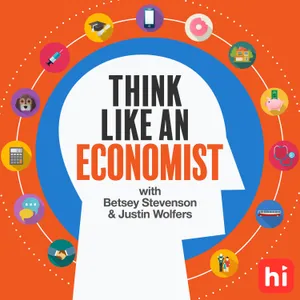
Free Daily Podcast Summary
Platypus Economics with Justin Wolfers: Daily Summaries Delivered
by Betsey Stevenson & Justin Wolfers
From world events to everyday decisions, economics explains it all. Platypus Economics makes it clear, useful, and actually fun.
Latest Episodes
The most recent episodes — sign up to get AI-powered summaries of each one.
- Yesterday24 min
Trump Wants Cheap Money. Why Are Rates Going Up Anyway?
What happens when a president wants lower interest rates—but the economy, inflation, and bond markets are all pushing the other way?In this episode of What Next with Mary Harris from Slate, Justin Wolfers explains why the latest fight over interest rates is about much more than one Federal Reserve meeting.Subscribe:on YouTube 👉 https://youtube.com/platypuseconomicson Substack 👉 https://newsletter.platypuseconomics.comthe Podcast 👉 https://platypuseconomics.com/podcastFollow on Social Media @PlatypusEconomics and @JustinWolfers
- 2 days ago45 min
Why Workers Are Getting Less of What the Economy Produces | Off The Clock
Justin Wolfers and Bloomberg columnist Stacey Vanek Smith slow down to unpack the one number that quietly shapes your paycheck: labor's share of income. For most of modern history, workers took home about two-thirds of the pie. Today it's down to 53% — and the rest goes to the people who own the companies, not the ones who show up to work. Then the stakes get bigger.Justin argues that past $100 million, the only thing money buys is power — and in an election decided by 115,000 votes, one billionaire's checkbook could theoretically swing thousands more. The same logic drives the AI question: the same technology makes your life utopian if you own the robot and dystopian if your boss does.From the first-ever live edition of Off the Clock, recorded at Stanford.Subscribe:on YouTube 👉 https://youtube.com/platypuseconomicson Substack 👉 https://newsletter.platypuseconomics.comthe Podcast 👉 https://platypuseconomics.com/podcastFollow on Social Media @PlatypusEconomics and @JustinWolfers
- 2 days ago18 min
What September's Employment Numbers Really Say | Diving In
The September jobs report landed with a thud: just 29,000 jobs created, well short of the 80,000–90,000 forecasters expected, with July and August both revised down and unemployment ticking up to 4.2%. In this episode of Diving In, Justin Wolfers walks you through why those numbers are disappointing by historical standards — yet why unemployment can still stay low and stable at the same time.Then there's your paycheck. Wage growth has slumped to around 3% — slower than prices — so if you feel like you can't keep up, you're not imagining it. Justin explains what weak wages mean for the Fed, why a rate hike now looks more likely in December than October, and why Wall Street shrugged.Subscribe:on YouTube 👉 https://youtube.com/platypuseconomicson Substack 👉 https://newsletter.platypuseconomics.comthe Podcast 👉 https://platypuseconomics.com/podcastFollow on Social Media @PlatypusEconomics and @JustinWolfers
- 4 days ago33 min
Are Your Financial Mistakes Making Someone Else Rich? | The Professor Is In
Every dollar you spend having your money actively managed by someone in a sports car is paying for that sports car. In this Professor Is In episode, Justin Wolfers takes questions after his keynote at Stanford's Initiative for Financial Decision Making and lands on the core ideas he thinks every personal finance course must teach.Subscribe:on YouTube 👉 https://youtube.com/platypuseconomicson Substack 👉 https://newsletter.platypuseconomics.comthe Podcast 👉 https://platypuseconomics.com/podcast Follow on Social Media @PlatypusEconomics and @JustinWolfers
- 5 days ago19 min
Why Good Money Advice Fails to Land | Diving In
Most of us wash our hands even though we've never seen a germ. But when it comes to personal finance, hardly anyone "washes their hands" — and the mistakes are expensive. Justin Wolfers, back from a Stanford keynote to finance educators, argues that ignoring sound financial advice may cost people somewhere between 2% and 10% of their lifetime consumption — putting it in the same neighborhood as the welfare cost of climate change, and dwarfing the 0.1–1% economists usually assign to business cycles.So why won't people listen? Because the public doesn't trust economists: surveys show they rank barely above politicians in favorability. Justin makes the case that the fix isn't more experts screaming about interest rates — it's using plainer speech, telling better stories, showing real empathy, and laying out one clear action at a time. Here's what's in it for you: the employer match you're leaving on the table, the credit card interest compounding daily while your cash sits in savings, the actively managed fund quietly skimming your returns. Small mistakes, moved across a lifetime, add up to real money — yours.Subscribe:on YouTube 👉 https://youtube.com/platypuseconomicson Substack 👉 https://newsletter.platypuseconomics.comthe Podcast 👉 https://platypuseconomics.com/podcastFollow on Social Media @PlatypusEconomics and @JustinWolfers
- 1 weeks ago14 min
What Airbags Teach Us About Artificial Intelligence | The Professor Is In
AI safety fears are in the news, so Justin Wolfers sits down with producer Augusta to work through the economics — and the ethics — of building guardrails into AI. Using airbags as the analogy, he shows why a "safe" AI, like a car with airbags, works a little less well than one built with no precautions — and why that tradeoff is worth taking when the downside isn't a fender bender but the electricity grid, a biological weapon, or human extinction.Subscribe:on YouTube 👉 https://youtube.com/platypuseconomicson Substack 👉 https://newsletter.platypuseconomics.comthe Podcast 👉 https://platypuseconomics.com/podcastFollow on Social Media @PlatypusEconomics and @JustinWolfers
- 1 weeks ago29 min
How Much Should We Spend to Prevent an AI Catastrophe? | Diving In
The people building the most powerful AI see faster science, better medicines, and explosive economic growth. Others see catastrophe. Justin Wolfers steps into that argument with the one tool that can actually weigh the two: economics.Subscribe:on YouTube 👉 https://youtube.com/platypuseconomicson Substack 👉 https://newsletter.platypuseconomics.comthe Podcast 👉 https://platypuseconomics.com/podcastFollow on Social Media @PlatypusEconomics and @JustinWolfers
- 1 weeks ago24 min
How Accountability Shapes National Borrowing Rates | The Professor Is In
What's the relationship between journalism and borrowing costs?When a local paper shuts down, something surprising happens: the town starts paying higher interest on its debt. Justin Wolfers sits down with producer Augusta to answer viewer questions about why press freedom isn't just a civics-class ideal — it's an economic force that touches your mortgage rate, your government's bond yields, and the whole institutional plumbing that keeps prosperity running. Subscribe:on YouTube 👉 https://youtube.com/platypuseconomicson Substack 👉 https://newsletter.platypuseconomics.comthe Podcast 👉 https://platypuseconomics.com/podcastFollow on Social Media @PlatypusEconomics and @JustinWolfers
Get Platypus Economics with Justin Wolfers summaries in your inbox
Free AI-powered daily recaps. Key takeaways, quotes, and mentions — in a 5-minute read.
Get Free Summaries →Free forever for up to 3 podcasts. No credit card required.
You Might Also Like
Listeners also like.
Planet Money
Explains how economic forces influence everyday life and global events through storytelling and deep dives into surprising topics.
Optimist Economy
Economists analyze U.S. economic challenges like housing, healthcare, and retirement, pairing data and history with practical solutions.

It's The Economy
A weekly breakdown of economic concepts and their real-world impact, explained by experts in short, accessible episodes.

Planet Money Summer School
A crash course in economics that teaches fundamental concepts through real-world examples in everyday life.
Trumponomics
A weekly analysis of Donald Trump’s economic policies and their impact on the U.S. and global economy.

Freakonomics Radio
Stephen J. Dubner explores the hidden side of everyday phenomena, from human behavior to surprising economic forces.

Everybody's Business
A weekly look at business news from Wall Street to unusual ventures, with insights from Bloomberg Businessweek journalists.

Afford Anything | Get Smarter With Money
A weekly discussion on financial freedom covering psychology, income, investing, real estate, and entrepreneurship with experts.
The Economics of Everyday Things
A journalist explores the hidden economic forces behind everyday objects and routines.
Economist Podcasts
Daily global news analysis from correspondents on major international stories.

Monetary Matters with Jack Farley
Expert interviews exploring macroeconomics, financial markets, and monetary policy.
Capitalisn't
Examines the flaws in modern capitalism and explores solutions with insights from economics and business journalism.
About Platypus Economics with Justin Wolfers
From world events to everyday decisions, economics explains it all. Platypus Economics makes it clear, useful, and actually fun.
Customized Recaps
AI-powered recaps with compact key takeaways, quotes, and insights.
Straight to Your Inbox
Get key takeaways from Platypus Economics with Justin Wolfers in a 5-minute read.
Save Hours Every Week
Stay current on your favorite podcasts without falling behind.
Frequently Asked Questions
What is Podzilla's Platypus Economics with Justin Wolfers daily summary?
It's a free AI-powered email that summarizes new episodes of Platypus Economics with Justin Wolfers as soon as they're published. You get the key takeaways, notable quotes, and links & mentions — all in a quick read.
How does the Platypus Economics with Justin Wolfers podcast summary work?
When a new episode drops, our AI transcribes and analyzes it, then generates a personalized summary tailored to your interests and profession. It's delivered to your inbox every morning.
Is this an official Platypus Economics with Justin Wolfers product?
No. Podzilla is an independent service that summarizes publicly available podcast content. We're not affiliated with or endorsed by Betsey Stevenson & Justin Wolfers.
Can I get summaries of other podcasts too?
Absolutely! The free plan covers up to 3 podcasts. Upgrade to Pro for 15, or Premium for 50. Browse our full catalog at /podcasts.
How often does Platypus Economics with Justin Wolfers release new episodes?
Platypus Economics with Justin Wolfers publishes daily. Our AI generates a summary within hours of each new episode.
What topics does Platypus Economics with Justin Wolfers cover?
Platypus Economics with Justin Wolfers covers topics including Science, Education, Business, Courses, Social Sciences. Our AI identifies the specific themes in each episode and highlights what matters most to you.
Start getting Platypus Economics with Justin Wolfers summaries tomorrow morning.
Free forever for up to 3 podcasts. No credit card required.
Free forever for up to 3 podcasts. No credit card required.