Free Daily Podcast Summary
UnMind: Zen Moments With Great Cloud: Daily Summaries Delivered
by Silent Thunder Order
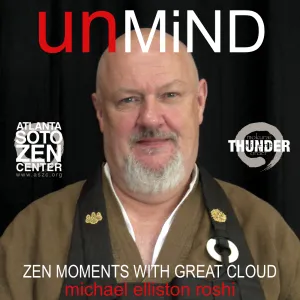
A podcast of original teachings and music by Zenkai Taiun Michael Elliston Roshi, guiding teacher of the Atlanta Soto Zen Center and abbot of the Silent Thunder Order.
Latest Episodes
The most recent episodes — sign up to get AI-powered summaries of each one.
- Aug 5, 202619 min
189: Please Excuse My Dear Aunt Sally
Welcome once again to UnMind, the podcast of Great Cloud, my Zen name, also published on Substack, and as my DharmaByte in the newsletter of the Silent Thunder Order (STO) - visit www.STOrder.org. Please let me know if there is a subject you would like to hear about in a future segment. We are pioneering a creative, collaborative approach to establishing true Zen community (Skt. sangha) in the USA. We invite you to come aboard the raft. If you are in the Southeast, visit www.aszc.org for our schedule. "Excuse Me My Dear Aunt Sally," in case you are unfamiliar with the expression, is a mnemonic I learned in high school for remembering the proper sequence of arithmetical operations to be performed in solving quadratic equations: solve the exponents first; then do the multiplication; then the division; the addition; and finally, any subtraction called for. If you do not follow this sequence exactly, you will not get the right answer. Setting aside for now the question of what may be the larger point of getting the right answer, as well as the question of the potential arbitrariness of the "givens" of any equation — i.e. the initial values attributed to "x" and "y" — XMDAS provides an analogy for the process of solving any problem, from a design-thinking perspective. Let's look at each of the five steps, one at a time. From writing a book to simplifying our life, it works. Determining what value lies under the radical in an exponent (X) is roughly analogous to defining the reason for pursuing any problem, whether in a professional setting or in everyday life. "What's it all about, Alfie?" or "What's the meaning of this?" as my grandfather would sternly demand, when we were caught roughhousing, in my younger days. He didn't realize what a profoundly central question he was asking. I find myself at the intersection of Zen and design-thinking, when confronting the various aspects of daily life. Zen practice and the discipline of design-science, as one of my many mentors, R. Buckminster Fuller, termed it, are both generalist worldviews oriented to a problem-solving mentality as an approach to navigating the challenges of life in our times and developing the specialist skills necessary to that endeavor. Key to finding the best solution to any problem is developing the best definition of the problem. In the professional context, working for the benefit of a client company, the first step may involve redefining the client's own definition of the problem they are asking you to solve. One of the values of using outside consultants is that they ostensibly are not subject to the same tunnel vision of insiders, though of course they may be hindered by another sort of tunnel vision. The process outlined is meant to mitigate against this. Returning to and redefining the focus of the initiative is a crucial part of the process. It should be noted that someone writes down the ideas on a whiteboard for all to see. The second step, doing the multiplication (M), is likewise analogous to brainstorming, engaging in the uninhibited free association of any and all factors that may have a role in developing the final solution to the given problem. This is where thoroughness and lack of prejudging come into play. Best done as a form of playful "What-if" scenarios. The third, division (D), correlates roughly with sorting the various free-ranging comments into groupings or categories of related items, like the familiar "One of these things is not like the others" theme f
- Jul 1, 202614 min
187: Dichotomy
Welcome, once again, to my UnMind podcast, also published on Substack, and as my Dharma Byte in the newsletter of the Silent Thunder Order (visit www.STOrder.org — STO). Please let me know if there is a subject you would like to hear about in a future segment. In STO, we are pioneering a creative, collaborative approach to establishing true Zen community (Skt. sangha) in the USA. This haiku poem, in the traditional 5,7,5-syllable format, I composed some years ago. Memorial day this year happened to coincide with the 51st anniversary of wedding my long-suffering wife, the love of my life, a living bodhisattva of compassion. The bouquet I presented her at our breakfast date had a few buds that had not yet blossomed, until this morning. Recalling my mother often saying, "Don't bring me dead flowers!" I realized that cut flowers are, indeed, if not dead already, then at least dying, as we trim them and put them in a vase, prolonging the decaying process with water and flower food. I revised the haiku to read: Flowers blossom allunaware of their beauty —though doomed to failure Repositioning "all" so that it modifies both "flowers" and "unaware" depending on the reader's interpretation, the last line reflects my mother's cold-eyed insight that cut flowers are no longer living, and that the seeds they produce through pollination have the chance of a snowball in hell of germinating. This brings up another common trope of modernity, the concept of "dichotomies." Giving dying flowers to celebrate the living is a kind of dichotomy, or contradiction. My root teacher, Matsuoka-roshi, was prone to say, "There is no dichotomy in Zen!" I think he was implying that any dichotomy is in the eye — or mind, or both — of the beholder. Suffering from obsessive curiosity as to all things verbal, I looked up the term in the New Oxford American Dictionary bundled with my MacBook Pro: di•chot•o•mynoun (plural dichotomies) [usually in singular] a division or contrast between two things that are or are represented as being opposed or entirely different: a rigid dichotomy between science and mysticism. • Botany repeated branching into two equal parts. One of the most common dichotomies — speaking of a "rigid dichotomy between science and mysticism." and which has become a trope in the USA, and perhaps all over the world — is the expression, "There are two kinds of people in the world..." followed by the speaker's perspective on some defining difference between their worldview and that of others. My rather circular version is "There are two kinds of people in this world: those who believe there are two kinds of people in this world, and those who don't." But seriously, folks... It occurs to me that one of the many such distinctions that do make a difference — particularly on the social level, and with ramifications in the natural sphere — is of religious viewpoints. The "first kind of people in the world" believe that there is a loving creator God watchi
- Jun 3, 202614 min
187: Zen Is Not A Religion
Welcome to another segment of the UnMind podcast and DharmaByte column. I would like to share a concern about something I have witnessed in the propagation of Zen. I am afraid that Zen in America is being categorized — in my opinion, erroneously -— as a "religion," during its second century in the West. As Zen assimilates into the volatile and increasingly violent American cultural milieu — primarily under the influence of Christian and Judaic traditions — Zen is widely, and wildly, misinterpreted as a faith or belief system. Buddhism is counted as one of the world's big four religions, we are told. But unlike Christianity, Islam or Hinduism, as well as Judaism, Buddhism is not a form of theism. I would not go so far as to categorize it as atheism — which is said to be the strongest form of theism — but that the question of the existence or nonexistence of God with a capital "G," or a pantheon of gods with lower "g's," simply does not arise. The traditional Zen saying would classify the term "god" as a "head upon a head" — a superfluous addition — on top of the reality that we all face in life. If god is what god is purported to be — i.e. omniscient and omnipresent — then there is no need to name that concept. More to the point, Zen is not based on a set of beliefs, or doctrine, but upon direct experience, whether yours or that of Buddha — who, after all, was not a Buddhist, any more than Christ was a Christian. Both were human beings, just like you. According to my poor understanding, in Buddhism, no independent, self-existent entity can be found anywhere in the universe. "Universe" is another word for naming the totality, but it is not conceived of as a conscious being, though the phrase "Vairocana Buddha" or "Cosmic Buddha," used to designate the concept, may suggest as much. An AI / Wikipedia summary says: Vairocana is the "Cosmic Buddha" or "Great Illuminator" in Mahayana and Vajrayana Buddhism, representing the ultimate, formless truth (Dharmakaya) and the source from which all Buddhas emanate. Unlike historical figures, he is a universal Buddha, often depicted at the center of the Five Dhyani Buddhas, embodying wisdom and dispelling ignorance. The "he" pronoun here is a tell — that Buddhist cultures of origin were patriarchal if not misogynistic — and any spiritual beings were cast in the mold of humanity. A section in the ancient Ch'an poem, Hsinhsinming—Trust in Mind, refers to this idea of an essential truth from the perspective of personal experience, characteristic of Zen: If the mind makes no discriminationsthe ten thousand things are as they are of single essenceUnderstanding the mystery of this One-essencewe are released from all entanglementsWhen all things are seen equally the timeless Self-essence is reached Note that this underlying unity, or noumenon in today's vernacular, is a thread running through the "ten thousand things," or all phenomena, not just human consciousness. "Timeless Self-essence" may smack of the western concept of an eternal soul, but this assumption amounts to a kind of cultural appropriation, interpreting the 7th century Chinese view of "essence" as a self-existent entity, which is anathema to Buddhism. The historical Buddha, Shakyamuni, testified to the fact that he found no evidence of any such transmigrating soul,
- May 6, 202617 min
186: Category Error
Beginning with this segment of the UnMind podcast and DharmaByte column, I want to depart from commenting on the content of my Substack postings, which feature chapters from a manuscript we anticipate publishing in future, working title: "Speaking With One (Zen) Voice." It is subtitled: "25 Centuries of Buddha-Dharma; 3 Countries of Origin; 9 Dharma Masters; 2 Dozen Teachings; with Commentary by an American ZenElder." Long subtitle, but at least it lets you know what your are in for. Instead, in going forward, I want to introduce you to some of the most mysterious and compelling implications of Buddhism that I have come across in my studies, admittedly limited to those texts that are available in English translation. The first is the startling claim that Buddha enjoys an infinite life span throughout eternity, as testified to in the Lifespan Chapter of the Lotus Sutra, considered to be his last teaching. This use of "buddha" should, I think, be understood in both senses: as it relates to the historical "fully-awakened one," his teachings about reality and his place in it—Buddha with a capital "B"; as well as its application to human consciousness—buddha with a small "b." The latter, generalized as buddha-nature, true of all sentient beings. This message implies that in our conventional wisdom—philosophical and religious beliefs surrounding the "Great Matter" of birth and death—we are making a kind of category error as to first causes and final conclusions. Let's take a look at what a cursory bit of research online has to say about this phrase, consulting Master AI: AI Overview — category errorA category mistake (or category error) is a logical fallacy where an object, property, or concept is mistakenly assigned to a category to which it does not belong. Popularized by philosopher Gilbert Ryle, it often involves treating abstract concepts as if they were phy
- Apr 1, 202613 min
185: Metta Sutra / Loving Kindness Sutra
Welcome to another installment of my Dharma Byte column and UnMind podcast. We have initiated a Substack posting of the unexpurgated reference texts for this series, based on the manuscript for future publication as a book, titled: "Speaking with One (Zen) Voice — 25 Centuries of Buddha-Dharma: 3 Countries of Origin; 9 Dharma Masters; 2 Dozen Teachings — with Commentary by an American Zen Elder" In reviewing the written record of Zen Buddhism spanning some two-and-a-half millennia — from Shakyamuni Buddha in India, through the Chinese transmission legendarily initiated by Bodhidharma, to Japan through Dogen Zenji in the 13th Century, and finally to America through Matsuoka-roshi in the 20th Century — the main thesis of the book is that all these great masters and geniuses of Zen were speaking with one voice, so to say: transmitting the same truth — that is, pointing directly at the nondual reality — through differing languages and cultural idioms. Our mission in propagating Zen today is of the same nature. To borrow a meme from end-user research, we must find a way to come to the same findings, conclusions, and recommendations that they did, following the method of Zen meditation, or zazen; and then find a way to translate — or better, paraphrase — the traditional teachings into the language and idiom of modernity, as well as the cultural context of our times. As my root teacher, Matsuoka-roshi would often say, "Zen is always contemporary." My efforts in publishing in this digital age are dedicated to this proposition. This month's commentary is on the sixth chapter of the book, the "Loving Kindness Sutra," or the Metta Suttain Sanskrit. This is one of the most ecumenical of the teachings attributed to Buddha, and the least controversial in terms of including jargon and ideas to which other religions and philosophies might take exception. Which is one reason it is commonly quoted in interfaith gatherings. But I hope to point out some of the subtler implications of the message. It is one that I have set to music, and a relatively brief passage, so I will quote it here in its entirety: This is what may be accomplished by the one who is wise; who seeks the good and has obtained peace: let one be strenuous upright and sincere; without pride; easily contented and joyous; let one not be submerged by the things of the world. Let one not take upon oneself the burden of riches; let one’s senses be controlled; let one be wise but not puffed up; let one not desire great possessions even for one’s family; let one do nothing that is mean or that the wise would reprove. May all beings be happy! May they be joyous and live in safety; all living beings whether weak or strong; in high middle or low realms of existence; small or great; visible or invisible; near or far; born or yet to be born.May all beings be happy! Let no one deceive another nor despise any being in any state; let none by anger or hatred wish harm to another. Even as a mother at the risk of her life watches over and protects her only child; so with a boundless mind should one cherish all living things; suffusing love over the entire world above below and all around without limit; so let one cultivate an infinite good will
- Mar 4, 202615 min
184: Surangama Sutra
In the introduction to “The Surangama Sutra, A New Translation” by the Buddhist Text Translation Society, the section on “The Reasons for the Teaching” explains six reasons for this particular sutra, the title translating to something like, "heroic march or journey": 1) The first is the importance of balancing learning and meditation practice. The authors explain that Ananda, the interlocutor in this sutra, had “the keenest memory of all the Buddha’s disciples” but thought he could rely solely on his intelligence and neglected his meditation practice, thus making himself vulnerable to the “spell” the young courtesan in the story cast upon him on the way to the meeting with Shakyamuni Buddha.They also explain “The Syllogism and the Tetralemma” as key forms of formal logical argument that the Buddha employs in trying to help Ananda navigate the intricacies of the nondual nature of Mind. Quoting one example, using the five parts of a syllogism: proposition, reason, instance, application and conclusion: 1) Proposition: it is the mind, not the eyes, that see2) Reason: our visual awareness is active even if nothing is being seen;3) Instance drawn from ordinary life: In the Buddha’s words, “If you asked a blind man on the street, ‘Do you see anything?’ he would no doubt answer, ‘All I see is darkness.’”4) Application of the instance: “Reflect upon what that might mean. Although the blind man sees only darkness, his visual awareness is intact.”5) Conclusion: “The eyes themselves simply reveal visible objects; it is the mind that sees, not the eyes.” A brief explanation of the Tetralemma, or Fourfold Negation, follows: In the logic of ancient India, statements could be affirmed, negated, neither affirmed nor negated, and both affirmed and negated. In this fourfold negation, sometimes called the “tetralemma,” (catuskoti), a proposition is asserted to be neither true, nor not true, nor both true and not true, nor neither true nor not true. That’s a lot of neither-nors, for those of us who presume that Zen promotes a positive mental attitude. But they go on to explain that “This formula can serve as a reminder in our practice that all we perceive is empty of any attribute, and so nothing definitive can be asserted about the world and the contents of the mind.” In more recent times, namely the Thirteenth Century, Master Dogen affirms this tenet in several fascicles from his masterwork, the Shobogenzo, including “Self-Fulfilling Samadhi (J. Jijuyu Zammai): All this however does not appear within perception because it is unconstructedness in stillness — it is immediate realization. If practice and realization were two things, as it appears to the ordinary person, each could be recognized separately. But what can be met with recognition is not realization itself, because realization is not reached by a deluded mind. Implicit in this last is that, therefore, any form of recognition, of any
- Feb 4, 202611 min
183: Four Immeasurables part 4 -- Equanimity
The fourth and last of the immeasurables of Buddhism is translated as "equanimity" — in Sanskrit, upekkha. Has the ring of authenticity, doesn’t it? Equanimity, not so much. Too familiar, too ordinary. Besides, nobody really knows what it means. Note how much more authoritative it sounds when we use the Sanskrit. Brings to mind the Peter Sellers scene in The Naked Truth where, trying to pass for Irish in a pub in order to buy a bomb from the IRA says, “Well, we always have the Gaelic…” and after launching into a monologue, is immediately punched in the nose and thrown out of the bar. Fake accent of an Englishman — a dead giveaway. This tendency — to rely heavily on jargon-speak — has a similar deleterious effect in any category of discourse, and can be especially disingenuous in dharma dialog. For one thing, it sets up an “us and them” dichotomy, whether intended or not. It tends to imply that the speaker possesses greater knowledge, moreexpertise — at least in her or his own estimation — and therefore, presumably, the listener is rendered lesser inthat regard. It leverages the faux asymmetry of the relationship. Zen is, or should be, the great equalizer. Boldly brandishing the Zen vernacular implies that I must have mastered its deeper meaning. This is whywe have to keep reminding ourselves that we do not master Zen — in any language — it masters us. Far betterto de-mystify any discussion, eliminating jargon wherever possible, and to rely on our own, direct experience — and plain language — to explore the true meaning of these ancient teachings. We teach each other Buddhism, as Matsuoka Roshi often said. Equanimity brings to mind other terms derived from the same root, such as equipoise, and equilibrium. The good thing about these terms is that they imply something physical, rather than strictly emotional, or mental. The first two syllables derive from “equal,” and the dictionary definitions all refer to balance. So all three would have some connection to the Sanskrit samadhi, one of the more frequently mentioned jargon terms in Buddhism, which loosely means "centered" or "balance." In zazen, if we sit still enough for long enough — and straight enough — we begin to experience equipoise in our upright seated posture, coming into perfect alignment with gravity. All forces of mass and weight come to center around the spine, like the cables supporting a digital cell tower. When we hit that sweet spot in the middle of our stomach, it is as if we are floating off the cushion — free-falling. Equilibrium ensues, profoundly affecting our mental clarity and emotional composure; which leads to equanimity. Eventuallyequanimity manifests even in the social sphere, where relationships with others benefit from less friction and conflict, more harmony. If we regard equanimity — along with loving kindness, compassion, and empathy — as essentially immeasurable, they connect to Master Dogen’s closing lines in Jijuyu Zammai (Self-fulfilling Samadhi): Hundreds of things all manifest original practice from the original faceIt is impossible to measureKnow that even if all the buddhas of the ten directionsAs innumerable as the sands of the GangesExert their strength and with the Buddha’s wisdomTry to measure the merit of one person’s zazenThey will not be
- Jan 7, 202610 min
182: Four Immeasurables part 3 -- Empathy
The third of the Four Immeasurables of Buddhism, as defined online, is sympathetic joy, or empathy, I have long taken to indicate the kind of genuine delight that one can feel at the good fortune of others.Unfortunately, in the context of our prevailing dog-eat-dog, winner-take-all, loser-victim mentality—the emerging tribal take on social and economic standing in America—this fulsome embrace of the success of others has become a diminishingly rare commodity, if we are to believe the daily reporting. Your winning at the game of life means that I must be losing. As if there is a finite store of happiness, from which any one’sindividual achievement, or gain, necessarily takes away from the total available to others.However, if empathy has a more substantial base than its conventionally positive, but dualistic or relativistic meaning—reduced to like-mindedness, or even pity—it must also be operative in negative mode. In certain cases, when and where we are not at all sympathetic, but stubbornly indifferent; we may even find ourselves opposed to others. In which case, empathy for oneself tends to trump — no pun —any possibility of empathy for others.Shakyamuni Buddha was reputed to have been able to read minds. One of the ten honorifics accorded him during his lifetime translates as something like “controller of men,” which is roughly the meaning of Matsuoka Roshi’s first dharma name, “Soyu.” Empathy plays a central, determinative part in this ability to win friends and influence people. But our inborn, naturally altruistic empathy may need an occasional boost from the nurturing, tender loving care of meditation.My supposition is that Siddhartha Gautama was already a highly sensitive youngster, becomingestranged from existence itself, owing to the pain and suffering he had witnessed in his life. Like MasterDogen, he witnessed the death of his own mother at an early age. But his realization in meditation during hismid-thirties must have engendered the emergence of an even deeper and broader sensibility for the suffering of others. He clearly was a natural empath, born of magnanimous and nurturing mind, innately endowed with compassionate traits. Which were only amplified in, and by, his intense meditation under that fig tree.In the Surangama Sutra, attributed to Buddha, he suggests that it is possible, and even probable, that his followers will themselves develop such paranormal powers (Skt. siddhis) through their own meditation. One of which would be this ability to “know others’ minds.” In the Fifty Warnings attached to this sutra, cautionary tales against falling into certain states of delusion (Skt. mara), he offered specific spoiler alerts,flagging the likelihood of getting stuck at various stages of the process, ten in each of the Five Skandhas.By misinterpreting fifty gobsmackingly vivid meditative experiences that Buddha describes in meticulous detail—occurring at remote passes on the parallel track of transcending ordinary perception of reality—your average monk or nun might come to believe, falsely, that they are now fully enlightened. When, truth be told, they still have a long way to go, before finally getting off the train at anuttara samyak sambodhi, the end of the line.He also admonished them not to demonstrate any such abilities to others, as their audience might also get the wrong idea, that gaining such seemingly mystical or magical powers is what the practice of the Noble Eightfold Path is all about. Too soon. Wait—there’s more. Just keep on keepin’ on, no matter whateverfantastic or fabulous transformation seems to have taken place. You are not home free, yet.It is worth mentioning that at this time there were apparently any number of clever charlatans andwould-be magicians plying their trades of trickery in the public marketplace, masquerading as genuine sages (Skt. sadhu) or seers. Buddha apparently did not want his followers to settle for a “me too” position in the contemporaneous war of ideas, competing for the attention of the hoi polloi.This throughline of the teaching further suggests that in Buddha’s case, he had persevered, making itall the way down and throug
About UnMind: Zen Moments With Great Cloud
A podcast of original teachings and music by Zenkai Taiun Michael Elliston Roshi, guiding teacher of the Atlanta Soto Zen Center and abbot of the Silent Thunder Order.
Customized Recaps
AI-powered recaps with compact key takeaways, quotes, and insights.
Straight to Your Inbox
Get key takeaways from UnMind: Zen Moments With Great Cloud in a 5-minute read.
Save Hours Every Week
Stay current on your favorite podcasts without falling behind.
Frequently Asked Questions
What is Podzilla's UnMind: Zen Moments With Great Cloud daily summary?
It's a free AI-powered email that summarizes new episodes of UnMind: Zen Moments With Great Cloud as soon as they're published. You get the key takeaways, notable quotes, and links & mentions — all in a quick read.
How does the UnMind: Zen Moments With Great Cloud podcast summary work?
When a new episode drops, our AI transcribes and analyzes it, then generates a personalized summary tailored to your interests and profession. It's delivered to your inbox every morning.
Is this an official UnMind: Zen Moments With Great Cloud product?
No. Podzilla is an independent service that summarizes publicly available podcast content. We're not affiliated with or endorsed by Silent Thunder Order.
Can I get summaries of other podcasts too?
Absolutely! The free plan covers up to 3 podcasts. Upgrade to Pro for 15, or Premium for 50. Browse our full catalog at /podcasts.
What topics does UnMind: Zen Moments With Great Cloud cover?
UnMind: Zen Moments With Great Cloud covers topics including Religion & Spirituality, Spirituality, Buddhism, Philosophy, Culture, Society & Culture. Our AI identifies the specific themes in each episode and highlights what matters most to you.
Start getting UnMind: Zen Moments With Great Cloud summaries tomorrow morning.
Free forever for up to 3 podcasts. No credit card required.
Free forever for up to 3 podcasts. No credit card required.