Free Daily Podcast Summary
Very Bad Wizards: Daily Summaries Delivered
by Tamler Sommers & David Pizarro
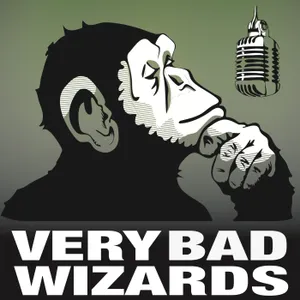
Very Bad Wizards is a podcast featuring a philosopher (Tamler Sommers) and a psychologist (David Pizarro), who share a love for ethics, pop culture, and cognitive science, and who have a marked inability to distinguish sacred from profane. Each podcast includes discussions of moral philosophy, recent work on moral psychology and neuroscience, and the overlap between the two.
Latest Episodes
The most recent episodes — sign up to get AI-powered summaries of each one.
- 4 days ago1h 3m
The Lotus Eaters Episode 10: Like-Minded [unlocked]
Tamler and Dave devote a full episode to Book 19 of The Odyssey. In what is one of the most emotionally intense chapters of the story so far, Odysseus continues his Cretan lies, has a long tête-à-tête with Penelope, and finally gets recognized by his former slave Eurycleia.
- 1 weeks ago49 min
The Lotus Eaters Episode 9: An Ode to Argos [unlocked]
Tamler and David discuss The Odyssey books 17 & 18, in which Telemachus and Odysseus, back at home, continue their deception and put everyone to the test. Everyone except for Argos, that is, because Argos was (and will always be) a very good boy.
- 1 weeks ago1h 37m
Episode 341: Psychology Ranked (With Paul Bloom)
David and Tamler welcome Paul Bloom back to the show for a definitive ranking of classic psychology experiments. Will the shocking results of the Milgram studies earn him a posthumous 'S' ranking? How far will Zimbardo fall? Is the Stroop effect a super effect? Did you see the Gorilla in these notes? Which is more plausible: that we have Paul Bloom as a guest, or we have Paul Bloom and a guest and it's a banger? Note: no dogs or baby monkeys were harmed in the making of this episode. Final Tier List Rankings (episode spoilers!) List of Studies Ranked (all links are to pages on wikipedia.org) Milgram Shock Studies Tversky and Kahneman Linda Problem Loftus Car Crash/False Memory Ekman Basic Emotions Studies Good Samaritan Study Invisible Gorilla Study Shepard Figure Rotation Harlow's Monkeys Seligman Learned Helplessness Asch Conformity Stroop Effect Dunning-Kruger Effect Visual Cliff Experiment Zimbardo Prison Experiment False Belief Task Bem ESP Study Marshmallow Test Bargh Elderly Walking Prime
- 2 weeks ago1h 2m
The Lotus Eaters Episode 8: Home and Homelessness [unlocked]
In this episode, Tamler and David discuss The Odyssey Books 15 & 16, in which father and son (and father figure and son) are reunited, and in which the Odysseus and Telemachus start planning their revenge against the suitors.
- 3 weeks ago55 min
The Lotus Eaters Episode 7: Lying Odysseus [unlocked]
Tamler and David discuss Books 13 & 14 of The Odyssey. Odysseus finally makes it to Ithaca and meets up with Athena, gets a disguise, and has a chat with his most loyal slave Eumaeus.
- 3 weeks ago1h 15m
Episode 340: The Sublime Folly of Hope
Why do baseball players have so many superstitious rituals compared to athletes in other sports? How does this relate to the magic rituals of the Trobriand Islanders of Melanesia? We dive into Bronisław Malinowski's classic 1925 paper "Magic, Science, and Religion" along with George Gmelch's "Baseball Magic," two articles that explore the role of religion and superstition as a response to the absence of control. And speaking of losing control, we do a conceptual analysis of "crashing out" in the opening segment- analytic philosophy at its finest. Malinowski, B. (1925). Magic, science and religion. In J. Needham (Ed.), Science, religion and reality (pp. 19–84). The Macmillan Company. [link to our Amazon S3 so everyone can find it easily] Gmelch, G. (2012). Baseball magic. In J. Spradley, D. W. McCurdy, & R. Shandy (Eds.), Conformity and conflict: Readings in cultural anthropology (14th ed., pp. 266–274). Pearson. (Original work published 1971).
- Sep 3, 202658 min
The Lotus Eaters Episode 6: Psyches [unlocked]
David and Tamler discuss The Odyssey's iconic books 11 & 12, in which our hero visits the ghosts of the dead, hears the call of the sirens, and survives a no-win situation.
- Aug 27, 202654 min
The Lotus Eaters Episode 5: Circe, Cyclops, and Psychedelics (Oh My!)
Tamler and David discuss the action-packed books 9 & 10 of The Odyssey, in which Odysseus makes some questionable choices, the crew encounters cannibal giants, and Circe casts her porcine spells.
Get Very Bad Wizards summaries in your inbox
Free AI-powered daily recaps. Key takeaways, quotes, and mentions — in a 5-minute read.
Get Free Summaries →Free forever for up to 3 podcasts. No credit card required.
You Might Also Like
Listeners also like.
Philosophize This!
Explores the history of philosophy by breaking down key thinkers and ideas in chronological order for a general audience.
The UnMute Podcast
Philosophers discuss current social and political issues with insight, humor, and a drive for change.

Psychiatry & Psychotherapy Podcast
Explores psychiatry and psychotherapy through interviews with experts, trainees, and individuals sharing lived mental health experiences.
Inner Cosmos with David Eagleman
Neuroscientist David Eagleman examines how the brain interprets reality through science, stories, and interviews.

Forum Borealis
In-depth interviews with authors and thinkers on unconventional topics in history, science, philosophy, and politics.
The Psychology Podcast
Explores human potential and possibility through conversations with scientists, thinkers, and self-actualized individuals.
The Emerald
Explores myth, story, and imagination to reframe modern discourse on society, science, art, and the human experience.
In Our Time: Philosophy
Discusses philosophers, theories, and key themes in philosophy, from altruism to Wittgenstein.
The Magic Story Podcast
Explores the characters, worlds, and stories of the Magic: The Gathering Multiverse for longtime players and new fans alike.
Stuff To Blow Your Mind
Explores the strange edges of science, consciousness, and reality through neuroscience, cosmology, evolution, and emerging technology.
Ologies with Alie Ward
Alie Ward interviews scientists about their fields, from volcanoes to slug sex, blending humor and curiosity to explore how the world works.
The Grimerica Show
Casual conversations with fringe thinkers on spirituality, alternative history, and UFOs.
About Very Bad Wizards
Very Bad Wizards is a podcast featuring a philosopher (Tamler Sommers) and a psychologist (David Pizarro), who share a love for ethics, pop culture, and cognitive science, and who have a marked inability to distinguish sacred from profane. Each podcast includes discussions of moral philosophy, recent work on moral psychology and neuroscience, and the overlap between the two.
Customized Recaps
AI-powered recaps with compact key takeaways, quotes, and insights.
Straight to Your Inbox
Get key takeaways from Very Bad Wizards in a 5-minute read.
Save Hours Every Week
Stay current on your favorite podcasts without falling behind.
Frequently Asked Questions
What is Podzilla's Very Bad Wizards daily summary?
It's a free AI-powered email that summarizes new episodes of Very Bad Wizards as soon as they're published. You get the key takeaways, notable quotes, and links & mentions — all in a quick read.
How does the Very Bad Wizards podcast summary work?
When a new episode drops, our AI transcribes and analyzes it, then generates a personalized summary tailored to your interests and profession. It's delivered to your inbox every morning.
Is this an official Very Bad Wizards product?
No. Podzilla is an independent service that summarizes publicly available podcast content. We're not affiliated with or endorsed by Tamler Sommers & David Pizarro.
Can I get summaries of other podcasts too?
Absolutely! The free plan covers up to 3 podcasts. Upgrade to Pro for 15, or Premium for 50. Browse our full catalog at /podcasts.
How often does Very Bad Wizards release new episodes?
Very Bad Wizards publishes weekly. Our AI generates a summary within hours of each new episode.
What topics does Very Bad Wizards cover?
Very Bad Wizards covers topics including Philosophy, Culture, Society & Culture. Our AI identifies the specific themes in each episode and highlights what matters most to you.
Start getting Very Bad Wizards summaries tomorrow morning.
Free forever for up to 3 podcasts. No credit card required.
Free forever for up to 3 podcasts. No credit card required.