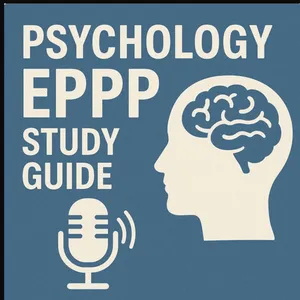
Free Daily Podcast Summary
EPPP Study Podcast-: Daily Summaries Delivered
by Circle Of Insight Productions
A podcast to prepare for the EPPP licensing exam
Latest Episodes
The most recent episodes — sign up to get AI-powered summaries of each one.
- Today3 min
Piaget vs. Erikson vs. Kohlberg: Developmental Stages You Need to Know
Piaget, Erikson, and Kohlberg all proposed stage theories of development, but the EPPP may test whether you can distinguish what each theorist believed was actually developing. This episode compares Piaget’s cognitive stages, Erikson’s psychosocial conflicts, and Kohlberg’s levels of moral reasoning using memorable examples and high-yield exam distinctions. You’ll also learn a simple strategy for identifying the correct theorist when an EPPP question gives you a developmental vignette.
- 3 days ago3 min
Broca vs. Wernicke: Brain Areas You Need to Know for the EPPP
One of the easiest ways to lose points on the EPPP is to know that Broca’s and Wernicke’s areas are involved in language—but confuse what each one actually does.
- 4 days ago3 min
Broca vs. Wernicke: Brain Areas You Need to Know for the EPPP
Broca’s area and Wernicke’s area are two of the most frequently tested language regions in neuropsychology. For the EPPP, you need to distinguish expressive from receptive language problems, recognize the major aphasia patterns, and understand cerebral lateralization. This episode gives you the high-yield differences and memory tricks you need for exam day.
- 1 weeks ago3 min
EPPP Study Guide: Forensic Psychology, Ethics, and Standards
EPPP Study Guide: Forensic Psychology, Ethics, and Standards
- 2 weeks ago6 min
EPPP Study Guide: Supervisory & Consultative Relationships
Clinical supervision is a formal, hierarchical relationship where the supervisor acts as a gatekeeper and retains ultimate legal, clinical, and ethical responsibility for patient welfare. Under this framework, supervisors are subject to direct liability for inadequate oversight and vicarious liability for the negligent actions of their trainees. In contrast, professional consultation operates as a non-hierarchical, collaborative, and time-limited interaction where the consultant does not assume direct clinical responsibility for the consultee's client. Managing these arrangements effectively requires explicit informed consent contracts, careful avoidance or containment of dual roles, and structured frameworks such as Gerald Caplan’s consultation model
- 3 weeks ago3 min
EPPP High-Yield: Competence Is Not Licensure—Scope of Practice vs. Scope of Competence
The EPPP tests whether you can tell the difference between what the law lets you do and what your training actually prepared you to do. APA 2.01 and the competence standards turn on matching education, supervised experience, and current skill to the specific population, problem, and modality in front of you. Clinical vignettes almost always hinge on knowing when to consult, document expansion, or refer rather than stretch.
- 4 weeks ago9 min
Telepsychology and Technology-Mediated Services: Consent, Security, and Jurisdictional Competence (EPPP Study Guide)
This guide expands the provided material into a structured, exam-ready resource. Each major concept includes an expanded definition, a simplified explanation accessible to a 16-year-old, and a detailed clinical or research example relevant to EPPP decision-making. Telepsychology is not a casual substitute for in-person care. The same APA Ethics Code applies, alongside additional responsibilities involving technology, client location, and crisis response. Informed consent must be tailored to virtual care and revisited as needed, rather than simply copied from an office-based consent form. Clinicians must use technology that meets applicable privacy and security requirements, including HIPAA requirements when relevant. This involves evaluating encryption, platform settings, and whether a Business Associate Agreement is required. The suitability of a platform depends on its configuration, contractual protections, and applicable law, rather than its name alone. As a general rule, psychologists must be authorized to practice where the client is physically located at the time of service. PSYPACT can expand that authority when the participating jurisdictions and the psychologist’s credentials meet its requirements. Remote practice also requires a written emergency plan that addresses the client’s current location, local crisis resources, and the steps to take if the connection drops during a high-risk situation. Competence under Standard 2.01 includes knowing how to use the technology and recognizing when legal, ethical, or security concerns make its use inappropriate. Psychologists must understand the limits of their authority to practice across state lines and the risks of using unsecured tools. Email, texting, social media, cloud storage, AI tools, wearables, and apps introduce additional concerns about privacy, access to information, and data ownership that must be evaluated, disclosed as appropriate, and managed. Telepsychology expands access to care while introducing substantial ethical and legal complexity. For EPPP preparation, the central issue is not simply whether a psychologist can operate a virtual platform, but whether they understand the professional responsibilities that accompany its use.
- Aug 30, 202616 min
The Four Lobes: A High-Yield Neuroanatomy Review for the EPPP
This EPPP study episode breaks down the four primary lobes of the brain — frontal, parietal, temporal, and occipital — and the core functions tested on exam day. It covers the key structures and lesion effects most likely to show up on multiple-choice items, with an eye toward how neuroanatomy connects to conditions like ADHD and autism spectrum disorder. A quick, focused review designed to lock in the neuroanatomy basics before moving into more applied biopsychology content.
Get EPPP Study Podcast- summaries in your inbox
Free AI-powered daily recaps. Key takeaways, quotes, and mentions — in a 5-minute read.
Get Free Summaries →Free forever for up to 3 podcasts. No credit card required.
You Might Also Like
Listeners also like.
Speaking of Psychology
Explores recent psychological research and its applications to daily life.
Psychiatry & Psychotherapy Podcast
Explores psychiatry and psychotherapy through interviews with experts, trainees, and individuals sharing lived mental health experiences.
De Facto Leaders
Pediatric therapist Dr. Karen Dudek-Brannan shares evidence-based strategies for educators and clinicians to support student growth and leadership.

People Who Read People: A Behavior and Psychology Podcast
Explores human behavior through interviews with experts in psychology, law, sports, and poker.

Huberman Lab
Explores neuroscience and science-based tools for understanding and improving brain function, behavior, and health.
Parenting With Psychology
A clinical psychologist offers practical parenting advice based on psychological research to help families manage challenges and strengthen relationships.
The CopDoc Podcast: Aiming for Excellence in Leadership
Examines police leadership and innovation through interviews with experts focused on improving law enforcement and community relationships.

Finance Exam Prep
A podcast that breaks down tax certification exams into clear, focused lessons covering key concepts and common pitfalls.

All Ears English Podcast
American English lessons covering idioms, cultural norms, and conversation skills for intermediate to advanced learners.
First Bite: Fed, Fun, Functional SLP Insights
Pediatric speech therapy insights covering feeding, swallowing, AAC, and early language development for clinicians and caregivers.
In the Interim...
Explores Bayesian statistics and adaptive clinical trial designs in medical research with insights from industry experts.
The Internet Book of Critical Care Podcast
A podcast exploring critical care medicine through chapter discussions and evidence-based updates from The Internet Book of Critical Care.
About EPPP Study Podcast-
A podcast to prepare for the EPPP licensing exam
Customized Recaps
AI-powered recaps with compact key takeaways, quotes, and insights.
Straight to Your Inbox
Get key takeaways from EPPP Study Podcast- in a 5-minute read.
Save Hours Every Week
Stay current on your favorite podcasts without falling behind.
Frequently Asked Questions
What is Podzilla's EPPP Study Podcast- daily summary?
It's a free AI-powered email that summarizes new episodes of EPPP Study Podcast- as soon as they're published. You get the key takeaways, notable quotes, and links & mentions — all in a quick read.
How does the EPPP Study Podcast- podcast summary work?
When a new episode drops, our AI transcribes and analyzes it, then generates a personalized summary tailored to your interests and profession. It's delivered to your inbox every morning.
Is this an official EPPP Study Podcast- product?
No. Podzilla is an independent service that summarizes publicly available podcast content. We're not affiliated with or endorsed by Circle Of Insight Productions.
Can I get summaries of other podcasts too?
Absolutely! The free plan covers up to 3 podcasts. Upgrade to Pro for 15, or Premium for 50. Browse our full catalog at /podcasts.
How often does EPPP Study Podcast- release new episodes?
EPPP Study Podcast- publishes weekly. Our AI generates a summary within hours of each new episode.
What topics does EPPP Study Podcast- cover?
EPPP Study Podcast- covers topics including Science, Education, Fitness, Health & Fitness, Mental Health, Social Sciences. Our AI identifies the specific themes in each episode and highlights what matters most to you.
Start getting EPPP Study Podcast- summaries tomorrow morning.
Free forever for up to 3 podcasts. No credit card required.
Free forever for up to 3 podcasts. No credit card required.