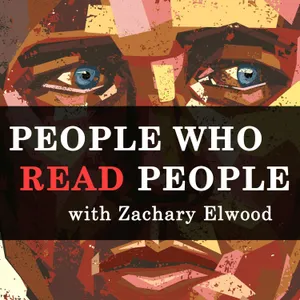
Free Daily Podcast Summary
People Who Read People: A Behavior and Psychology Podcast: Daily Summaries Delivered
by Zachary Elwood
This is a podcast about deciphering human behavior and understanding why people do the things they do. I, Zach Elwood, talk with people from a wide range of fields about how they make sense of human behavior and psychology. I've talked to jury consultants, interrogation professionals, behavior researchers, sports analysts, professional poker players, to name a few. There are more than 135 episodes, many of them quite good (although some say I'm biased).
Latest Episodes
The most recent episodes — sign up to get AI-powered summaries of each one.
- Today1h 11m
A private investigator's tips on reading and manipulating people
A talk with Andrew Thompson, a New York City-area private investigator and a researcher of criminal behavior and interrogation techniques. Andrew shares how he gets people talking while lacking the authority and command of a police badge, and what studying FBI crime cases and interrogations taught him about linguistic clues to deception in people’s stories. We also discuss his research into criminal personality categories and how that may be tied to linguistic patterns. We discuss how mistaking signs of anxiety for guilt or deception can send investigators down very wrong paths; and how aggressive questioning can contribute to false confessions and other negative outcomes. We discuss why appearing uninterested in an important revelation from someone can sometimes encourage them to reveal more, and other tips on influencing and manipulating people in order to achieve investigative results. And Andrew discusses how AI advances have affected the investigative industry. Hosted by Simplecast, an AdsWizz company. See pcm.adswizz.com for information about our collection and use of personal data for advertising.
- 6 days ago44 min
She’s certified by Joe Navarro in body language: How has it helped her?
On this podcast I sometimes explore the “behavior expert” industry. One thing I'm curious about is the value people say that they’ve received from “behavior expert” trainings and certifications. This is a talk with Gallia Winkler, a psychological coach and a behavioral student of Joe Navarro’s; she’s been certified in his Body Language Expert Program. I ask her about what drives her interest in nonverbal behavior, what value she believes she’s gotten from Navarro's teachings, and how those teachings have helped her in her personal and professional life. Hosted by Simplecast, an AdsWizz company. See pcm.adswizz.com for information about our collection and use of personal data for advertising.
- 1 weeks ago1h 54m
Are all “behavior experts” frauds? On Paul Ekman, Joe Navarro, the Behavior Panel, and more
A talk with former CIA officer Kent Clizbe about the exaggerated, irresponsible claims made by many self-described “behavior experts,” focusing especially on Paul Ekman, Joe Navarro, microexpressions, and attempts to detect deception from body language. We discuss why facial expressions and physical movements cannot be interpreted through a universal dictionary, how cultural and individual differences make behavioral judgments especially difficult, and why nervousness or discomfort is rarely meaningful evidence of guilt or deception in high-stakes situations. We examine the failed TSA SPOT program, the influence of shows like “Lie to Me” (which was loosely based on Paul Ekman’s work), and the lack of convincing real-world, high-stakes examples supporting “behavior expert” claims. We also explore how behavioral hunches can contribute to tunnel vision, false confessions, and wrongful convictions; why games like poker can offer a more constrained and useful setting for behavioral reads; and why the most actionable information in high-stakes situations almost always comes from what people say, what they leave out, and how their statements compare with known facts. Hosted by Simplecast, an AdsWizz company. See pcm.adswizz.com for information about our collection and use of personal data for advertising.
- Aug 28, 20261h 28m
Army Psy-Op veteran talks influence, blowback, psy-op myths, and more
A talk with an Army Psychological Operations soldier about what military psy-op work really involves—and how different the reality is from many people's ideas about the nature of that work. We discuss his psy-op work in Afghanistan, why credibility and truth are usually much more persuasive and effective than deception, and fascinating historical operations involving surrender appeals, staged intelligence, and Vietnam’s eerie “ghost tapes.” We also explore the legal and ethical limits on influencing Americans, how social media has blurred those boundaries, how foreign influence campaigns exploit political polarization, and why “PSYOP” has become an all-purpose label for conspiracy theories. Finally, we examine the red flags that can help you identify self-proclaimed-but-deceptive military-persuasion experts (like Chase Hughes) who fabricate and exaggerate their credentials and experience to sell their psychology- and behavior-focused training and products. Hosted by Simplecast, an AdsWizz company. See pcm.adswizz.com for information about our collection and use of personal data for advertising.
- Aug 28, 20261h 34m
Army Psy-Op veteran talks influence, blowback, psy-op myths, and more
A talk with an Army Psychological Operations soldier about what military psy-op work really involves—and how different the reality is from popular ideas about mind control and secret manipulation of the public. We discuss his psy-op work in Afghanistan, why credibility and truth are usually much more persuasive and effective than deception, and fascinating historical operations involving surrender appeals, staged intelligence, and Vietnam’s eerie “ghost tapes.” We also explore the legal and ethical limits on influencing Americans, how social media has blurred those boundaries, how foreign influence campaigns exploit political polarization, and why “PSYOP” has become an all-purpose label for conspiracy theories. Finally, we examine the red flags that can help you identify self-proclaimed-but-deceptive military-persuasion experts (like Chaes Hughes) who fabricate and exaggerate their credentials and experience to sell their psychology- and behavior-focused training and products. Learn more about your ad choices. Visit megaphone.fm/adchoices
- Aug 12, 20261h 0m
Can computers spot lies better than humans?, with Bennett Kleinberg
Can machines spot a lie better than we can? I talk with psychology researcher Bennett Kleinberg, whose work brings together psychology, machine learning, natural-language processing, and deception detection. We explore why humans are bad at identifying lies, which verbal clues may reveal deception—and why nervousness is often misleading. Bennett explains how liars use detail and how level of detail can be a clue to deception, the fact that deception usually involves a good amount of truth in the mix and what that means, and what happens when human judgment is combined with AI. We also discuss the risks of the mysterious black-box nature of some machine learning systems, and how smarter, research-informed interviewing techniques could transform criminal investigations. For more details and a transcript, see this episode’s entry at www.behavior-podcast.com. Hosted by Simplecast, an AdsWizz company. See pcm.adswizz.com for information about our collection and use of personal data for advertising.
- Aug 11, 20261h 0m
Can computers detect lies better than humans?, with Bennett Kleinberg
Can machines spot a lie better than we can? I talk with psychology researcher Bennett Kleinberg, whose work brings together psychology, machine learning, natural-language processing, and deception detection. We explore why humans are bad at identifying lies, which verbal clues may reveal deception—and why nervousness is often misleading. Bennett explains how liars use detail and how level of detail can be a clue to deception), the fact that deception usually involves a good amount of truth in the mix and what that means, and what happens when human judgment is combined with AI. We also discuss the risks of the mysterious black-box nature of some machine learning systems, and how smarter, research-informed interviewing techniques could transform criminal investigations. For more details and a transcript, see this episode’s entry at www.behavior-podcast.com. Learn more about your ad choices. Visit megaphone.fm/adchoices
- Aug 1, 20261h 23m
Inside a Scientology e-meter auditing session, with Chris Shelton
Former Scientologist Chris Shelton spent thousands of hours using the e-meter to "audit" fellow members of the Church—but what does the device actually measure, and why do Scientologists trust it as an infallible guide to the truth? Chris takes us inside a typical auditing session, explaining the personal questions auditors ask, the needle movements they watch for, and what they believe those reactions reveal. We compare the e-meter with the polygraph, explore how relentless questioning can produce false memories and confessions, and examine how auditors can sincerely believe they are helping even when their methods become coercive or abusive. If you’re interested in Scientology, interrogation, or behavior reading, this is a fascinating look at how a simple machine can acquire enormous power through belief. For more on this topic, check out Chris’s podcast Speaking of Cults. Hosted by Simplecast, an AdsWizz company. See pcm.adswizz.com for information about our collection and use of personal data for advertising.
Get People Who Read People: A Behavior and Psychology Podcast summaries in your inbox
Free AI-powered daily recaps. Key takeaways, quotes, and mentions — in a 5-minute read.
Get Free Summaries →Free forever for up to 3 podcasts. No credit card required.
You Might Also Like
Listeners also like.
The Psychology Podcast
Explores human potential and possibility through conversations with scientists, thinkers, and self-actualized individuals.
Speaking of Psychology
Explores recent psychological research and its applications to daily life.

Influence Anyone
Explores the psychology of influence through expert interviews on mindset, persuasion, branding, and leadership.
Growth Mindset Psychology: The Science of Self-Improvement
Explores the science behind lasting self-improvement through psychology, neuroscience, and timeless wisdom traditions.
Decoded | Unlock The Secrets of Human Behavior, Emotion and Motivation
Explores subconscious patterns behind human behavior and provides tools to rewire destructive cycles and live with intention.
The Jordan B. Peterson Podcast
Explores how values, religion, and culture shape individuals and society through interviews and lectures.

The Jordan Harbinger Show
Conversations with top performers across fields, distilling actionable insights on success, relationships, and personal growth.
Mayim Bialik's Breakdown
Explores the intersection of science and spirituality through conversations on consciousness, healing, and unexplained phenomena.

Psychiatry & Psychotherapy Podcast
Explores psychiatry and psychotherapy through interviews with experts, trainees, and individuals sharing lived mental health experiences.
Inner Cosmos with David Eagleman
Neuroscientist David Eagleman examines how the brain interprets reality through science, stories, and interviews.
How to Be a Better Human
Conversations exploring practical ways to improve yourself and connect more meaningfully with others, inspired by TED’s Ideas blog.
Huberman Lab
Explores neuroscience and science-based tools for understanding and improving brain function, behavior, and health.
About People Who Read People: A Behavior and Psychology Podcast
This is a podcast about deciphering human behavior and understanding why people do the things they do. I, Zach Elwood, talk with people from a wide range of fields about how they make sense of human behavior and psychology. I've talked to jury consultants, interrogation professionals, behavior researchers, sports analysts, professional poker players, to name a few. There are more than 135 episodes, many of them quite good (although some say I'm biased).
Customized Recaps
AI-powered recaps with compact key takeaways, quotes, and insights.
Straight to Your Inbox
Get key takeaways from People Who Read People: A Behavior and Psychology Podcast in a 5-minute read.
Save Hours Every Week
Stay current on your favorite podcasts without falling behind.
Frequently Asked Questions
What is Podzilla's People Who Read People: A Behavior and Psychology Podcast daily summary?
It's a free AI-powered email that summarizes new episodes of People Who Read People: A Behavior and Psychology Podcast as soon as they're published. You get the key takeaways, notable quotes, and links & mentions — all in a quick read.
How does the People Who Read People: A Behavior and Psychology Podcast podcast summary work?
When a new episode drops, our AI transcribes and analyzes it, then generates a personalized summary tailored to your interests and profession. It's delivered to your inbox every morning.
Is this an official People Who Read People: A Behavior and Psychology Podcast product?
No. Podzilla is an independent service that summarizes publicly available podcast content. We're not affiliated with or endorsed by Zachary Elwood.
Can I get summaries of other podcasts too?
Absolutely! The free plan covers up to 3 podcasts. Upgrade to Pro for 15, or Premium for 50. Browse our full catalog at /podcasts.
How often does People Who Read People: A Behavior and Psychology Podcast release new episodes?
People Who Read People: A Behavior and Psychology Podcast publishes weekly. Our AI generates a summary within hours of each new episode.
What topics does People Who Read People: A Behavior and Psychology Podcast cover?
People Who Read People: A Behavior and Psychology Podcast covers topics including Science, News, Fitness, Health & Fitness, Mental Health, Social Sciences. Our AI identifies the specific themes in each episode and highlights what matters most to you.
Start getting People Who Read People: A Behavior and Psychology Podcast summaries tomorrow morning.
Free forever for up to 3 podcasts. No credit card required.
Free forever for up to 3 podcasts. No credit card required.