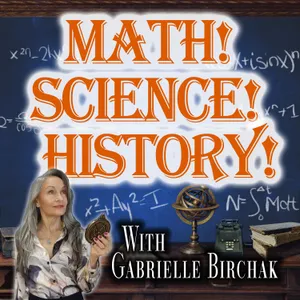
Free Daily Podcast Summary
Math! Science! History!: Daily Summaries Delivered
by Gabrielle Birchak
Why do some scientific breakthroughs look different up close than they do in our textbooks? How did math quietly shape the modern world? Math! Science! History! explores the human side of discovery, including the rivalries, the failed attempts, the bold ideas, and the marginalized voices behind the equations and experiments that changed science, technology, and everyday life. Hosted by Gabrielle Birchak, who holds degrees in mathematics and journalism, the show connects codebreaking, astronomy, probability, physics, and innovation to the world we live in today. If you enjoy science stories, historical investigations, and clear math grounded in context, clarity, and research, this show is for you.
Latest Episodes
The most recent episodes — sign up to get AI-powered summaries of each one.
- 5 days ago25 min
The Library of Alexandria: What Really Happened?
After nearly seven years and more than 200 episodes, this is where I say goodbye to Math! Science! History!. The podcast began with my book Hypatia: The Sum of Her Life and grew into something far beyond what I imagined. Thank you for listening, for following me through all of these stories, and for giving me the opportunity to explore the history behind mathematics, science, and the people and ideas that changed our understanding of the world. The podcast may be ending, but the archive, the research, and the stories will remain here for you to explore. And perhaps it's fitting that our final story is about the Library of Alexandria. The Library didn't survive as an institution, but its ideas survived because people copied them, studied them, translated them, and passed them on. I hope Math! Science! History! can do something similar. As I move into whatever comes next, I'll leave you with the original meaning of carpe diem: to pluck the day, to savor what is ripe and ready, and then use that harvest to plant the seeds for the next season. Thank you for seven incredible years. Carpe diem, my friends. 3 Things You'll Learn 1. The Library of Alexandria was not necessarily destroyed by Caesar. Caesar's fire in 48 BCE certainly destroyed books, but the ancient evidence does not establish that it destroyed the entire Library. Alexandria's scholarly institutions and collections continued afterward. 2. The Library disappeared through a much longer and more complicated process. The Royal Library, Mouseion, Serapeum, and other collections existed in different forms and at different times. Political instability, changing patronage, violence, destruction, and institutional decline all played roles in the gradual disappearance of Alexandria's great scholarly institutions. 3. Knowledge can survive even when institutions disappear. The books of Alexandria did not remain together as one intact collection, but ideas survived through copying, translation, and transmission. Centuries later, scholars working across the Byzantine, Syriac, Persian, and Islamic worlds helped preserve and transmit Greek knowledge into Arabic and beyond. 🔗 Explore more on our website: mathsciencehistory.com 📚 To buy my book Hypatia: The Sum of Her Life on Amazon, visit https://a.co/d/g3OuP9h 🌍 Let's Connect!Bluesky: https://bsky.app/profile/mathsciencehistory.bsky.social <span style= "mso-bidi-font-family: 'Times New Roman'; mso-bidi-theme-fon
- 1 weeks ago14 min
Descartes' Secret Notebook: The Hidden Math Behind Topology
René Descartes is famous for Cogito, ergo sum and his revolutionary approach to philosophy and mathematics. But he also left behind a mysterious 16-page manuscript written in code. In this episode, we uncover the story of Descartes' hidden notebook, the waterlogged manuscripts that nearly disappeared, and Gottfried Wilhelm Leibniz's dramatic attempt to decipher the coded pages. At the center of the mystery is a mathematical relationship involving the vertices, edges, and faces of three-dimensional shapes. Today expressed as V − E + F = 2, this relationship became associated with Leonhard Euler and is closely connected to the development of topology. We'll explore why this mathematics mattered in the seventeenth century, why Descartes may have feared revealing his ideas, and how the mathematics of shapes and connectivity eventually became relevant to our modern digital world. 3 Things You'll Learn 1. Why Descartes wrote in code The story behind Cogitata Privata, Descartes' "I proceed masked" philosophy, and the secret manuscript that disappeared after Leibniz examined it. 2. How V − E + F = 2 works Using cubes and pyramids, we'll see how vertices, edges, and faces combine to produce a remarkably consistent mathematical relationship. 3. Why this old mathematics still matters The episode connects the history of polyhedra to topology and modern applications such as 3D computer graphics and digital modeling. Sources Amir D. Aczel, Descartes's Secret Notebook: A True Tale of Mathematics, Mysticism, and the Quest to Understand the Universe David S. Richeson, Euler's Gem: The Polyhedron Formula and the Birth of Topology Peter J. Federico, Descartes on Polyhedra: A Study of the "De solidorum elementis" Matthew L. Jones, The Good Life in the Scientific Revolution Frances A. Yates, The Rosicrucian Enlightenment Johannes Kepler, The Harmony of the World René Descartes, Discourse on the Method Full source list appears in the episode transcript at https://www.MathScienceHistory.com 📚 To buy my book Hypatia: The Sum of Her Life on Amazon, visit https://a.co/d/g3OuP9h 🌍 Let's Connect!Bluesky: https://bsky.app/profile/mathsciencehistory.bsky.social Instagram: https://www.instagram.com/math.science.history <p class="MsoNormal" style= "text-indent: 0in; line-he
- 1 weeks ago12 min
SCIENCE NEWS TUESDAY: A New Species is Discovered
Scientists have officially identified a new wild cat species in Bolivia and a new snake species from New Guinea—and one of them is named after Guns N' Roses guitarist Slash. But these discoveries are about much more than a cute cat and a rock-star snake. In this episode of How Did We Get Here? Science News Tuesday, we look at how scientists identify new species, why some animals can remain hidden in plain sight for centuries, and how modern genetics and genomics are changing our understanding of the tree of life. From Carl Linnaeus and the origins of scientific classification to DNA analysis and museum specimens, we explore how scientists went from naming what they could see to uncovering evolutionary relationships that aren't visible to the naked eye. And there's a bigger question: How many species are still out there waiting to be recognized—and could some disappear before we even know they exist? Three Things You'll Learn 1. How a "new" species can hide in plain sight. 2. Why a snake was named after Slash, and how Slash rocks out for animals! 3. How DNA changed the way we classify life 4. Why discovering species matters for conservation Welcome to the jungle: newly-discovered snake named after Slash from Guns N' Roses - Field Museum https://www.scientificamerican.com/article/see-the-first-new-species-of-cat-discovered-in-more-than-a-century-its-adorable 🔗 Explore more on our website: mathsciencehistory.com <span style= "mso-bidi-font-size: 12.0pt; font-family: 'Se
- 3 weeks ago22 min
GH Hardy, Ramanujan, The Search For Proof And The Discovery Of Truth
GH Hardy was a character. He had qualities that were odd, yet endearing. He was a rigorous mathematician. Yet, when he received a letter from Srinivasa Ramanujan, he changed. He learned a new way of equating mathematics, and developed a deep and loving respect for an individual who was never formally educated in math. This is the story of a man who had the ability to see genius in another person, even when that person couldn't see it in themselves. 🔗 Explore more on our website: mathsciencehistory.com 📚 To buy my book Hypatia: The Sum of Her Life on Amazon, visit https://a.co/d/g3OuP9h 🌍 Let's Connect!YouTube: Math! Science! History! - YouTube Bluesky: https://bsky.app/profile/mathsciencehistory.bsky.social Instagram: https://www.instagram.com/math.science.history Facebook: https://www.facebook.com/mathsciencehistory LinkedIn: https://www.linkedin.com/company/math-science-history/ <span style= "mso-bidi-font-size: 12.0pt; font-family: 'Segoe UI Emoji',sans-serif; mso-fareast-font-family: 'Times New Rom
- Sep 3, 202612 min
E230 REPOST The Resilience of Subrahmanyan Chandrasekhar
In this episode of Math, Science, History, host Gabrielle Birchak does a repost about Subrahmanyan Chandrasekhar, a 19-year-old prodigy whose curiosity during a two-week sea voyage in 1930 led to a groundbreaking discovery. While sailing from India to England, Chandrasekhar, armed only with a notebook and the vast expanse of the ocean, began questioning the fate of stars after they exhausted their fuel. Explore more on our website: mathsciencehistory.com To buy my book Hypatia: The Sum of Her Life on Amazon, visit https://a.co/d/g3OuP9h Enjoying the Podcast? If you love Math, Science, History, here's how you can help: Leave a review – It helps more people discover the show! Share this episode with friends & fellow history buffs! Subscribe on your favorite podcast platform ☕ Support the Show! We are sponsored by Coffee!! https://shorturl.at/bHIsc Checking out our merch: https://www.mathsciencehistory.com/the-store Music: All music is public domain and has no Copyright and no rights reserved. On Matters of Consequence from The Little Prince by Lloyd Rodgers Until next time, carpe diem!
- Aug 27, 202619 min
REPOST: When Women Gather
What happens when women gather? Throughout the eighteenth century, women across Europe began creating intellectual communities where they could discuss science, mathematics, philosophy, politics, literature, and medicine. During the Enlightenment, these gatherings helped women challenge the idea that intellectual discovery belonged exclusively to men. Women such as Laura Bassi, Maria Gaetana Agnesi, Émilie du Châtelet, Catharine Macaulay, Caroline Herschel, and many others built on one another's work and created a path for future generations of women in science. And that path matters far beyond science. When women gather, exchange knowledge, encourage one another, and make room for the next woman, they can change science, politics, education, and society. Resources • Read the original "When Women Gather" article • Download my list of eighteenth-century women in science • Laura Bassi, University of Bologna • Émilie du Châtelet's translation of Newton's Principia, Bibliothèque nationale de France • A Vindication of the Rights of Woman, Library of Congress • Caroline Herschel, Royal Astronomical Society A Note from Gabrielle After seven years of making Math! Science! History!, I am putting the podcast on hiatus. This isn't goodbye. It is a pause, and a chance to step back, breathe, and think about what comes next. Thank you for gathering with me all these years. As this episode reminds us, when women gather, we share knowledge, empower one another, and create paths for the women who come after us. And that is a pretty wonderful place to pause. 🔗 Explore more on our website: mathsciencehistory.com 📚 To buy my book Hypatia: The Sum of Her Life on Amazon, visit https://a.co/d/g3OuP9h 🌍 Let's Connect!Bluesky: https://bsky.app/profile/mathsciencehistory.bsky.social</spa
- Aug 21, 20268 min
FLASHCARDS! Three Lessons from a Tobacco Engineer on Curiosity and Identity
Your job is what you do, not who you are - and that distinction could change your life. Gabrielle Birchak spotlights the astonishing story of Paul Tannery, a daytime engineer in the French tobacco administration whose after-hours curiosity helped reshape the history of mathematics and science.If you've ever felt like your work has started to define your entire identity, this episode offers a powerful reset. Gabrielle makes the case for building a second life around curiosity, hobby, and learning - not as a luxury, but as a source of well-being, purpose, and even legacy.You'll discover: · Why meaningful interests outside work are linked to lower stress and higher life satisfaction · How hobbies and non-work activities can strengthen mental health across cultures · Why curiosity matters even when it never becomes "productive" · The surprising power of sharing what you learn with other people · A simple 20-minute weekly practice to become more than your job title Gabrielle connects Tannery's life to modern research, including findings on psychological detachment from work and global studies on hobby engagement and mental well-being. The result is a short episode with a big message: the things you pursue for joy may end up shaping your life more than the work that pays the bills. Perfect for anyone feeling stuck in their role, hungry for a fuller identity, or looking for permission to follow their curiosity again. If you need a reminder that learning for its own sake still matters, this one will leave you thinking differently about your time, your talents, and your future. Notable Quotes · "Your job is what you do, but it does not have to be who you are." · "Curiosity is not a distraction from life. It is one of the things that makes life
- Aug 18, 202633 min
Paul Tannery: The Tobacco Engineer Who Changed the History of Math
Paul Tannery didn't begin his career intending to become one of the most influential historians of mathematics. He trained as an engineer at the École Polytechnique and spent much of his professional life working in France's state tobacco administration. But after work, Tannery pursued a very different passion: ancient mathematics, astronomy, philosophy, and the history of science. What began as an intellectual interest became a lifetime of scholarship. 3 TAKEAWAYS: 1. How Paul Tannery transformed a personal passion into groundbreaking scholarship 2. Why Tannery believed historical claims needed evidence, not repetition 3. Why your "side interest" may matter more than you realize RESOURCES: Paul Tannery — MacTutor History of Mathematics Archive René Taton, "Paul Tannery (1843–1904) Palatine Library - Complesso Monumentale della Pilotta 🔗 Explore more on our website: mathsciencehistory.com 📚 To buy my book Hypatia: The Sum of Her Life on Amazon, visit https://a.co/d/g3OuP9h 🎧 Enjoying the Podcast? ☕ Support the Show: Coffee!! PayPal <span style= "mso-bidi-font-size: 12.
Get Math! Science! History! summaries in your inbox
Free AI-powered daily recaps. Key takeaways, quotes, and mentions — in a 5-minute read.
Get Free Summaries →Free forever for up to 3 podcasts. No credit card required.
You Might Also Like
Listeners also like.
Relatively Prime: Stories from the Mathematical Domain
A podcast featuring stories from the world of mathematics.
Opinionated History of Mathematics
Reinterprets the history of mathematics, challenging mainstream views and exploring its connections to science, philosophy, and education.
A Brief History of Mathematics
Marcus du Sautoy explores the lives and ideas of influential mathematicians and their impact on modern science.

The Quanta Podcast
A weekly discussion on groundbreaking science and math stories with Quanta's editorial team.
Math & Physics Podcast
Two University of Toronto students discuss topics in math and physics.
The Joy of Why
Mathematicians and astrophysicists explore fundamental scientific and mathematical questions with leading researchers.
The Joy of x
A mathematician explores the lives and ideas of leading scientists through in-depth conversations.

The Rest Is Science
Hannah Fry and Michael Stevens explore the strange and overlooked questions at the boundary of scientific understanding.

Inquiring Minds
Explores the intersection of science and society through critical thinking and in-depth analysis.
Unsung Science
Explores the overlooked stories behind major scientific and technological breakthroughs and the people who created them.
In Our Time: Science
Discusses scientific principles, theories, and influential figures in the development of science.

Science Quickly
A bite-sized science podcast exploring discoveries with journalists and experts.
About Math! Science! History!
Why do some scientific breakthroughs look different up close than they do in our textbooks? How did math quietly shape the modern world? Math! Science! History! explores the human side of discovery, including the rivalries, the failed attempts, the bold ideas, and the marginalized voices behind the equations and experiments that changed science, technology, and everyday life. Hosted by Gabrielle Birchak, who holds degrees in mathematics and journalism, the show connects codebreaking, astronomy, probability, physics, and innovation to the world we live in today. If you enjoy science stories, historical investigations, and clear math grounded in context, clarity, and research, this show is for you.
Customized Recaps
AI-powered recaps with compact key takeaways, quotes, and insights.
Straight to Your Inbox
Get key takeaways from Math! Science! History! in a 5-minute read.
Save Hours Every Week
Stay current on your favorite podcasts without falling behind.
Frequently Asked Questions
What is Podzilla's Math! Science! History! daily summary?
It's a free AI-powered email that summarizes new episodes of Math! Science! History! as soon as they're published. You get the key takeaways, notable quotes, and links & mentions — all in a quick read.
How does the Math! Science! History! podcast summary work?
When a new episode drops, our AI transcribes and analyzes it, then generates a personalized summary tailored to your interests and profession. It's delivered to your inbox every morning.
Is this an official Math! Science! History! product?
No. Podzilla is an independent service that summarizes publicly available podcast content. We're not affiliated with or endorsed by Gabrielle Birchak.
Can I get summaries of other podcasts too?
Absolutely! The free plan covers up to 3 podcasts. Upgrade to Pro for 15, or Premium for 50. Browse our full catalog at /podcasts.
How often does Math! Science! History! release new episodes?
Math! Science! History! publishes 2x weekly. Our AI generates a summary within hours of each new episode.
What topics does Math! Science! History! cover?
Math! Science! History! covers topics including Science, History, Mathematics. Our AI identifies the specific themes in each episode and highlights what matters most to you.
Start getting Math! Science! History! summaries tomorrow morning.
Free forever for up to 3 podcasts. No credit card required.
Free forever for up to 3 podcasts. No credit card required.