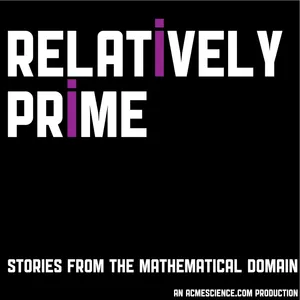
Free Daily Podcast Summary
Relatively Prime: Stories from the Mathematical Domain: Daily Summaries Delivered
by ACMEScience
A mathematics podcast from ACMEScience featuring the best math stories from the world of maths
Latest Episodes
The most recent episodes — sign up to get AI-powered summaries of each one.
- Mar 25, 20251h 6m
Relatively Prime Seminar: Funding
We are back with a new series in Relatively Prime that we are going to be calling Seminars! The seminars are going to be going out into the Relatively Prime feed off and on and they will be tackling the big questions about mathematics. In other words the seminars will be more of a meta conversation about what goes on in mathematics and our first conversation is going to be about funding in mathematics. If you have a question that you want to hear a seminar about please just email seminar@acmescience.com Joining our host Sam Hansen to discuss funding in mathematics we have Carrie Diaz Eaton (BSky), a mathematician, an associate professor of digital and computational studies at Bates College, and the executive director of the Rios Institute, Drew Lewis (BSky), a mathematician and independent consultant, and Jude Higdon (BSky), the chief operation officers of the Institute for Quantitative Study of Inclusion, Diversity and Equity or QSide (BSky). Timeline of Executive Actions from the American Institute of Biological Sciences Resources Mentioned in the Seminar:Breakdown of Federal Mathematics FundingFederal Funding for all Disciplines ReportCruz ReportSilicon Reckoner NewsletterScience Magazine Reporting on Howard Hughes Medical Institute Inclusive Excellence Fellows Program CancellationNIH in Your StateIbberson Spreadsheet Music:l
- Oct 30, 202458 min
Carry the Two: Mathematics & Voting
Sorry for the unannounced hiatus that has now lasted for four years, but our host and producer Sam Hansen has had a lot of life events and changes that led them to not be able to devote the time they needed to making the show. We are planning on coming back very soon, but until then please enjoy this episode about the Mathematics of Voting from the podcast Carry the Two made by the Institute for Mathematical and Statistical Innovation where Sam is the new Director of Communications and Engagement. Download Episode ACMEScience · RelPrimeCt2 Mix ——————– IMSI is very proud to announce that Carry the Two is back and with a new co-host, IMSI’s new Director of Communications and Engagement Sam Hansen! Subscribe: Apple Podcasts • Spotify • RSS We in the United States are deep in the middle of a major national election, and over half of the world’s population also have elections in 2024. This is why Carry the Two is going to focus on the intersection of mathematics and democracy for our new season. In this episode, the first episode of our mathematics and democracy season, we speak with mathematician Ismar Volić of Wellesley College and Director of the Institute for Mathematics and Democracy and Victoria Mooers, an economics PhD student at Columbia University. We discuss what mathematics has to say about our current plurality voting system, how switching to preference ranking votings systems could limit polarization and negative campaigning, and why too much delegation causes problems for those pushing for Liquid Democracy. Find our transcript here: Google Doc or .txt file Curious to learn more? Check out these additional links: Ismar Volić Making Democracy Count: How Mathematics Improves Voting, Electoral Maps, and Representation Institute for Mathematics and Democracy Victoria Mooers Liquid Democracy. Two Experiments on Delegation in Voting Follow more of IMSI’s work: www.IMSI.institute, (twitter) @IMSI_institute, (mastodon) https://sciencemastodon.com/@IMSI, (instagram) IMSI.institute Music by Blue Dot Sessions and lowercase n The Institute for Mathematical and Statistical Innovation (IMSI) is funded by NSF grant DMS-1929348
- Nov 9, 202035 min
#BlackInMathWeek
On this episode of Relatively Prime, Michole Enjoli and Noelle Sawyer take over for Black in Math Week. They talk to Brea Ratliff and José Vilson, two Black math educators, and discuss what it’s like to be Black in math, what they would say to people making common false statements about Black students in math, and better hopes and dreams for Black students. Black in Math week is November 8th – 13th, 2020! It’s a week on Twitter to celebrate community among and uplift Black mathematicians. Check us out @BlackInMath for updates! Brea is currently pursuing a PhD at Auburn University in Math Education. She is the founder of and CEO Me to the Power of Three and is a past president of the Benjamin Banneker association. José is located in New York City and is the founder and executive director of EDUcolor. He is currently pursuing a Ph.D. at Teachers College at Columbia University in Sociology and Education. We talk a bit about Afrofuturism in this episode. If you’re interested in checking out more on Afrofuturism, try SpaceBox, a STEM escape room to save astronauts from a virus, and this special minizine from Bitten Magazine! Download Episode Music:Kirshmusic Transcript: Michole: This is Relatively rime Black in Math Week in the mathematical domain. I’m one of your host, Michole Enjoli. Noelle: And I’m Noelle Sawyer Noelle: We’e here as a part of Black and Math Week to talk to some Black math educators. I’m actually an assistant professor of math at Southwestern university in Georgetown, Texas. So I, myself, am a math educator, I’m from The Bahamas and I’ve also got a few teachers in my family line there. So education has got a special place in my heart. Michole: And again, Michole Enjoli, I’m a mathematician, educator ,and STEM edutainment producer. I originally hailed from Atlanta, Georgia, and Seattle, Washington, but now I’m in Ann Arbor working on my PhD in math education. I also have a lot of educators in my family and I always like to make it be known that I’m an educator before mathematician. Noelle: I talked to Bria Ratliff for this podcast and I asked her how she introduces herself to strangers. If you’re sitting next to a stranger in the before times, right. When we did that and someone and someone asked you, like, what do you do? How do you answer them? Brea: Um , generally I say that I’m a mathematics educator and can we go back for a minute? Cause the before times, and the Hunger Games was reference just really gives me life right now. (laughs) Um, that that pretty much is mathematics or STEM educator, I think is probably the best collective term for all the things that I do. And I’m involved with. I have been an administrator and a coach and currently delving deeper into research and have been a research coordinator and whatnot for a while. And I have my own business also, I’m consulting on mathematics and STEM, but at the heart of what I do, I am a mathematics educator.</p
- Nov 1, 202036 min
Black Girl Mathgic
On this episode of Relatively Prime Samuel is joined by Brittany Rhodes the creator of the amazing monthly mathematics subscription box Black Girl Mathgic. They discuss where the idea of the box came from, what comes in the boxes each month, and why everyone benefits when young Black women are centered in mathematics. If you want to help Brittany and Black Girl Mathgic reach more people you can help out by donating a box. ACMEScience · Relatively Prime: Black Girl Mathgic Download the episode Music:Broke For Free (Night Owl) (Only Instrumental) [The podcast episode file has been update to remove repeated narration segments]
- Mar 31, 202026 min
The Somervilles
On this episode of Relatively Prime Samuel is joined by Brigitte Stenhouse of the Open University to talk about the life and times of Mary, and William, Somerville. Download the episode Music:Lowercase n
- Feb 29, 202010 min
3 Scenes from the Life of Benjamin Banneker
On this month’s Relatively Prime Samuel shares three scenes from the life of Benjamin Banneker. One about a clock, one about a solar eclipse projectsion, and one about a puzzle. You can learn more about the life of Benjamin Banneker by checking out the book The Life of Benjamin Banneker by Silvio Bendini which was essential in the production of this episode and it is available to borrow for free on the Internet Archive or if you prefer a physical copy your library may have it on hand and if they do not the amazing system that is Interlibrary Loan should be able to provide for you. Download the Episode Music:Chris ZabriskeRodrigonzálezGriffin Lundinᕲi̾r̾੮ Porcelai̾n Transcript: 3 Scenes from the life of Benjamin Banneker Scene 1: The Clock It was only the second timepiece he had ever seen. And, to those of us alive today, the first we would have thought of as such, as this was a pocket watch and the other a simple sundial. That Benjamin Banneker had never seen a watch before is not that surprising. After all he was a teenaged free African American man in the colony of Maryland in either the late 1740s or early 1750s. While there were a number of clockmakers who provided their works to farmers in the Chesapeake region, it will likely not come as a surprise that a family where the father is a freed slave and the mother the daughter of a freed slave and a formerly indentured servant were not among those clockmakers clients, though the family’s tobacco farm did allow them to be self-sufficient. The most likely thing is that Benjamin found a merchant or a traveler who not only owned a pocket watch but was willing to let a precocious free young black man take a good long look at it. There is no historical evidence of what exactly Benjamin did when he set his eyes upon the second timepiece he had ever seen but we can make some educated guesses. We can guess that he was able to get a good look at workings within. We can guess that he felt fascinated by these workings. We can guess his mind raced trying to understand how such workings were able to keep time so well that they could be relied upon. We can guess he wanted a clock of his own. We can make those guesses because of what we know. We know that after seeing the pocket watch Benjamin began to draw out the internal workings of gears and wheels and springs. We know he then worked on calculating the sizes and ratios needed to make a clock function correctly. And we know he used those drawings and calculations to make a clock all his own. Fashioned primarily out of wood he carved himself, up to and including the gears, the clock Benjamin Banneker designed and built at 21 worked until he died at 74. Scene 2: The Projection More than 30 years of working the farm later Benjamin Banneker learns about, and quickly falls in love with, astronomy. At first it is only through occasional discussions with neighbor and noted amateur astronomer George Ellicott, likely with some nighttime telescopic adventures. Never one to do things in half measure though, Benjamin wanted more. Which he got in 1788, when George offered to lend to him a telescope, some drafting instruments, and many astronomical texts. George also offered Benjamin lesson to help him through t
- Feb 15, 202044 min
Truthiness
In this live episode recorded at the 2020 Joint Mathematics Meetings in Denver Samuel Hansen talks about the truth behind the stories we all tell in mathematics. In order to do this they will investigate the actual facts of the Galois narrative, have a conversation about where and when the decimal point appeared with Glen Van Brummelen of Quest University, and play a game of 2 lies and a truth with some people in the audience. 2 Lies and a Truth Slide The podcast was recorded live on the occupied land of the Arapaho and Cheyenne Nations. Taken finally through violence in the Sand Creek Massacre. Colorado is also the current headquarters of the Southern Ute and Mountain Ute Tribes. There was also parts recorded on the occupied lands of the Anishinaabeg (including Odawa, Ojibwe, and Boodewadomi) and Wyandot tribes. Download the Episode Music:lowercase nSteve O’Brien
- Dec 31, 201932 min
2019 Year End Review
To wrap up the year 2019 Samuel Hansen is joined by Katie Steckles and Christian Lawson-Perfect of Aperiodical.com to discuss some of the big stories from the world of mathematics this year.The stories they discuss include Hannah Fry’s Royal Institution Christmas Lectures, Karen Uhlenbeck’s Abel Prize, year two of the Big Internet Math Off, a new multiplication algorithm, a new pi digits record, 33 and 42 as the sum of three cubes, and advances toward solutions for Collatz and Riemann. Download the episodeMusic:lowercase n
Get Relatively Prime: Stories from the Mathematical Domain summaries in your inbox
Free AI-powered daily recaps. Key takeaways, quotes, and mentions — in a 5-minute read.
Get Free Summaries →Free forever for up to 3 podcasts. No credit card required.
You Might Also Like
Listeners also like.

The Quanta Podcast
A weekly discussion on groundbreaking science and math stories with Quanta's editorial team.
Opinionated History of Mathematics
Reinterprets the history of mathematics, challenging mainstream views and exploring its connections to science, philosophy, and education.
The Joy of x
A mathematician explores the lives and ideas of leading scientists through in-depth conversations.
Math & Physics Podcast
Two University of Toronto students discuss topics in math and physics.
A Brief History of Mathematics
Marcus du Sautoy explores the lives and ideas of influential mathematicians and their impact on modern science.
My Favorite Theorem
A mathematician discusses their favorite theorem and what they enjoy pairing with it.
From First Principles
Breaks down major science stories weekly, explaining the mechanics behind physics, space, AI, and biotech developments.
The Joy of Why
Mathematicians and astrophysicists explore fundamental scientific and mathematical questions with leading researchers.

Cosmos in a Pod
Explores space, science, philosophy, and technology to reveal the wonders of the universe and humanity's place within it.

Babbage from The Economist
A weekly exploration of science and technology, from AI and genetics to space travel, featuring interviews with leading researchers.
Curious Cases
Hannah Fry and Dara Ó Briain use science to solve listeners' questions and mysteries.
The Universe Speaks in Numbers
Conversations with leading physicists and mathematicians exploring the deep connections between mathematics and the laws of nature.
About Relatively Prime: Stories from the Mathematical Domain
A mathematics podcast from ACMEScience featuring the best math stories from the world of maths
Customized Recaps
AI-powered recaps with compact key takeaways, quotes, and insights.
Straight to Your Inbox
Get key takeaways from Relatively Prime: Stories from the Mathematical Domain in a 5-minute read.
Save Hours Every Week
Stay current on your favorite podcasts without falling behind.
Frequently Asked Questions
What is Podzilla's Relatively Prime: Stories from the Mathematical Domain daily summary?
It's a free AI-powered email that summarizes new episodes of Relatively Prime: Stories from the Mathematical Domain as soon as they're published. You get the key takeaways, notable quotes, and links & mentions — all in a quick read.
How does the Relatively Prime: Stories from the Mathematical Domain podcast summary work?
When a new episode drops, our AI transcribes and analyzes it, then generates a personalized summary tailored to your interests and profession. It's delivered to your inbox every morning.
Is this an official Relatively Prime: Stories from the Mathematical Domain product?
No. Podzilla is an independent service that summarizes publicly available podcast content. We're not affiliated with or endorsed by ACMEScience.
Can I get summaries of other podcasts too?
Absolutely! The free plan covers up to 3 podcasts. Upgrade to Pro for 15, or Premium for 50. Browse our full catalog at /podcasts.
How often does Relatively Prime: Stories from the Mathematical Domain release new episodes?
Relatively Prime: Stories from the Mathematical Domain publishes monthly. Our AI generates a summary within hours of each new episode.
What topics does Relatively Prime: Stories from the Mathematical Domain cover?
Relatively Prime: Stories from the Mathematical Domain covers topics including Science, Education, Mathematics, Natural Sciences. Our AI identifies the specific themes in each episode and highlights what matters most to you.
Start getting Relatively Prime: Stories from the Mathematical Domain summaries tomorrow morning.
Free forever for up to 3 podcasts. No credit card required.
Free forever for up to 3 podcasts. No credit card required.