Free Daily Podcast Summary
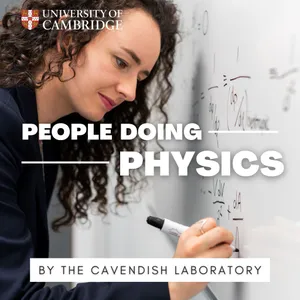
People doing Physics: Daily Summaries Delivered
by Cavendish Laboratory
As fascinating as physics can be, it can also seem very abstract, but behind each experiment and discovery stands a real person trying to understand the universe. Join us at the Cavendish Laboratory as we get up close and personal with the researchers, technicians, students, teachers, and people that are the beating heart of Cambridge University’s Physics department. If you want to know what goes on behind the doors of a Physics department, are curious to know how people get into physics, or simply wonder what physicists think and dream about, listen in!
Latest Episodes
The most recent episodes — sign up to get AI-powered summaries of each one.
- 3 days ago55 min
Thulani Rachia & Oli Shorttle in conversation
Each year, we invite the Cavendish Arts Science Fellow to join us for a conversation with one of the scientists whose ideas helped shape their time in Cambridge.Today’s episode is one of those conversations, and I’m delighted to welcome artist Thulani Rachia and planetary geoscientist Oliver – Oli - Shorttle to the studio.Thulani is the fifth Cavendish Arts Science Fellow. A South African artist working across moving image, performance, music composition and sculpture, he explores two closely connected ideas: critique and recovery. His work, which has been shown nationally and internationally, questions how communities can reclaim what colonial violence has erased or displaced.Over the past year, Thulani has immersed himself in conversations with Cambridge scientists though the annual Cavendish Arts Science Fellowship at Girton College. One of the strongest connections to emerge was with Oli, sparked by a deceptively familiar material central to both their work: graphite.Oli is Professor of Planetary Geoscience, working across the Institute of Astronomy and the Department of Earth Sciences at the University of Cambridge. Combining fieldwork, geochemical analysis and modelling, he investigates the chemical and dynamic processes unfolding within planetary interiors and crusts.What follows is a conversation that begins with the graphite in a pencil and quickly expands…to darkness and light, lightning and deep time, the origins of life and the histories held within materials. Along the way, Thulani and Oli ask what artists and scientists can reveal to one another when they resist easy answers and follow a shared question… wherever it leads.Useful Links:Explore Thulani's work : obuyile - Thulani Rachia StudioIf you would like to learn more about Oli's Planetary Chemistry research visit Planetary Chemistry – University of Cambridge | Oliver ShorttleLearn more about the Cavendish Arts Science programme and fellowship at Cavendish Arts ScienceThulani refers to the project: RE Handle with care. Watch the videos: https://vimeo.com/1215845563 and https://vimeo.com/1215854527Share and join the conversationHelp us get better by taking our quick survey. Your feedback will help us understand how we can improve in the future. Thank you!If you like this episode don’t forget to rate it and leave a review on your favourite podcast app. It really helps others to find us.Any comment about the podcast or question you would like to ask our physicists, email us at podcast@phy.cam.ac.uk or join the conversation on Twitter using the hashtag #PeopleDoingPhysics.Episode creditsHosts: Vanessa BismuthRecording and editing: Chris BrockThis podcast uses the following third-party services for analysis: OP3 - https://op3.dev/privacy
- Jun 4, 202651 min
Didier Queloz: the importance of getting it wrong
Today, we have the privilege of being joined by one half of the team behind what is arguably one of humankinds’ epochal breakthroughs – the first observation of a planet outside our solar system. Both a professor at the University of Zurich and Jacksonian Professor of Natural Philosophy here at Cambridge, Didier Queloz began his research career by achieving the great aim of all PhD students; a publication in Nature. Since then, the techniques and instruments he pioneered have led to the identification of over 4,000 other exoplanets and revolutionised our understanding of planetary formation.His more recent work looks into the detection of earth-like planets, understanding their habitability, and the search for universal life more widely. He is now Director of the Leverhulme Centre for Life in the Universe here at Cambridge – an interdisciplinary hub looking at how life emerges, evolves, and persists in the cosmos.In the course of his career, he has published hundreds of papers and been recipient of numerous prestigious awards, including the unarguably most famous of all scientific awards – the Nobel Prize, which he shared with Michel Mayor and James Peebles in 2019 "for contributions to our understanding of the evolution of the universe and Earth’s place in the cosmos".Together we talk about Didier's route into physics, his work looking at one of the profound questions of whether humankind is alone in the universe, and whether he replaced the bike that made him miss the call from the Nobel Prize committee.Useful links:To learn more about Didier's current research, visit Home | Leverhulme Centre for Life in the UniverseWatch Didier's interviews for The Nobel Prize: Didier Queloz – Interview - NobelPrize.orgShare and join the conversationHelp us get better by taking our quick survey. Your feedback will help us understand how we can improve in the future. Thank you!If you like this episode don’t forget to rate it and leave a review on your favourite podcast app. It really helps others to find us.Any comment about the podcast or question you would like to ask our physicists, email us at podcast@phy.cam.ac.uk or join the conversation on Twitter using the hashtag #PeopleDoingPhysics.Episode creditsHost: Jacob ButlerRecording and editing: Chris BrockThis podcast uses the following third-party services for analysis: OP3 - https://op3.dev/privacy
- May 7, 202646 min
Montu Saxena: insights from a condensed-matter physicist
Today we are delighted to be joined by Siddharth Shanker Saxena, known to friends and colleagues as Montu, a condensed-matter physicist at the Cavendish Laboratory and head of the Cambridge Central Asia Forum. By Montu’s own admission, he was never able to pick a side, and so has spent his whole life exploring the world of superconductivity, all the while advocating for international relations and anthropology.Together we talk about the moments that shape a scientific life: learning to believe you belong, the role of mentoring, and what “failure" can teach you. We also dig into the enduring puzzle of superconductivity: how to explain it simply, why it continues to captivate physicists, and how to stay comfortable saying “we don’t know.”Useful Links:Montu talked in depth about superconductivity in this podcast for Quanta Magazine: Will Better Superconductors Transform the World? | Quanta MagazineHe was also recently featured in this Varsity article: Meet the Cambridge physicist who advocates for the humanities | VarsityTo explore Montu's work : Siddharth Saxena | Jesus College in the University of CambridgeAnd finally, to learn more about the Cambridge Central Asia Forum, visit Cambridge Central Asia Forum |Share and join the conversationHelp us get better by taking our quick survey. Your feedback will help us understand how we can improve in the future. Thank you!If you like this episode don’t forget to rate it and leave a review on your favourite podcast app. It really helps others to find us.Any comment about the podcast or question you would like to ask our physicists, email us at podcast@phy.cam.ac.uk or join the conversation on Twitter using the hashtag #PeopleDoingPhysics.Episode creditsHosts: Charlotte Lane and Vanessa BismuthRecording and editing: Chris BrockThis podcast uses the following third-party services for analysis: OP3 - https://op3.dev/privacy
- Apr 2, 202631 min
Jocelyn Bell Burnell: a star among the stars
We are so happy to be joined by Professor Dame Jocelyn Bell Burnell, legendary astrophysicist who made the first observations of pulsars during her PhD at the Cavendish, and went on to become a fierce advocate of diversity in science. Dame Jocelyn is visiting Cambridge to give a special talk organised by the Cambridge University Women in Physics Society for International Women’s Day and we’re really excited to be able to spend time with her and ask her about her journey. --A brief note for our listeners: this episode includes personal reflections on life in academia and physics in past decades, and it may refer to attitudes, behaviours, and workplace cultures that many will find outdated, uncomfortable, or shocking. These accounts are shared to document lived experience and help us understand how the culture has changed; they do not represent current values and operations. Useful Links:Learn more about the Bell Burnell Graduate Scholarship Fund | Institute of PhysicsJourneys of discovery: Jocelyn Bell Burnell and pulsars - This article published on the University of Camrbidge website includes the photo of Jocelyn mentioned in our conversation.To explore Charlotte's student society's activities, visit Cambridge University Women in Physics Society | CUWPSShare and join the conversationHelp us get better by taking our quick survey. Your feedback will help us understand how we can improve in the future. Thank you!If you like this episode don’t forget to rate it and leave a review on your favourite podcast app. It really helps others to find us.Any comment about the podcast or question you would like to ask our physicists, email us at podcast@phy.cam.ac.uk or join the conversation on Twitter using the hashtag #PeopleDoingPhysics.Episode creditsHosts: Charlotte Lane and Vanessa BismuthRecording and editing: Chris BrockThis podcast uses the following third-party services for analysis: OP3 - https://op3.dev/privacy
- Dec 4, 202534 min
Verity Allan: From ancient words to distant worlds
Today we’re joined by Verity Allan, who works as a project manager, developer, and programmer of architecture and software for the Square Kilometre Array, which will be the world's largest radio telescope. A graduate of Cambridge, Oxford, and The Open University, Verity came to Cambridge from a town in the Midlands to study Anglo-Saxon, Norse and Celtic. How did she go from studying ancient languages, to coding, designing security for telescope software systems, and pursuing a PhD in high performance computing for astrophysics? These are just some of the twists and turns we hope to explore in our chat with Verity. Stay with us.Useful Links:Explore | SKAO - Learn more about the two largest telescope arrays in the worldRoss Anderson's book on Security Engineering, mentioned by Verity, is available at https://www.cl.cam.ac.uk/archive/rja14/book.html (all three editions plus some videos)Verity wrote two papers on the history of scientific computing: The Cavendish Computors: The women working in scientific computing for Radio Astronomy and Scientific Computing in the Cavendish Laboratory and the pioneering women ComputorsLearn more about Jodrell Bank Centre for Astrophysics - The University of Manchester and about our Astrophysics work in Cambridge.Share and join the conversationHelp us get better by taking our quick survey. Your feedback will help us understand how we can improve in the future. Thank you!If you like this episode don’t forget to rate it and leave a review on your favourite podcast app. It really helps others to find us.Any comment about the podcast or question you would like to ask our physicists, email us at podcast@phy.cam.ac.uk or join the conversation on Twitter using the hashtag #PeopleDoingPhysics.Episode creditsHosts: Vanessa Bismuth and Charlie WalkerRecording and editing: Chris BrockThis podcast uses the following third-party services for analysis: OP3 - https://op3.dev/privacy
- Sep 4, 202547 min
Creativity in science: a conversation with Akeelah Bertram and Kevin Lim
I’m delighted to welcome Akeelah Bertram and Kevin Lim to this episode of People Doing Physics.Akeelah, a British multi-disciplinary artist and the current Cavendish Arts Science Fellow, creates immersive installations that blend digital and interactive art, performance, creative technology, and sculpture—all with a focus on collective storytelling. Her work often experiments with new modes of communication, crafting experiences that connect people across different locations and contexts.Over the past year, Akeelah has been deeply engaged with scientists at the Cavendish Laboratory as part of her fellowship—a journey that led her to meet Kevin Lim.Kevin, a Postdoctoral Researcher in Physics at the Cavendish, describes himself as a curious creative in Cambridge: a singer-songwriter, storyteller, and scientist. By day, he investigates how water reacts to sound and light waves. After hours, he’s a musician and videographer, teaching guitar, releasing new music, and making short films.Naturally, their paths converged, sparking a vibrant exchange of ideas and perspectives. Out of this encounter emerged a rich and reflective conversation, weaving together the threads of physics, art, and culture through personal stories and philosophical exploration.Together we delve into the way scientific practice and artistic creativity intertwine, and consider how personal histories, institutional contexts, and different ways of knowing shape our pursuit of knowledge and creativity.Stay with us. Useful Links:LEAP Lab - Learn more about the LEAP Lab: Living Experiments in Arts-Science Practice to Re-imagine SustainabilityKevin's Youtube Channel - For more videos from Kevin, visit his YouTube channelKevin Lim - curious creative in Cambridge - Explore Kevin's artistic work on his website. Cavendish Arts Science - Learn more about the Cavendish Arts Science programme and fellowship.Akeelah Bertram websiteShare and join the conversationHelp us get better by taking our quick survey. Your feedback will help us understand how we can improve in the future. Thank you!If you like this episode don’t forget to rate it and leave a review on your favourite podcast app. It really helps others to find us.Any comment about the podcast or question you would like to ask our physicists, email us at podcast@phy.cam.ac.uk or join the conversation on Twitter using the hashtag #PeopleDoingPhysics.Episode creditsHosts: Vanessa BismuthRecording and editing: Chris BrockThis podcast uses the following third-party services for analysis: OP3 - https://op3.dev/privacy
- Jul 3, 202547 min
Teuta Pilizota: The itch that drives research
Today in People Doing Physics, we’re delighted to welcome Professor Teuta Pilizota, a physicist who works at the intersection of biology, chemistry and physics. Having set up her first lab during her PhD, Teuta is no stranger to the challenges of moving a lab, and she recently brought her innovative biological physics work to the Cavendish Laboratory. Teuta brings a unique perspective to science. She’s someone who finds the complexities of maths more straightforward than those of human nature, and who will choose excitement over logic when selecting scientific questions to research. Her curiosity drives her to scratch the surface of living matter, and to seek out new physics that is not yet understood. Together today, we talk about resilience, patience, perseverance... and what to look for in the basement of a physics lab. Stay with us. Useful linksLearn more about Teuta's research: Prof Teuta Pilizota and her start-up company OGI Bio Ltd To learn more of the Biological Physics field at the Cavendish, explore our Physics of Life research theme. To learn more about the Cavendish Laboratory, or if you are interested in joining us or studying with us, go to the Cavendish website.Share and join the conversationHelp us get better by taking our quick survey. Your feedback will help us understand how we can improve in the future. Thank you!If you like this episode don’t forget to rate it and leave a review on your favourite podcast app. It really helps others to find us.Any comment about the podcast or question you would like to ask our physicists, email us at podcast@phy.cam.ac.uk or join the conversation on Twitter using the hashtag #PeopleDoingPhysics.Episode creditsHosts: Charlie Walker and Vanessa BismuthRecording and editing: Chris BrockThis podcast uses the following third-party services for analysis: OP3 - https://op3.dev/privacy
- Apr 3, 202544 min
Russell Cowburn: physics, faith... and nanotechnology
We’re excited to welcome Russell Cowburn, professor or experimental physics at the Cavendish Laboratory, serial entrepreneur, and a man of faith, newly appointed Canon Scientist at St Albans Cathedral. Russel’s journey to becoming a physicist started with a light bulb moment, quite literally. From his early interest in electronics to his education and career in Cambridge, with a couple of detours through engineering and France, his profile sits at the intersection between science and technology. With over 60 patents granted, Russell is a master at translating discoveries into technologies. The emergence of nanotechnology - the manipulation of matter on a tiny scale - in the late 90s shaped his research approach, recognising the need for collaboration across disciplines and the importance of technology transfer to solve real-world problems. In that spirit, he’s founded three companies, including one focused on nanotechnology instrumentation and another aimed at speeding up drug discovery, reflecting his commitment to applying science to the needs of our modern societies. Together we talk about the oh-so important ability to pivot in science, standing on the shoulders of giants and his engagement in bridging science and faith. Useful linksLearn more about Russell's spin-out companies: Semarion and Durham Magneto Optics Watch one of Russell's TED talk: Nanotechnology, Creation and God. | Prof Russell Cowburn | TEDxSt To learn more about the Cavendish Laboratory, or if you are interested in joining us or studying with us, go to the Cavendish website.Share and join the conversationHelp us get better by taking our quick survey. Your feedback will help us understand how we can improve in the future. Thank you!If you like this episode don’t forget to rate it and leave a review on your favourite podcast app. It really helps others to find us.Any comment about the podcast or question you would like to ask our physicists, email us at podcast@phy.cam.ac.uk or join the conversation on Twitter using the hashtag #PeopleDoingPhysics.Episode creditsHosts: Charlie Walker and Vanessa BismuthRecording and editing: Chris BrockThis podcast uses the following third-party services for analysis: OP3 - https://op3.dev/privacy
Get People doing Physics summaries in your inbox
Free AI-powered daily recaps. Key takeaways, quotes, and mentions — in a 5-minute read.
Get Free Summaries →Free forever for up to 3 podcasts. No credit card required.
You Might Also Like
Listeners also like.
Physics for Future
Experts discuss quantum mechanics, atomic clocks, and AI to make physics accessible for students and the public.
Math & Physics Podcast
Two University of Toronto students discuss topics in math and physics.
From First Principles
Breaks down major science stories weekly, explaining the mechanics behind physics, space, AI, and biotech developments.
Physics to God
Explores the intersection of modern physics and theology, examining fine tuning, the multiverse, and the concept of God.
The Life Scientific
A scientist discusses their research, inspirations, and career with physicist Jim Al-Khalili.
The Joy of x
A mathematician explores the lives and ideas of leading scientists through in-depth conversations.
Bringing Chemistry to Life
Talks with leading chemists about their discoveries, careers, and the science shaping our world.
The Science of Everything Podcast
Explores diverse topics in natural and social sciences through the lens of the scientific method.
Periodically
A University of Oxford podcast exploring how menstruation impacts undergraduate life in chemistry, from tutorials to labs.

PBS Space Time
An astrophysicist explains cosmic phenomena like black holes and galaxy evolution through accessible, science-driven discussions.
Dear People of Earth Science and Physics- The UFO Podcast - Disclosure - Aliens - UAP
Explores UFO and UAP phenomena through scientific analysis, physics, and expert discussions on credible sightings and cosmic mysteries.

The Quanta Podcast
A weekly discussion on groundbreaking science and math stories with Quanta's editorial team.
About People doing Physics
As fascinating as physics can be, it can also seem very abstract, but behind each experiment and discovery stands a real person trying to understand the universe. Join us at the Cavendish Laboratory as we get up close and personal with the researchers, technicians, students, teachers, and people that are the beating heart of Cambridge University’s Physics department. If you want to know what goes on behind the doors of a Physics department, are curious to know how people get into physics, or simply wonder what physicists think and dream about, listen in!
Customized Recaps
AI-powered recaps with compact key takeaways, quotes, and insights.
Straight to Your Inbox
Get key takeaways from People doing Physics in a 5-minute read.
Save Hours Every Week
Stay current on your favorite podcasts without falling behind.
Frequently Asked Questions
What is Podzilla's People doing Physics daily summary?
It's a free AI-powered email that summarizes new episodes of People doing Physics as soon as they're published. You get the key takeaways, notable quotes, and links & mentions — all in a quick read.
How does the People doing Physics podcast summary work?
When a new episode drops, our AI transcribes and analyzes it, then generates a personalized summary tailored to your interests and profession. It's delivered to your inbox every morning.
Is this an official People doing Physics product?
No. Podzilla is an independent service that summarizes publicly available podcast content. We're not affiliated with or endorsed by Cavendish Laboratory.
Can I get summaries of other podcasts too?
Absolutely! The free plan covers up to 3 podcasts. Upgrade to Pro for 15, or Premium for 50. Browse our full catalog at /podcasts.
How often does People doing Physics release new episodes?
People doing Physics publishes monthly. Our AI generates a summary within hours of each new episode.
What topics does People doing Physics cover?
People doing Physics covers topics including Science, Education, Physics. Our AI identifies the specific themes in each episode and highlights what matters most to you.
Start getting People doing Physics summaries tomorrow morning.
Free forever for up to 3 podcasts. No credit card required.
Free forever for up to 3 podcasts. No credit card required.