Free Daily Podcast Summary
The Bio Report: Daily Summaries Delivered
by Levine Media Group
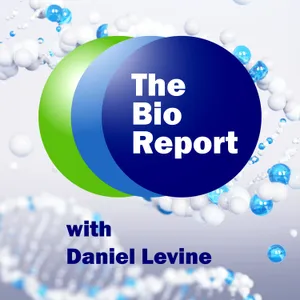
The Bio Report podcast, hosted by award-winning journalist Daniel Levine, focuses on the intersection of biotechnology with business, science, and policy.
Latest Episodes
The most recent episodes — sign up to get AI-powered summaries of each one.
- 1 weeks ago37 min
Neutralizing Tumor Acidity to Improve Cancer Immunotherapy
Many cancer treatments fail not because immune cells can’t recognize a tumor, but because the hostile environment surrounding it can prevent them from doing their job. Dyve Biosciences is seeking to address that problem by targeting tumor acidity, which the company says can suppress T-cell activity, promote immune evasion, and contribute to resistance to checkpoint inhibitors and other therapies. Its solution is a transdermal drug-delivery platform designed to move a buffering agent through the skin and into systemic circulation. The company’s lead oncology candidate, DYV 800, is intended to raise extracellular tumor pH and thereby make the tumor microenvironment more hospitable to immune attack. Ryan Beal, CEO of Dyve Biosciences, discusses why the company sees acidity as an overlooked but foundational target in oncology, how its delivery technology may overcome the limitations of oral bicarbonate dosing, and indications beyond cancer that the company is pursuing.
- 2 weeks ago26 min
How a Breast-Milk-Derived Peptide Could Change Bladder Cancer Care
For people with non-muscle-invasive bladder cancer, treatment can involve repeated procedures, a high risk of tumor recurrence, toxic therapies and, in some cases, removal of the bladder. Hamlet Biopharma is developing Alpha1H, a synthetic peptide inspired by a protein complex found in human breast milk. Catharina Svanborg, chair of Hamlet Biopharma, discusses how Alpha1H is designed to selectively target bladder tumor cells while sparing healthy tissue, the science that led to the program, and the clinical-development path ahead.
- 3 weeks ago29 min
Targeting Visceral Fat with RNA Therapeutics
GLP-1 therapies have dramatically reshaped obesity care, but the next generation of medicines may be judged by more than how much weight patients lose. A central question is whether treatments can selectively reduce the visceral fat associated with cardiometabolic disease while maintaining the muscle needed for physical function, metabolic health, and durable weight management. Erik Ingelsson, chief scientific officer of Wave Life Sciences, discusses the biology behind a new RNA-based approach designed to remove a natural brake on fat breakdown, how the company is thinking about clinical endpoints and patient populations, and why precision approaches to fat loss could change the definition of success in obesity treatment.
- 4 weeks ago31 min
Engineering T-Cell Engagers for Solid Cancers
T-cell engagers have delivered important advances in blood cancers, but extending their success to solid tumors has proved considerably more difficult. Physical barriers, immunosuppressive tumor microenvironments, and the risk of attacking healthy tissue have constrained the field. Deck Bio is developing multi-target T-cell engagers to address these limitations. Jack Silberstein, the company’s CEO, discusses Deck Bio’s efforts to create therapies that reach more cancer cells, reduce the likelihood that tumors will evade treatment, and minimize harm to healthy tissue.
- Sep 2, 202633 min
Resetting Severe Allergies at Their Cellular Source
For people with severe allergies and mast cell diseases, the risk of a dangerous reaction can shape everyday decisions about food, activities, and family routines. Current treatments generally manage symptoms or lower the likelihood of a reaction, rather than directly targeting the immune cells thought to drive the disease. Allergene AI Therapeutics is developing an in vivo mRNA CAR-T therapy intended to address that underlying biology. The approach aims to temporarily program a patient’s own T cells to target mast cells, with the goal of eliminating sensitized cells and enabling the immune system to rebuild a less reactive mast cell population. Sid Kerkar, founder and CEO of Allergene AI Therapeutics, discusses the scientific rationale for this proposed immune reset, the potential for mRNA and lipid nanoparticle delivery to simplify and broaden access to CAR-T therapy, and the work needed to move the approach from early research into clinical testing.
- Aug 26, 202629 min
Innovating ADCs with Dual Targeting and Smarter Delivery
Antibody-drug conjugates have established themselves as an important cancer-treatment modality, but their effectiveness and tolerability in solid tumors can be constrained by inadequate tumor delivery, incomplete internalization, and off-target toxicity. NEOK Bio is seeking to overcome those challenges with its bispecific ADC platform that uses dual-antigen targeting, engineered antibodies, and next-generation linker technology. Mayank Gandhi, co-founder and CEO of NEOK Bio, discusses the company’s bispecific ADC platform, its two clinical programs, and its strategy to develop more selective therapies for patients with advanced solid tumors.
- Aug 19, 202634 min
Targeting the Brain’s Immune System in Alzheimer’s Disease
Alzheimer’s disease remains one of medicine’s most intractable challenges. While existing therapies may address individual features of the disease, such as amyloid or tau, they have yet to reverse the progressive cognitive decline, inflammation, and neurodegeneration that characterize it. Evinco Therapeutics is developing nanoscale, natural killer cell-derived particles that carry proteins and microRNAs to target the neuroinflammation underlying Alzheimer’s. Alan Trounson, founder and CEO of Evinco Therapeutics, discusses the company’s multifaceted therapeutic approach, how these particles are designed to cross the blood-brain barrier, and their potential to modulate neuroinflammation, support the brain’s immune cells, and promote amyloid clearance.
- Aug 12, 202638 min
How Gilead Is Building Durable Oncology and Immunology Franchises
Gilead today stands at an inflection point. Its HIV and broader virology business still account for roughly two-thirds of total revenue, even as oncology has grown into a mid–single-digit billion-dollar franchise and inflammation and immunology remain earlier-stage bets. The company is tackling the strategic challenge of diversifying beyond HIV while preserving its leadership in virology. Chief Medical Officer Dietmar Berger discusses how the company is raising the bar for mechanistic understanding before making major investments, using targeted acquisitions to build platform-based franchises, and bringing in differentiated therapies and platforms that can be applied across solid tumors, autoimmune diseases, and even future viral threats.
Get The Bio Report summaries in your inbox
Free AI-powered daily recaps. Key takeaways, quotes, and mentions — in a 5-minute read.
Get Free Summaries →Free forever for up to 3 podcasts. No credit card required.
You Might Also Like
Listeners also like.

Unbiased Science
Dr. Jess Steier and guests analyze viral health claims using scientific evidence and explain key findings for everyday conversations.

Biohack-it
A weekly exploration of biohacking, holistic health, and science-driven strategies for optimizing physical and mental well-being.

The Peter Attia Drive
Conversations with experts on health, longevity, performance, and critical thinking led by physician Peter Attia.

Treated with Dr. Sara Szal
Dr. Sara Szal explores holistic health solutions through conversations with experts and patients seeking mind, body, and soul healing.
Paul Saladino MD podcast
A physician explores the root causes of chronic disease and optimal health through science and personal experimentation.
Huberman Lab
Explores neuroscience and science-based tools for understanding and improving brain function, behavior, and health.

Red Pill Your Healthcast
Two healthcare providers discuss overlooked health issues and empower listeners to make informed decisions for their families.

Science Magazine Podcast
Weekly episodes covering original scientific research, global science news, and expert commentary.

The Dan Buettner Podcast
Shares practical habits and insights from the world’s longest-lived populations to improve longevity and well-being.
The Human Upgrade: Biohacking for Longevity & Performance
Dave Asprey explores biohacking, longevity, and performance through science and expert interviews to improve energy, focus, and resilience.
The Art of Being Well
Explores holistic wellness through functional medicine, focusing on body, mind, spirit, and relationships as acts of self-respect.

Solutions with Henry Blodget
Henry Blodget interviews experts in business, tech, and politics about practical solutions for building a better future.
About The Bio Report
The Bio Report podcast, hosted by award-winning journalist Daniel Levine, focuses on the intersection of biotechnology with business, science, and policy.
Customized Recaps
AI-powered recaps with compact key takeaways, quotes, and insights.
Straight to Your Inbox
Get key takeaways from The Bio Report in a 5-minute read.
Save Hours Every Week
Stay current on your favorite podcasts without falling behind.
Frequently Asked Questions
What is Podzilla's The Bio Report daily summary?
It's a free AI-powered email that summarizes new episodes of The Bio Report as soon as they're published. You get the key takeaways, notable quotes, and links & mentions — all in a quick read.
How does the The Bio Report podcast summary work?
When a new episode drops, our AI transcribes and analyzes it, then generates a personalized summary tailored to your interests and profession. It's delivered to your inbox every morning.
Is this an official The Bio Report product?
No. Podzilla is an independent service that summarizes publicly available podcast content. We're not affiliated with or endorsed by Levine Media Group.
Can I get summaries of other podcasts too?
Absolutely! The free plan covers up to 3 podcasts. Upgrade to Pro for 15, or Premium for 50. Browse our full catalog at /podcasts.
How often does The Bio Report release new episodes?
The Bio Report publishes weekly. Our AI generates a summary within hours of each new episode.
What topics does The Bio Report cover?
The Bio Report covers topics including Science, Business, Medicine, Fitness, Health & Fitness, Life Sciences. Our AI identifies the specific themes in each episode and highlights what matters most to you.
Start getting The Bio Report summaries tomorrow morning.
Free forever for up to 3 podcasts. No credit card required.
Free forever for up to 3 podcasts. No credit card required.