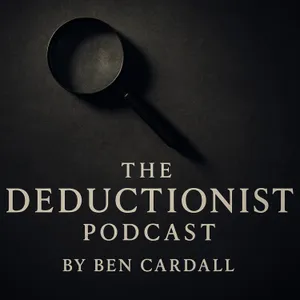
Free Daily Podcast Summary
The Deductionist Podcast: Daily Summaries Delivered
by ben cardall
Look no further, dear listener, for The Deductionist podcast is here to sharpen your deductive skills and blow your mind with its clever insights. Hosted by the charming and enigmatic deductionist himself (HA!) and the Watson of awesomeness! Each episode is a masterclass in observation, deduction, and logic, as they take you on a journey through the mysteries of everyday life. From analyzing crime scenes to decoding the hidden meanings in social interactions, The Deductionist podcast brings a fresh and witty perspective to the art of deduction. With a razor-sharp mind and quick wit...ish, they'll have you hooked from the very first episode. So join us as we explore the secrets of the world around us, and learn how to become a master of deduction like the one and only Deductionist. It's time to uncover the truth and take your deductive skills to the next level.
Latest Episodes
The most recent episodes — sign up to get AI-powered summaries of each one.
- 1 weeks ago57 min
Lie Detection vs Investigative Interviewing: The Truth
Lie detection has been the wrong goal all along. Mark Anderson spent decades in law enforcement, and his conclusion is blunt: the mindset you carry into an interview matters more than any signal you think you're reading off someone's face.In this episode: Why curiosity over certainty is an operational principle, not a motivational slogan, and what it actually changes in practice The lie detection problem: why watching for behavioural signals produces confirmation bias rather than accurate reads How behavioural observation functions as question fuel rather than a truth-or-deception verdict, and why that distinction matters operationally The power and control dynamic in investigative interviews, and why maintaining control by giving it up is the move most interviewers won't make Bob Pointer on talking to the mask: why addressing who the person wants to be seen as is more productive than trying to strip it away System 1 vs System 2 thinking in the interview room, and how pressure to act on instinct produces the worst outcomes at the highest stakes Why red-teaming your own interview mindset reduces confirmation bias more reliably than technique training alone Subscribe wherever you get your podcasts. Access the free tier or go deeper with exclusive paid challenges:https://www.omniscient-insights.com/axiomhttps://www.omniscient-insights.com/community-home MERCH -- https://the-deductionist.myspreadshop.co.uk/allE-SCAPE GAME -- https://www.youtube.com/@thedeductionistteamEverything else you need -- https://linktr.ee/bencardall #criticalthinking #interviewing #markanderson Music provided by https://robertjohncollinsmusic.com/`
- 1 weeks ago1h 22m
Disclaimers and Critical Thinking With Kent Axell
Most people think critical thinking means finding the right answer faster. Kent Axell has spent a career proving it means knowing exactly which doors you're closing behind yourself, and why that distinction changes everything from a Las Vegas stage to a jury room.In this episode: Why magicians develop critical thinking skills that investigators and analysts rarely get trained in The assumption gradient: where useful belief ends and self-deception begins Why "I don't know" is a more powerful position than certainty, and how the skeptic community gets this wrong Disclaimers in mentalism, what they actually communicate, and why technically honest is still functionally deceptive The Chris Voss story: what happened when a master negotiator watched a mentalism show and still ended up in the wrong box Why "body language" as a term sets people up to believe in something that does not work the way they think Vincent Denault's research on how public misconceptions about behavioural reading are actively influencing police training, jury evaluation, and interrogation If the gap between what people believe they can read and what the evidence actually supports concerns you, this episode goes there. Kent is at @kenttalksmagic on youtube@kentaxell on instagramGhost stories is at https://www.1923lv.com/ghost-stories-show-las-vegas-with-kent-axell/ Subscribe so you never miss an episode. Access the free tier or go deeper with exclusive paid challenges:https://www.omniscient-insights.com/axiomhttps://www.omniscient-insights.com/community-home MERCH -- https://the-deductionist.myspreadshop.co.uk/allE-SCAPE GAME -- https://www.youtube.com/@thedeductionistteamEverything else you need -- https://linktr.ee/bencardall #criticalthinking #kentaxell #magic Music provided by https://robertjohncollinsmusic.com/`
- 2 weeks ago43 min
What's Actually Driving You (And Why You're Probably Wrong About It) w/Pete Rushmer
Pete Rushmore built a business, hit the metrics that were supposed to mean something, and felt nothing. Not because he failed. Because the vision he was chasing was answering a question he'd never actually asked. This episode follows the performance trifecta he developed out of that realisation: direction, skills, energy, and why energy is the foundation even though it's the last thing anyone looks at. Motivational mapping, self-determination theory, the gap between what people say drives them and what actually does. Bob and Ben both have opinions. Pete handles them graciously. https://www.omniscient-insights.com/rls-program - FIRST MONTH FREE Subscribe so you never miss an episode. Access the free tier or go deeper with exclusive paid challenges:https://www.omniscient-insights.com/axiomhttps://www.omniscient-insights.com/community-home MERCH -- https://the-deductionist.myspreadshop.co.uk/allE-SCAPE GAME -- https://www.youtube.com/@thedeductionistteamEverything else you need -- https://linktr.ee/bencardall Music provided by https://robertjohncollinsmusic.com/` #criticalthinking #sherlockholmes #reasoning
- 4 weeks ago31 min
The Zoologist Who Cracked the Human Code (And Nobody Gave Him Enough Credit)
Desmond Morris spent 98 years watching humans the way scientists watch animals. No assumptions. No sentiment. Just systematic field observation turned into a working method. If you have ever read a room, clocked a liar, or known something was wrong before you could explain why, some version of Morris is in that skill. You just never knew his name. In this episode, Ben and Bob Pointer break down the man, the method, and the books that changed how serious practitioners read people. You will learn: Why The Naked Ape was banned, bought by 12 million people, and still more relevant than anything published this decade What ethogram methodology is and why it produces more reliable reads than any checklist-based system What The Human Zoo got right about behaviour under pressure that investigators still rely on today How Morris distinguished incidental movement from deliberate gesture, and why that single distinction will change how you observe What Manwatching gives you that no body language course ever will Why proximity and touch, mapped by Morris in Intimate Behaviour, remain two of the most underused intelligence streams in modern practice 98 years of watching. This episode is the debrief. Subscribe for weekly episodes applying the Sherlock Holmes method to real human behaviour. Podcast available on all major platforms. Subscribe so you never miss an episode. Access the free tier or go deeper with exclusive paid challenges: https://www.omniscient-insights.com/axiom https://www.omniscient-insights.com/community-home MERCH -- https://the-deductionist.myspreadshop.co.uk/all E-SCAPE GAME -- https://www.youtube.com/@thedeductionistteam Everything else you need -- https://linktr.ee/bencardall Music provided by https://robertjohncollinsmusic.com/` #criticalthinking #sherlockholmes #reasoning
- 4 weeks ago46 min
221B - Where This Goes Next with the Sherlock Holmes Skillset
221A was the case so far. The evidence reviewed. The record examined.221B is the next chapter. And if you have been listening, you already know the case is getting bigger. In this solo episode, Ben maps the forward trajectory of The Deductionist. Not predictions. Not promises. A reasoned projection based on what the work has shown, what the culture is demanding, and where Holmesian methodology actually needs to go next. What gets covered:Where the framework goes when the mainstream finally catches up to what this show has been saying for yearsHow the methodology evolves when the cases get harder and the observers get betterWhat is coming for the show, the audience, and the missionWhy the cultural moment this podcast was built for has arrived, and what that means for everyone already in the room 221 episodes in. The work is not done. The interesting part is starting now. Subscribe for weekly episodes applying the Sherlock Holmes method to real human behaviour. Podcast available on all major platforms. Subscribe so you never miss an episode. Access the free tier or go deeper with exclusive paid challenges:https://www.omniscient-insights.com/axiomhttps://www.omniscient-insights.com/community-home MERCH -- https://the-deductionist.myspreadshop.co.uk/allE-SCAPE GAME -- https://www.youtube.com/@thedeductionistteamEverything else you need -- https://linktr.ee/bencardall Music provided by https://robertjohncollinsmusic.com/` #criticalthinking #sherlockholmes #reasoning
- Apr 24, 202649 min
221 Episodes of Deduction: What Sherlock Holmes Taught Me About the Human Mind
221 episodes. One question that started it all: is brainy really the new sexy? In this milestone retrospective, Ben revisits the full arc of The Deductionist podcast. What began as a question about intelligence versus the performance of intelligence has grown into one of the most scientifically grounded behaviour and deduction shows available anywhere. This episode is the case file review. The debrief before the next chapter. Covered in this episode: How the show's central thesis formed around Jonathan Haidt's research on moral reasoning and post hoc rationalisation. Why most people are bad at observation, and why that has nothing to do with intelligence. The inference cycle, and the difference between a guess and a genuine deduction. Memory as an engineering problem, from Nelson Cowan's working memory research to the method of loci documented by Cicero. Why the popular mythology around body language is almost entirely wrong, and what Bella DePaulo's meta analysis actually showed. The Nicola Bulley case as a live study in how online communities reason under uncertainty. The emotional recession, Gallup's global data, and what Sherry Turkle's research on the flight from conversation tells us about where we are headed. Antonio Damasio's somatic marker hypothesis and why suppressing emotion does not make you more rational. What 221 episodes has actually taught about the unified nature of the deductionist skill set. 221b is coming. Subscribe for weekly episodes applying the Sherlock Holmes method to real human behaviour. Podcast available on all major platforms. Subscribe for weekly episodes applying the Sherlock Holmes method to real human behaviour. Podcast available on all major platforms. Subscribe so you never miss an episode. Access the free tier or go deeper with exclusive paid challenges:https://www.omniscient-insights.com/axiomhttps://www.omniscient-insights.com/community-home MERCH -- https://the-deductionist.myspreadshop.co.uk/allE-SCAPE GAME -- https://www.youtube.com/@thedeductionistteamEverything else you need -- https://linktr.ee/bencardall Music provided by https://robertjohncollinsmusic.com/` #criticalthinking #sherlockholmes #reasoning
- Apr 24, 202633 min
Conditioning, Cults, and Coffee Shops: The Science of Invisible Control
You think you're making free choices. You're not. In this episode, Ben and Bob break down the psychology of behavioural conditioning and show you exactly how it operates on your decisions, your habits, your spending, your compliance, and your relationships without you ever noticing. From Pavlov's dog to pandemic supermarkets. From love bombing to the compliance ladder. From cult control via Steve Hassan's BITE model to the social conditioning that made the entire UK pay motorway prices without question. This isn't conspiracy. This is documented behavioural science that the average person has never been taught to see. And once you see it, you can't unsee it. TOPICS COVERED:00:00 Opening and Desmond Morris tribute03:15 What behavioural conditioning actually is07:30 Steve Hassan's BITE Model explained12:00 COVID, supermarkets, and large-scale behavioural nudging17:45 Love bombing as structured conditioning22:00 The compliance ladder (Freedman and Fraser, 1966)28:00 Penalty signals: silence, exclusion, and group control33:00 How to spot if you're inside a conditioned environment38:00 Final thoughts KEYWORDS: behavioural conditioning, psychology of control, BITE model, Steve Hassan, Pavlov, operant conditioning, social proof, compliance ladder, love bombing, Desmond Morris, behavioural analysis, critical thinking, body language, deception detection Subscribe for weekly episodes applying the Sherlock Holmes method to real human behaviour. Podcast available on all major platforms. Subscribe so you never miss an episode. Access the free tier or go deeper with exclusive paid challenges:https://www.omniscient-insights.com/axiomhttps://www.omniscient-insights.com/community-home MERCH -- https://the-deductionist.myspreadshop.co.uk/allE-SCAPE GAME -- https://www.youtube.com/@thedeductionistteamEverything else you need -- https://linktr.ee/bencardall Music provided by https://robertjohncollinsmusic.com/` #criticalthinking #sherlockholmes #reasoning
- Apr 17, 202644 min
The Quiet Ones Are Watching You: What Humility Reveals About Behaviour
What if the quietest person in the room is also the most dangerous observer in it? In this episode, Ben and Bob are joined by leadership coach Marcel for a conversation that cuts straight to the behavioural mechanics of humility.Marcel can be found https://www.linkedin.com/in/marcelvandehoef/And here for more insight from him and here Not the watered-down, doormat version the word often conjures, but the kind that functions as a precision instrument for reading people, reading rooms, and reading yourself. The conversation covers why silence in a meeting is not passivity, how the humble observer collects information that the loudest voice in the room never will, what Marcus Aurelius knew about staying grounded under social pressure, the difference between empathy and compassion when analysing another person's behaviour, and why political culture is one of the last environments where genuine humility can survive. If you work in investigation, behavioural analysis, leadership, or any field where reading people accurately gives you an edge, this one is built for you.Martin Seligman's work on character strengths is referenced throughout. Timothy Leary's interpersonal circumplex is discussed in the context of positioning within conversations. The coaching framework of staying curious longer, developed by Michael Bungay Stanier, also features. Subscribe and hit the bell so you never miss an episode #BehaviouralAnalysis #CriticalThinking #BehaviouralScience #podcast
Get The Deductionist Podcast summaries in your inbox
Free AI-powered daily recaps. Key takeaways, quotes, and mentions — in a 5-minute read.
Get Free Summaries →Free forever for up to 3 podcasts. No credit card required.
You Might Also Like
Listeners also like.

The Deduction
Experts explain tax policy, trade, and economic impacts in plain terms.
Detectives Don't Sleep
Real detectives recount their investigations into history's most compelling criminal cases.

People Who Read People: A Behavior and Psychology Podcast
Explores human behavior through interviews with experts in psychology, law, sports, and poker.

Inquiring Minds
Explores the intersection of science and society through critical thinking and in-depth analysis.

The Jordan Harbinger Show
Conversations with top performers across fields, distilling actionable insights on success, relationships, and personal growth.

Killer Psyche
A retired FBI agent examines the psychological motives behind notorious criminals and their crimes.
You Are Not So Smart
A psychology podcast exploring human reasoning, cognitive biases, and the science behind self-delusion.
The Curiosity Shop with Brené Brown and Adam Grant
Brené Brown and Adam Grant explore boldness amid uncertainty through research, debate, and dialogue in a six-episode series.

Intelligence Squared
Live debates and in-depth discussions on pressing global issues featuring leading experts and thinkers.
The Telepathy Tapes
Autistic individuals and others share verifiable telepathic and consciousness-expanding experiences through science and personal accounts.

Google DeepMind: The Podcast
A mathematician explores AI's real-world impact through behind-the-scenes insights from a leading research lab.
Decoder Ring
A cultural critic investigates the origins and significance of curious phenomena, from forgotten trends to everyday rituals.
About The Deductionist Podcast
Look no further, dear listener, for The Deductionist podcast is here to sharpen your deductive skills and blow your mind with its clever insights. Hosted by the charming and enigmatic deductionist himself (HA!) and the Watson of awesomeness! Each episode is a masterclass in observation, deduction, and logic, as they take you on a journey through the mysteries of everyday life. From analyzing crime scenes to decoding the hidden meanings in social interactions, The Deductionist podcast brings a fresh and witty perspective to the art of deduction. With a razor-sharp mind and quick wit...ish, they'll have you hooked from the very first episode. So join us as we explore the secrets of the world around us, and learn how to become a master of deduction like the one and only Deductionist. It's time to uncover the truth and take your deductive skills to the next level.
Customized Recaps
AI-powered recaps with compact key takeaways, quotes, and insights.
Straight to Your Inbox
Get key takeaways from The Deductionist Podcast in a 5-minute read.
Save Hours Every Week
Stay current on your favorite podcasts without falling behind.
Frequently Asked Questions
What is Podzilla's The Deductionist Podcast daily summary?
It's a free AI-powered email that summarizes new episodes of The Deductionist Podcast as soon as they're published. You get the key takeaways, notable quotes, and links & mentions — all in a quick read.
How does the The Deductionist Podcast podcast summary work?
When a new episode drops, our AI transcribes and analyzes it, then generates a personalized summary tailored to your interests and profession. It's delivered to your inbox every morning.
Is this an official The Deductionist Podcast product?
No. Podzilla is an independent service that summarizes publicly available podcast content. We're not affiliated with or endorsed by ben cardall.
Can I get summaries of other podcasts too?
Absolutely! The free plan covers up to 3 podcasts. Upgrade to Pro for 15, or Premium for 50. Browse our full catalog at /podcasts.
How often does The Deductionist Podcast release new episodes?
The Deductionist Podcast publishes weekly. Our AI generates a summary within hours of each new episode.
What topics does The Deductionist Podcast cover?
The Deductionist Podcast covers topics including Science, Education, How To, Life Sciences. Our AI identifies the specific themes in each episode and highlights what matters most to you.
Start getting The Deductionist Podcast summaries tomorrow morning.
Free forever for up to 3 podcasts. No credit card required.
Free forever for up to 3 podcasts. No credit card required.