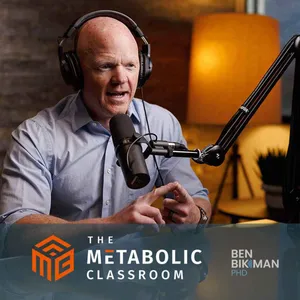
Free Daily Podcast Summary
The Metabolic Classroom with Dr. Ben Bikman: Daily Summaries Delivered
by Insulin IQ
Welcome to The Metabolic Classroom, a nutrition and lifestyle podcast focused on metabolism, which is how our bodies use energy, and the truth behind why we get sick and fat. Every week, Dr. Ben Bikman shares valuable insights that you can apply in your own life and share with friends and loved ones.
Latest Episodes
The most recent episodes — sign up to get AI-powered summaries of each one.
- 3 days ago24 min
Why Micronized Progesterone Is Different
Question? 📢 Ask Dr. Bikman’s Digital Mind (multilingual):https://benbikman.com/ben-bikmans-digital-ai-mind📢 Dr. Bikman’s Community & Coaching Site: https://insuliniq.comDr. Bikman explains why micronized progesterone should not be confused with the synthetic progestins historically used in many hormone therapies. Micronized progesterone is chemically identical to the hormone produced naturally by a woman’s ovaries, while synthetic progestins can also activate cortisol- or testosterone-related receptors, potentially affecting insulin sensitivity, blood lipids, and other aspects of metabolic health.Ben reviews clinical evidence showing that micronized progesterone can effectively protect the uterine lining when estrogen is used while preserving more of estrogen’s favorable metabolic effects. Oral micronized progesterone is also converted into allopregnanolone, which enhances the brain’s calming GABA signaling and may improve sleep. Better sleep itself can support insulin sensitivity, while progesterone may also reduce hot flashes and night sweats that interfere with sleep.The safety evidence is also encouraging. Compared with some synthetic progestins, micronized progesterone appears more favorable with respect to blood clots, breast cancer risk, and metabolic markers. Ben’s overall conclusion is that for women using menopausal hormone therapy who need progesterone to protect the uterus, micronized progesterone appears to be a metabolically favorable partner to estrogen.References:For complete show notes and references, we invite you to become an Insider subscriber. You’ll enjoy real-time, livestream Metabolic Classroom access which includes live Q&A with Ben after the lecture, unlimited access to Dr. Bikman’s Digital Mind, ad-free podcast episodes, show notes and references, and Ben’s Weekly Research Review Podcast. Learn more: https://www.benbikman.comNOTE: The information presented is not intended to be a substitute for professional medical advice, diagnosis, or treatment. Dr. Bikman is not a clinician—and, he is not your doctor. Always seek the advice of your own qualified health providers with questions you may have regarding medical conditions. Hosted on Acast. See acast.com/privacy for more information.
- 2 weeks ago26 min
Can Your Body Make More GLP-1 Naturally?
Question?📢 Ask Dr. Bikman’s Digital Mind (multilingual):https://benbikman.com/ben-bikmans-digital-ai-mind📢 Dr. Bikman’s Community & Coaching Site: https://insuliniq.comSummary:Dr. Bikman explains why some people may produce an inadequate GLP-1 response and how insulin resistance could be part of the problem. Because intestinal L cells have insulin receptors, chronically elevated insulin can make these cells insulin resistant, reducing their ability to release GLP-1 and potentially creating a cycle of faster stomach emptying, higher glucose, more insulin, and further impairment of the natural GLP-1 response.Ben uses this physiology to explain how he believes GLP-1 medications should be used: not simply to produce maximum weight loss, but as a temporary window in which carbohydrate cravings become easier to control. Rather than escalating automatically to the highest tolerated dose, he favors using the lowest dose that makes refined carbohydrates easier to resist while still requiring the person to exercise some choice and discipline. During that window, the goal is to establish meals centered on protein, healthy fats, and whole foods while improving sleep and resistance training.Ben also addresses concerns about lean-mass loss, explaining that body-composition scans can classify losses of water, glycogen, organ fat, and even the non-fat portion of adipose tissue as “lean mass.” Ultimately, he argues that GLP-1 therapy should have an exit strategy: improve insulin sensitivity, restore the body's own GLP-1 signaling as much as possible, establish sustainable habits, and then work with a clinician to gradually reduce the medication rather than assuming it must be permanent.References:For complete show notes and references, we invite you to become an Insider subscriber. You’ll enjoy real-time, livestream Metabolic Classroom access which includes live Q&A with Ben after the lecture, unlimited access to Dr. Bikman’s Digital Mind, ad-free podcast episodes, show notes and references, and Ben’s Weekly Research Review Podcast. Learn more: https://www.benbikman.com Hosted on Acast. See acast.com/privacy for more information.
- 3 weeks ago30 min
What Your Glucose Monitor Is Missing
Question?📢 Ask Dr. Bikman’s Digital Mind (multilingual):https://benbikman.com/ben-bikmans-digital-ai-mind📢 Dr. Bikman’s Community & Coaching Site: https://insuliniq.comTopic:Continuous glucose monitoring shows how the body handles glucose, but it cannot reveal how much insulin was required to produce that glucose response. By continuously measuring ketones alongside glucose, the new dual sensor may provide an indirect window into insulin activity, fat burning, and metabolic flexibility while also helping people with diabetes detect dangerous ketone elevations earlier.Summary:Dr. Ben Bikman explores a new wearable that continuously measures both glucose and ketones. Unlike a traditional continuous glucose monitor, Abbott’s Libre Duo can track beta-hydroxybutyrate (BHB) alongside glucose, providing another window into what is happening metabolically. For people with diabetes, continuous ketone monitoring could provide earlier warning of dangerous ketoacidosis, particularly in people with type 1 diabetes or those using SGLT2 inhibitors.Ben explains why ketones provide information that glucose alone cannot. Because insulin strongly suppresses fat release, fat oxidation, and ketone production, changes in ketones can serve as an indirect indicator of insulin activity. A seemingly normal glucose response can therefore hide the fact that the body required a large amount of insulin to produce it, while watching glucose and ketones together may reveal more about how readily the body transitions between glucose and fat metabolism.Ben sees potential value beyond diabetes as well. During fasting or carbohydrate restriction, glucose would generally fall while ketones rise; after a carbohydrate-rich meal, the opposite occurs. Tracking both signals continuously could therefore offer a more complete picture of metabolic flexibility and help people better understand their individual responses to food, fasting, and other metabolic changes.References:For complete show notes and references, we invite you to become an Insider subscriber. You’ll enjoy real-time, livestream Metabolic Classroom access which includes live Q&A with Ben after the lecture, unlimited access to Dr. Bikman’s Digital Mind, ad-free podcast episodes, show notes and references, and Ben’s Weekly Research Review Podcast. Learn more: https://www.benbikman.comAlso, Dr. Bikman’s Digital Mind can interact with you in many languages: https://benbikman.com/ben-bikmans-digital-ai-mindNOTE: The information presented is not intended to be a substitute for professional medical advice, diagnosis, or treatment. Dr. Bikman is not a clinician—and, he is not your doctor. Always seek the advice of your own qualified health providers with questions you may have regarding medical conditions. Hosted on Acast. See acast.com/privacy for more information.
- Sep 8, 202625 min
The New GLP-1 Pills & What You Need to Know
Question?📢 Ask Dr. Bikman’s Digital Mind (multilingual):https://benbikman.com/ben-bikmans-digital-ai-mind📢 Dr. Bikman’s Community & Coaching Site: https://insuliniq.comIn today’s mini-lecture, Dr. Ben Bikman explains the new generation of oral GLP-1 medications and why two drugs that come as pills can work very differently. Oral semaglutide is still a peptide, so it requires a special absorption enhancer to protect it from digestion and help it cross the stomach lining. Even then, only about 1% of the dose reaches the bloodstream, requiring strict instructions about taking it on an empty stomach. Orforglipron, by contrast, is a small molecule rather than a peptide, allowing it to survive digestion and be absorbed much more efficiently without the same restrictions.Ben reviews studies comparing the drugs for blood glucose control, weight loss, side effects, and maintaining weight loss after injectable GLP-1 therapy. But he emphasizes that changing the delivery method does not change the underlying metabolic rules: insulin still governs whether fat is stored or released.Most importantly, Ben argues that GLP-1 medications should be viewed as an opportunity to change metabolic habits rather than simply as long-term weight-loss drugs. Because they can temporarily reduce cravings for sweets and refined carbohydrates, he believes that window should be used to reduce those foods, emphasize protein and fat, and develop habits that can eventually provide an “off-ramp” from the medication..References:For complete show notes and references, we invite you to become an Insider subscriber. You’ll enjoy real-time, livestream Metabolic Classroom access which includes live Q&A with Ben after the lecture, unlimited access to Dr. Bikman’s Digital Mind, ad-free podcast episodes, show notes and references, and Ben’s Weekly Research Review Podcast. Learn more: https://www.benbikman.comNOTE: The information presented is not intended to be a substitute for professional medical advice, diagnosis, or treatment. Dr. Bikman is not a clinician—and, he is not your doctor. Always seek the advice of your own qualified health providers with questions you may have regarding medical conditions.#GLP1 #GLP1Medications #OralGLP1 #Orforglipron #Semaglutide #WeightLoss #InsulinResistance #Insulin #MetabolicHealth #WeightLossMedication #GLP1WeightLoss #CarbCravings #BloodSugar #Type2Diabetes #Metabolism #LowCarb #DrBenBikman #MetabolicClassroom #MetabolismMatters #HealthScience Hosted on Acast. See acast.com/privacy for more information.
- Aug 24, 202634 min
Why Your Body Chooses Sugar Over Fat
Question?📢 Ask Dr. Bikman’s Digital Mind (multilingual):https://benbikman.com/ben-bikmans-digital-ai-mind📢 Dr. Bikman’s Community & Coaching Site: https://insuliniq.comTopic:Insulin is one of the body’s most important signals for determining whether you burn glucose or fat: when insulin rises, fat release and fat burning fall, while lower insulin allows stored fat to become available for fuel. This helps explain why reducing carbohydrates can dramatically increase fat oxidation even without changing the body’s basic ability to burn fat.Summary:In this mini-lecture Ben explains what determines whether the body burns glucose or fat for energy. He begins with the Randle cycle, also called the glucose-fatty acid cycle, which describes how these two fuels compete with one another. But Ben emphasizes that simply having fat available does not mean the body will burn it. Insulin plays a major role in deciding which fuel gets used. When insulin rises after eating carbohydrates, it suppresses the release of stored fat from fat cells and also makes it harder for long-chain fatty acids to enter the mitochondria to be burned. As a result, the body shifts toward burning glucose. When insulin falls, stored fat becomes available again and can more readily enter the mitochondria for energy.Ben reviews human studies showing that carbohydrate restriction can dramatically increase fat oxidation, including research in endurance athletes who became highly efficient fat burners without sacrificing performance or muscle glycogen. He also explains what happens with insulin resistance: insulin can remain high enough to block fat burning in muscle while insulin-resistant fat cells continue releasing fatty acids, creating a metabolic mismatch that promotes fat accumulation in places such as the liver and muscle.The central takeaway is that fuel selection is not simply about calories or which fuel happens to be available. Insulin strongly regulates whether stored fat can be released and burned, which is why lowering carbohydrate intake can dramatically increase the body’s ability to use fat for fuel.References:For complete show notes and references, we invite you to become an Insider subscriber. You’ll enjoy real-time, livestream Metabolic Classroom access which includes live Q&A with Ben after the lecture, unlimited access to Dr. Bikman’s Digital Mind, ad-free podcast episodes, show notes and references, and Ben’s Weekly Research Review Podcast. Learn more: https://www.benbikman.comNOTE: The information presented is not intended to be a substitute for professional medical advice, diagnosis, or treatment. Dr. Bikman is not a clinician—and, he is not your doctor. Always seek the advice of your own qualified health providers with questions you may have regarding medical conditions. Hosted on Acast. See acast.com/privacy for more information.
- Aug 17, 202638 min
The Biggest Myth About Mitochondrial Health
Question?📢 Ask Dr. Bikman’s Digital Mind (multilingual):https://benbikman.com/ben-bikmans-digital-ai-mind📢 Dr. Bikman’s Community & Coaching Site: https://insuliniq.comTopic:Mitochondria often struggle in insulin resistance not because they are broken, but because there are fewer of them trying to process too much incoming fuel. Exercise and improved metabolic health remain the most effective ways to build healthier mitochondria, while supplements may provide additional—but smaller—benefits.Summary:In this mini-lecture, Ben explains why mitochondria have become one of the most talked-about topics in health while separating scientific evidence from popular hype. He begins by reviewing how mitochondria convert the energy stored in carbohydrates, fats, and ketones into ATP, the usable energy that powers virtually every function in the body. Along the way, he explains concepts such as glycolysis, the Krebs cycle, the electron transport system, coupling versus uncoupling, and the production of reactive oxygen species. Ben then examines what happens in insulin resistance and type 2 diabetes. Rather than concluding that mitochondria are "broken," he explains that the evidence points to a different problem: people with insulin resistance generally have fewer mitochondria, more fragmented mitochondrial networks, and an excessive fuel load. As glucose and fatty acids arrive faster than the mitochondria can process them, byproducts such as lactate and acylcarnitines begin to accumulate, signaling a mismatch between fuel supply and mitochondrial capacity.The lecture also reviews current approaches to measuring mitochondrial health, including fasting lactate, the lactate-to-pyruvate ratio, and newer biomarkers such as GDF15 and FGF21. Dr. Bikman discusses several popular mitochondrial interventions—including methylene blue, urolithin A, CoQ10, red-light therapy, and cold exposure—highlighting where human evidence is promising and where it remains limited.The central message is that no supplement outperforms the fundamentals. Exercise consistently increases mitochondrial number and function while improving insulin sensitivity, and lowering carbohydrate intake reduces the fuel burden placed on mitochondria. Together, these strategies address the root problem more effectively than relying on supplements alone.References:For complete show notes and references, we invite you to become an Insider subscriber. You’ll enjoy real-time, livestream Metabolic Classroom access which includes live Q&A with Ben after the lecture, unlimited access to Dr. Bikman’s Digital Mind, ad-free podcast episodes, show notes and references, and Ben’s Weekly Research Review Podcast. Learn more: https://www.benbikman.comNOTE: The information presented is not intended to be a substitute for professional medical advice, diagnosis, or treatment. Dr. Bikman is not a clinician—and, he is not your doctor. Always seek the advice of your own qualified health providers with questions you may have regarding medical conditions.#Mitochondria #MitochondrialHealth #InsulinResistance #MetabolicHealth #ExerciseScience #ATP #CellBiology #Type2Diabetes #OxidativeStress #Lactate #Ketones #CoQ10 #UrolithinA #RedLightTherapy #ColdExposure #DrBenBikman #MetabolicClassroom #Metabolism #HealthScience #LowCarbScience Hosted on Acast. See acast.com/privacy for more information.
- Aug 10, 202623 min
Why Exercise Alone Won’t Help You Lose Weight
📢 Ask Dr. Bikman’s Digital Mind (multilingual):https://benbikman.com/ben-bikmans-digital-ai-mind📢 Dr. Bikman’s Community & Coaching Site: https://insuliniq.comBen challenges one of the most common beliefs about exercise—that its primary purpose is to help people lose weight. While exercise certainly burns calories, he explains that the body quickly adapts by reducing energy expenditure elsewhere and, in many people, increasing appetite. As a result, the amount of weight lost is often much less than simple calorie calculations would predict. Dr. Bikman explains that these adaptations do not mean exercise is ineffective. Instead, they reveal that body weight is the wrong outcome to focus on. Exercise dramatically improves insulin sensitivity, allowing contracting muscles to pull glucose out of the bloodstream without requiring insulin. It also increases the number of glucose transporters in muscle, improves mitochondrial function, reduces dangerous visceral fat, and helps preserve or build muscle mass.The lecture concludes by emphasizing that the greatest benefits of exercise have little to do with the number on the scale. Strength, fitness, muscle mass, and insulin sensitivity are all far better predictors of long-term health and longevity. Dr. Bikman’s message is simple: exercise to become stronger and healthier, and eat wisely if your goal is to become leaner.Disclaimer: The information presented is not intended to be a substitute for professional medical advice, diagnosis, or treatment. Dr. Bikman is not a clinician—and, he is not your doctor. Always seek the advice of your own qualified health providers with questions you may have regarding your medical conditions. Hosted on Acast. See acast.com/privacy for more information.
- Jul 27, 202629 min
Why Some People Stay Thin No Matter What They Eat
📢 Ask Dr. Bikman’s Digital Mind (multilingual):https://benbikman.com/ben-bikmans-digital-ai-mind📢 Dr. Bikman’s Community & Coaching Site: https://insuliniq.comTopic:Some people stay lean because they burn more fat in muscle, move more without realizing it, or naturally expend more energy throughout the day. Others only appear lean because they store fat inside the liver and around the organs, making metabolic health far more important than appearance alone.Summary:Dr. Bikman explores a common question: Why do some people seem to eat whatever they want and never gain weight? He explains that there isn't one simple answer. Instead, several different metabolic processes can produce the same outward appearance of being lean, even though the underlying health may be very different.The first explanation is fuel partitioning. After a meal, dietary fat can either be stored in fat tissue or burned by muscle. Which tissue "claims" that fat is heavily influenced by the enzyme lipoprotein lipase (LPL), whose activity is regulated by insulin. People whose muscles are better at taking up and burning fat tend to store less of it. Exercise training also shifts LPL activity toward muscle, while inactivity shifts it back toward fat storage.A second explanation is that some people unconsciously burn off excess calories through everyday movement. Research shows that fidgeting, standing, pacing, and other non-exercise activity can account for hundreds of calories each day, creating enormous differences in fat gain between people eating similar amounts of food. Genetics also appear to influence these natural tendencies.Finally, Dr. Bikman explains that some lean people are not avoiding fat storage at all—they're simply storing fat where it can't be seen. Instead of accumulating under the skin, fat may build up around the organs or inside the liver, pancreas, and muscle, increasing metabolic risk despite a normal body weight. The takeaway is that appearance alone cannot determine metabolic health. Blood markers such as fasting insulin and the triglyceride-to-HDL ratio provide a much better picture than body weight or BMI alone.References:For complete show notes and references, we invite you to become an Insider subscriber. You’ll enjoy real-time, livestream Metabolic Classroom access which includes live Q&A with Ben after the lecture, unlimited access to Dr. Bikman’s Digital Mind, ad-free podcast episodes, show notes and references, and Ben’s Weekly Research Review Podcast. Learn more: https://www.benbikman.comNOTE: The information presented is not intended to be a substitute for professional medical advice, diagnosis, or treatment. Dr. Bikman is not a clinician—and, he is not your doctor. Always seek the advice of your own qualified health providers with questions you may have regarding medical conditions.#WeightLoss #MetabolicHealth #FatStorage #InsulinResistance #LPL #LipoproteinLipase #VisceralFat #FattyLiver #PersonalFatThreshold #Metabolism #ThinOutsideFatInside #ExerciseScience #BodyFat #LowCarbScience #DrBenBikman #MetabolicClassroom #MetabolismMatters #HealthScience #Insulin #FuelPartitioningBen’s favorite yerba mate and fiber: https://ufeelgreat.com/usa/en/c/1BA884Exogenous ketones: A high-quality option is the NSF-certified goBHB from Clean Form Nutrition, where you can use the code BEN10 for a 10% discount: https://cleanformnutrition.com/products/go-bhbBen’s favorite meal-replacement shake: https://gethlth.com (discount: BEN10) Hosted on Acast. See acast.com/privacy for more information.
Get The Metabolic Classroom with Dr. Ben Bikman summaries in your inbox
Free AI-powered daily recaps. Key takeaways, quotes, and mentions — in a 5-minute read.
Get Free Summaries →Free forever for up to 3 podcasts. No credit card required.
You Might Also Like
Listeners also like.

The Holistic GLP-1 Podcast with Elizabeth McGann
Explores holistic approaches to GLP-1 for metabolic health, weight, and well-being through expert insights and natural strategies.

Fit + Fueled Life Podcast
A functional nutrition practitioner explores sustainable fat loss, hormone balance, and metabolic health for women over 40.

Biohack-it
A weekly exploration of biohacking, holistic health, and science-driven strategies for optimizing physical and mental well-being.

Live Like a Girl with Dr. Mindy Pelz
Dr. Mindy Pelz explores women's health through hormone science and wellness conversations to help women live in rhythm with their bodies.
Low Carb MD Podcast
Doctors discuss low-carb approaches to weight loss, wellness, and disease reversal with medical guests and patient cases.
Mastering Nutrition
A nutrition scientist discusses mitochondrial health and personalized metabolism using genetics, biochemistry, and research.

Diabetes Nerd
Discusses diabetes research, technology, management strategies, and personal stories through candid conversations.

Paul Saladino MD podcast
A physician explores the root causes of chronic disease and optimal health through science and personal experimentation.

Mind Pump: Raw Fitness Truth
Three fitness experts debunk myths and expose science-backed truths about training, nutrition, and health in the fitness industry.

The Dr. Hyman Show
Explores root causes of chronic disease and promotes functional medicine, nutrition, and preventive health through expert discussions.

Thinking Health Podcast
Explores health and wellness through expert interviews, focusing on low-carb science and practical strategies for improving well-being.

The Doctor's Kitchen Podcast
A doctor explores how food and lifestyle choices impact health and well-being, with expert guests offering practical advice.
About The Metabolic Classroom with Dr. Ben Bikman
Welcome to The Metabolic Classroom, a nutrition and lifestyle podcast focused on metabolism, which is how our bodies use energy, and the truth behind why we get sick and fat. Every week, Dr. Ben Bikman shares valuable insights that you can apply in your own life and share with friends and loved ones.
Customized Recaps
AI-powered recaps with compact key takeaways, quotes, and insights.
Straight to Your Inbox
Get key takeaways from The Metabolic Classroom with Dr. Ben Bikman in a 5-minute read.
Save Hours Every Week
Stay current on your favorite podcasts without falling behind.
Frequently Asked Questions
What is Podzilla's The Metabolic Classroom with Dr. Ben Bikman daily summary?
It's a free AI-powered email that summarizes new episodes of The Metabolic Classroom with Dr. Ben Bikman as soon as they're published. You get the key takeaways, notable quotes, and links & mentions — all in a quick read.
How does the The Metabolic Classroom with Dr. Ben Bikman podcast summary work?
When a new episode drops, our AI transcribes and analyzes it, then generates a personalized summary tailored to your interests and profession. It's delivered to your inbox every morning.
Is this an official The Metabolic Classroom with Dr. Ben Bikman product?
No. Podzilla is an independent service that summarizes publicly available podcast content. We're not affiliated with or endorsed by Insulin IQ.
Can I get summaries of other podcasts too?
Absolutely! The free plan covers up to 3 podcasts. Upgrade to Pro for 15, or Premium for 50. Browse our full catalog at /podcasts.
How often does The Metabolic Classroom with Dr. Ben Bikman release new episodes?
The Metabolic Classroom with Dr. Ben Bikman publishes weekly. Our AI generates a summary within hours of each new episode.
What topics does The Metabolic Classroom with Dr. Ben Bikman cover?
The Metabolic Classroom with Dr. Ben Bikman covers topics including Science, Nutrition, Fitness, Health & Fitness, Life Sciences. Our AI identifies the specific themes in each episode and highlights what matters most to you.
Start getting The Metabolic Classroom with Dr. Ben Bikman summaries tomorrow morning.
Free forever for up to 3 podcasts. No credit card required.
Free forever for up to 3 podcasts. No credit card required.