Free Daily Podcast Summary
This Week in Microbiology: Daily Summaries Delivered
by Vincent Racaniello
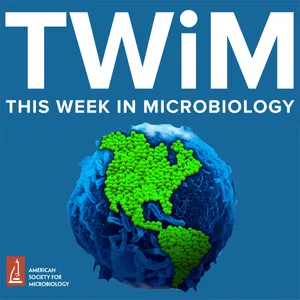
This Week in Microbiology is a podcast about unseen life on Earth hosted by Vincent Racaniello and friends. Following in the path of his successful shows 'This Week in Virology' (TWiV) and 'This Week in Parasitism' (TWiP), Racaniello and guests produce an informal yet informative conversation about microbes which is accessible to everyone, no matter what their science background.
Latest Episodes
The most recent episodes — sign up to get AI-powered summaries of each one.
- 1 weeks ago47 min
364: DNA Damage as Defense Against Bee Pathogens
TWiM wonders why archaea are not pathogenic, and reveals how a colibactin produced by a honeybee gut symbiont defends against pathogens. Become a patron of TWiM. Links for this episode: Why are archaea not pathogenic? (mBio) <p dir="ltr"
- 3 weeks ago58 min
363: Why Vegetables Are Good for Your Heart
TWiM the finding that Bunsen burners do not decrease deposition of microbe-containing particles, and how gut microbiota generate dinitrosyl iron complexes with cardiometabolic benefits. Become a patron of TWiM. Links for this episode: Bunsen burners don't do what you thought they did (Micro Spectrum) <span style= "font-size: 12pt; font-family: Arial, sans-serif; color: #1155cc; background-color: transparent; font-weight: 400; font-style: normal; font-variant-l
- Aug 29, 202651 min
362: When Gut Bacteria Share Chromosomes
TWiM explains how movement of DNA among gut bacteria drive large-scale genome mosaicism, and validation of a method for detection of Cyclospora cayetanensis in outbreak-linked fresh produce. Become a patron of TWiM. Links for this episode: Natural DNA transformation in the gut (ISME J) <li dir="ltr" style= "list-style-type: disc; font-size: 12pt; font-family: Arial, sans-serif; color: #000000; background-color: transparent; font-weight: 400; font-style: normal; font-variant-ligatures: normal; font-variant-caps: normal; font-variant-alternates: normal; font-variant-numeric: normal; font-variant-east-asian: normal; font-variant-position: normal; font-variant-emoji: normal; text-decoration: none; vertical-align: baseline; white-space: pre;" a
- Aug 14, 202653 min
361: Bacteria and Colon Cancer Recurrence
TWiM explains the discovery of avirulent bacterial signature associated with the development of recurrence following colorectal cancer surgery, and phage-derived proteins and conjugates that induce pilus detachment. Take the TWiM Survey
- Jul 31, 202656 min
Nitrogen Fixation Goes Eukaryotic
TWiM explains major implications of the link between plastic pollution and antimicrobial resistance, and the discovery of a new organelle, the nitrogen-fixing nitroplast. Hosts: Vincent Racaniello, Michael Schmidt, and Michele Swanson Become a patron of TWiM. Music used on TWiM is composed and performed by Ronald Jenkees and used with permission. Links for this episode Plastic pollution and antimicrobial resistance (Appl Envir Micro) The great Pacific garbage patch (YouTube) Rumen microbiome (Nat Biotech) Nitrogen-fixing organelle in marine alga (Science) This cell just changed biology (YouTube) Take the TWiM Listener survey! Send your microbiology questions and comments (email or recorded audio) to twim@microbe.tv
- Jul 18, 202648 min
359: Kin Killing and Metal Hunger
TWiM explains how cannibalism shapes biofilm structure and composition in Bacillus subtilis, and the importance of manganese uptake in uropathogenic E. coli during urinary tract infection. Become a patron of TWiM. Links for this episode: Cannibalism shapes biofilm structure (mBio) <span style= "font-size: 12pt; font-family: Roboto, sans-serif; color: #1155cc; background-color: transparent; font-weight: 400; font-style: normal; font-variant-ligatures: normal; font-vari
- Jul 4, 202658 min
358: Gut Microbes and ALS
TWiM explains the connection between inflammation caused by microbial glycogen in the gut and amyotrophic lateral sclerosis, and how disruption of cysteine metabolism leads to synthetic lethality and in vivo fitness impairment in Acinetobacter baumannii. Become a patron of TWiM. Links for this episode: Myeloid c
- Jun 15, 202655 min
357: Remembering Elio at Tufts
TWiM visits Tufts University School of Medcine and are joined by John Coffin, Michael Malamy, and Verna Manni for a tribute to Elio Schaechter who was chair of Molecular Biology and Microbiology for 23 years.
Get This Week in Microbiology summaries in your inbox
Free AI-powered daily recaps. Key takeaways, quotes, and mentions — in a 5-minute read.
Get Free Summaries →Free forever for up to 3 podcasts. No credit card required.
You Might Also Like
Listeners also like.
This Week in Virology
A netcast discussing viruses that cause illness.
This Week in Parasitism
A science podcast exploring eukaryotic parasites, how they cause disease, and ways to prevent infections.
The Weirdest Thing I Learned This Week
Three science journalists share bizarre and little-known facts they’ve recently discovered.

Science Magazine Podcast
Weekly episodes covering original scientific research, global science news, and expert commentary.

Inquiring Minds
Explores the intersection of science and society through critical thinking and in-depth analysis.
This Podcast Will Kill You
Two epidemiologists explore the science, history, and impact of diseases and medical mysteries, one deadly topic at a time.
This Week in Tech (Audio)
A weekly roundtable of tech insiders discusses the latest developments in AI, robotics, computing, and digital privacy.
Unbiased Science
Dr. Jess Steier and guests analyze viral health claims using scientific evidence and explain key findings for everyday conversations.
The World, the Universe and Us
Explores big scientific questions about life, consciousness, climate, and the cosmos with expert scientists and New Scientist journalists.
This Week in Cardiology
A weekly summary and analysis of key developments in cardiology for healthcare professionals.
In Our Time: Science
Discusses scientific principles, theories, and influential figures in the development of science.
Radiolab Podcasts (Radiolab)
WNYC Studios
About This Week in Microbiology
This Week in Microbiology is a podcast about unseen life on Earth hosted by Vincent Racaniello and friends. Following in the path of his successful shows 'This Week in Virology' (TWiV) and 'This Week in Parasitism' (TWiP), Racaniello and guests produce an informal yet informative conversation about microbes which is accessible to everyone, no matter what their science background.
Customized Recaps
AI-powered recaps with compact key takeaways, quotes, and insights.
Straight to Your Inbox
Get key takeaways from This Week in Microbiology in a 5-minute read.
Save Hours Every Week
Stay current on your favorite podcasts without falling behind.
Frequently Asked Questions
What is Podzilla's This Week in Microbiology daily summary?
It's a free AI-powered email that summarizes new episodes of This Week in Microbiology as soon as they're published. You get the key takeaways, notable quotes, and links & mentions — all in a quick read.
How does the This Week in Microbiology podcast summary work?
When a new episode drops, our AI transcribes and analyzes it, then generates a personalized summary tailored to your interests and profession. It's delivered to your inbox every morning.
Is this an official This Week in Microbiology product?
No. Podzilla is an independent service that summarizes publicly available podcast content. We're not affiliated with or endorsed by Vincent Racaniello.
Can I get summaries of other podcasts too?
Absolutely! The free plan covers up to 3 podcasts. Upgrade to Pro for 15, or Premium for 50. Browse our full catalog at /podcasts.
How often does This Week in Microbiology release new episodes?
This Week in Microbiology publishes biweekly. Our AI generates a summary within hours of each new episode.
What topics does This Week in Microbiology cover?
This Week in Microbiology covers topics including Science, Natural Sciences, Life Sciences. Our AI identifies the specific themes in each episode and highlights what matters most to you.
Start getting This Week in Microbiology summaries tomorrow morning.
Free forever for up to 3 podcasts. No credit card required.
Free forever for up to 3 podcasts. No credit card required.