Free Daily Podcast Summary
Hayek Program Podcast: Daily Summaries Delivered
by Mercatus Center at George Mason University
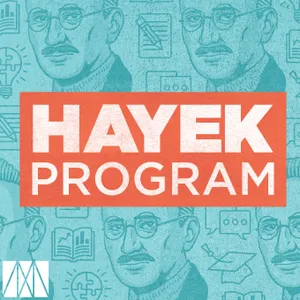
The Hayek Program Podcast includes audio from lectures, interviews, and discussions of scholars and visitors from the F. A. Hayek Program for Advanced Study in Philosophy, Politics, and Economics at the Mercatus Center at George Mason University. The F. A. Hayek Program is devoted to the promotion of teaching and research on the institutional arrangements that are suitable for the support of free and prosperous societies. Implicit in this statement is the presumption that those arrangements are to some extent open to conscious selection, as well as the appreciation that the type of arrangements that are selected within a society can influence significantly the economic, political, and moral character of that society.
Latest Episodes
The most recent episodes — sign up to get AI-powered summaries of each one.
- Sep 2, 20261h 40m
The Hayekian Triangle: James Buchanan and the Challenge of Self-Government
On the second episode of The Hayekian Triangle, Virgil Storr, Peter Boettke, and Chris Coyne examine James Buchanan’s views on human nature and self-government. They place Buchanan’s essays “Natural and Artifactual Man” and “Afraid to Be Free” in conversation, exploring the tension between human beings’ capacity for self-creation and their desire for protection from uncertainty and responsibility. The discussion considers education as a transformative process, the relationship between freedom and accountability, the dangers of state paternalism, the role of civil society, and the challenge classical liberals face in offering a compelling alternative to dependence on the state. The trio also reflect on Buchanan’s intellectual legacy, the importance of lifelong learning, and the conditions necessary for a self-governing society.**This episode was recorded on July 31, 2026**If you like the show, please subscribe, leave a 5-star review, and tell others about the show! We're available on Apple Podcasts, Spotify, Amazon Music, and wherever you get your podcasts.Check out our other podcast from the Hayek Program! Virtual Sentiments is a podcast in which political theorist Kristen Collins interviews scholars and practitioners grappling with pressing problems in political economy with an eye to the past. Subscribe today!Follow the Hayek Program on Twitter: @HayekProgramFollow the Mercatus Center on Twitter: @mercatusCC Music: Twisterium
- Aug 19, 20261h 7m
Brianne Wolf on Liberalism with Taste
On this episode of the Hayek Program Podcast, Peter Boettke sits down with Brianne Wolf to explore Adam Smith’s enduring relevance for liberalism, political economy, and contemporary debates about markets and democracy. Wolf discusses her forthcoming book, Beyond Rights and Price: Liberalism with Taste, and explains how thinkers including Smith, Hume, Rousseau, and Tocqueville illuminate the role of taste, judgment, sympathy, and persuasion in sustaining a liberal society. Their conversation ranges from changing student attitudes toward inequality, expertise, and democracy to Smith’s concern for the least advantaged, the relationship between the Scottish Enlightenment and the American founding, and the challenge classical liberals face in responding to critiques of capitalism. Boettke and Wolf also consider cosmopolitanism, the importance of local ties and civil society, and what the renewed attention surrounding the 250th anniversary of The Wealth of Nations can teach us about the liberal tradition.Dr. Brianne Wolf is Associate Professor of Political Theory and Director of the Political Economy minor at James Madison College at Michigan State University. Her current project, Beyond Rights and Price: Liberalism with Taste, explores the role of taste as a supplement to market relations and the legal framework of rights, fostering the moral possibilities of commercial society and the emotional connections between citizens that are necessary for a robust liberal politics.**This episode was recorded on July 28, 2026**Show Notes:Peter Boettke, The Struggle for a Better World (Mercatus Center, 2021)Carl Menger, “The Social Theories of Classical Political Economy and Modern Economic Policy”Bernard Yack, The Longing for Total Revolution: Philosophic Sources of Social Discontent from Rousseau to Marx and Nietzsche (University of California Press, 2022)Garry Wills, Inventing America: Jefferson's Declaration of Independence (Knopf Doubleday Publishing Group, 2018)Edward Gibbon, The History of the Decline and Fall of the Roman Empire: Abridged Edition (Penguin Classics, 2001)Martha C. Nussbaum, The Cosmopolitan Tradition: A Noble but Flawed Ideal (Harvard University Press, 2021)Glory M. Liu, Adam Smith’s America: How a Scottish Philosopher Became an Icon of American Capitalism (Princeton University Press, 2022)James R. Otteson, Adam Smith's Marketplace of Life (Cambridge University Press, 2002)If you like the show, please subscribe, leave a 5-star review, and tell others about the show! We're available on Apple Podcasts, Spotify, Amazon Music, and wherever you get your podcasts.Check out our other podcast from the Hayek Program! Virtual Sentiments is a podcast in which political theorist Kristen Collins interviews scholars and practitioners grappling with pressing problems in political economy with an eye to the past. Subscribe today!Follow the Hayek Program on Twitter: @HayekProgramFollow the Mercatus Center on Twitter: @mercatusCC Music: Twisterium
- Aug 5, 20261h 6m
Sympathy, Justice, and the Impartial Spectator with Kristen Collins
On this episode of the Hayek Program Podcast, Peter Boettke sits down with Kristen Collins for a wide-ranging conversation on Adam Smith's moral philosophy and its intersection with theories of justice, sympathy, and political power. The conversation moves through the relationship between sympathy, moral imagination, and the origins of our sense of justice, drawing on Michelle Schwarze's work on sympathetic resentment, before turning to why economists have historically misread Smith as indifferent to the poor and powerless — despite Smith's own repeated siding with the weak against the powerful. Boettke and Collins also explore Smith's "man of system" passages as a caution against imposing utopian visions by force, discuss Judith Shklar's "liberalism of fear" in relation to Hayek, and close with an extended look at Collins's research on Jeremy Bentham's little-known Sotomion — a proposed institution designed to protect unmarried pregnant women from social shame while preserving their social connections, offering a striking counterpoint to Bentham's more famous Panopticon.Dr. Kristen Collins is a Senior Fellow with the F.A. Hayek Program for Advanced Study in Philosophy, Politics, and Economics and a Senior Research Fellow at the Mercatus Center at George Mason University. She hosts the Virtual Sentiments podcast, which features conversations with scholars and practitioners reflecting on the ethics and politics of technology. She is currently working on a book, Seeing and Being Seen: Spectatorship and Surveillance in Liberal Democracies, under contract with Oxford University Press.**This episode was recorded on June 2, 2026**Show Notes:Kristen Collins, “Observed without Sympathy: Adam Smith on Inequality and Spectatorship” (American Journal of Political Science, 2020)Virtual Sentiments | Maria Pia Paganelli on 250 Years of Adam Smith’s Wealth of NationsVirtual Sentiments | Eileen Hunt on Mary Shelley and the Ethics of AIMartha C. Nussbaum, The Cosmopolitan Tradition: A Noble but Flawed Ideal (Harvard University Press, 2021)F.A. Hayek, “Individualism: True and False”Michelle Schwarze, Recognizing Resentment: Sympathy, Injustice, and Liberal Political Thought (Cambridge University Press, 2020)Carl Menger, “The Social Theories of Classical Political Economy and Modern Economic Policy”James R. Otteson, Adam Smith's Marketplace of Life (Cambridge University Press, 2012)Albert O. Hirschman, The Passions and the Interests: Political Arguments for Capitalism before Its Triumph (Princeton University Press, 2013)William Easterly, Violent Saviors: The West's Conquest of the Rest (Basic Books, 2025)Joshua L. Cherniss, <a rel="noreferrer noopener" target="_blank" href="https://press.princeton.edu/books/hardcover/9780691217031/liberalism-in-dark-times?srsltid=AfmBOopL6eD
- Jul 22, 202651 min
Don Boudreaux on The Wealth of Nations at 250
On this episode of the Hayek Program Podcast, Peter Boettke sits down with Don Boudreaux to mark the 250th anniversary of Adam Smith's An Inquiry into the Nature and Causes of the Wealth of Nations. Boudreaux reflects on his many years teaching a graduate seminar on Smith at George Mason University, the layers of insight he continues to discover on each re-read, and why so few professional economists ever read the book cover to cover despite its enduring relevance to questions of monopoly power, trade, taxation, and public debt. The conversation traces the relationship between The Wealth of Nations and Smith's earlier The Theory of Moral Sentiments, dismantling the old "Adam Smith Problem" and explaining why markets need both bourgeois virtue and hard institutional discipline to function. Boudreaux and Boettke also celebrate George Mason's distinctive culture as a "books department" shaped by mentors such as Roger Garrison, Walter Williams, and James Buchanan. Dr. Donald J. Boudreaux is a Senior Fellow with the F.A. Hayek Program for Advanced Study in Philosophy, Politics, and Economics at the Mercatus Center at George Mason University and a Professor of Economics and former economics-department chair at George Mason University. He is the author of many books, including The Triumph of Economic Freedom: Debunking the Seven Great Myths of American Capitalism (Rowman & Littlefield, 2025), The Essential Hayek (Fraser Institute, 2015), Hypocrites and Half-Wits: A Daily Dose of Sanity from Cafe Hayek (Free to Choose Press, 2012), and Globalization (Greenwood Press, 2007).**This episode was recorded on May 28, 2026**Show Notes:Adam Smith, An Inquiry into the Nature and Causes of the Wealth of Nations (Liberty Fund, 1982)Adam Smith, The Theory of Moral Sentiments (Liberty Fund, 1982)David Hume, A Treatise of Human Nature (Liberty Fund, 1896)John Maynard Keynes, The General Theory Of Employment, Interest, And Money (Harper Collins, 1965)James M. Buchanan, What Should Economists Do? (Liberty Fund, 1979)James M. Buchanan and Richard E. Wagner, Democracy in Deficit: The Political Legacy of Lord Keynes (Liberty Fund, 2000)George F. Will, The Conservative Sensibility (Grand Central Publishing, 2019)Liberty Matters | “Deirdre McCloskey and Economists’ Ideas about Ideas”If you like the show, please subscribe, leave a 5-star review, and tell others about the show! We're available on Apple Podcasts, Spotify, Amazon Music, and wherever you get your podcasts.Check out our other podcast from the Hayek Program! Virtual Sentiments is a podcast in which political theorist Kristen Collins interviews scholars and practitioners grappling with pressing problems in political economy with an eye to the past. Subscribe today!Follow the Hayek Program on Twitter: @HayekProgramFollow the <a rel="noreferrer noopener" t
- Jul 8, 20261h 7m
Paul Dragos Aligica — 2024 Markets and Society Conference Keynote
On this episode of the Hayek Program Podcast, Paul Dragos Aligica delivers a keynote lecture at the 2024 Markets & Society conference on resilience as a research frontier in mainline political economy. He traces how resilience has been largely absent from comparative economic systems scholarship, only to explode as a topic in the last decade, mostly imported from ecology and complexity theory rather than economics.He maps how three traditions at the core of the Mercatus research program—Austrian economics, public choice, and Ostromian institutionalism—each shape our understanding of resilience. Aligica also addresses claims that resilience thinking is merely a proxy for neoliberalism, closing with reflections on the normative stakes of self-governing societies.Dr. Paul Dragos Aligica is a Senior Research Fellow with the F.A. Hayek Program for Advanced Study in Philosophy, Politics, and Economics at the Mercatus Center at George Mason University, KPMG Professor of Governance at the University of Bucharest, and a Senior Nonresident Scholar with the Center for Governance and Markets at the University of Pittsburgh. His many publications include Governing Differences: Social Diversity, Polycentric Political Economy and Modus Vivendi (Edward Elgar, 2025) coauthored with Jennifer Brick Murtazashvili, Public Governance and the Classical Liberal Perspective: Political Economy Foundations (Oxford University Press, 2019), and Public Entrepreneurship, Citizenship, and Self-Governance (Cambridge University Press 2018).**This episode was recorded on October 11, 2024**If you like the show, please subscribe, leave a 5-star review, and tell others about the show! We're available on Apple Podcasts, Spotify, Amazon Music, and wherever you get your podcasts.Check out our other podcast from the Hayek Program! Virtual Sentiments is a podcast in which political theorist Kristen Collins interviews scholars and practitioners grappling with pressing problems in political economy with an eye to the past. Subscribe today!Follow the Hayek Program on Twitter: @HayekProgramFollow the Mercatus Center on Twitter: @mercatusCC Music: Twisterium
- Jun 24, 202623 min
Bobbi Herzberg — 2025 Markets and Society Conference Keynote
On this episode of the Hayek Program Podcast, Bobbi Herzberg delivers a keynote lecture at the 2025 Markets & Society conference on Vincent Ostrom’s understanding of democracy and self-governance. Reflecting on Ostrom’s life, scholarship, and enduring influence, Herzberg explores four central themes in his work: the emergence of social order through shared beliefs and norms, the capacity of individuals to govern themselves, the importance of polycentric systems of governance, and the fragility of democratic institutions. Drawing on Ostrom’s collaborations with his wife, Elinor Ostrom, and his engagement with the writings of Alexis de Tocqueville, Herzberg argues that democracy is not a mechanism imposed from above but an ongoing practice of cooperation, deliberation, and mutual responsibility. She concludes by emphasizing Ostrom’s vision of democracy as a living experiment in self-government that must be renewed and sustained by each generation. Dr. Roberta Herzberg is a Distinguished Senior Fellow and a Senior Research Fellow with the F.A. Hayek Program for Advanced Study in Philosophy, Politics, and Economics at the Mercatus Center at George Mason University and a Senior Fellow at the Fraser Institute.**This episode was recorded on October 17, 2025**If you like the show, please subscribe, leave a 5-star review, and tell others about the show! We're available on Apple Podcasts, Spotify, Amazon Music, and wherever you get your podcasts.Check out our other podcast from the Hayek Program! Virtual Sentiments is a podcast in which political theorist Kristen Collins interviews scholars and practitioners grappling with pressing problems in political economy with an eye to the past. Subscribe today!Follow the Hayek Program on Twitter: @HayekProgramFollow the Mercatus Center on Twitter: @mercatusCC Music: Twisterium
- Jun 10, 202639 min
Emily Chamlee-Wright — 2025 Markets and Society Conference Keynote
On this episode of the Hayek Program Podcast, Emily Chamlee-Wright delivers a keynote lecture at the 2025 Markets & Society conference on the precarious state of liberalism and the cultural foundations necessary to sustain a free society. Drawing on the cultural economy framework she developed with Virgil Storr, Chamlee-Wright argues that liberalism faces not only overt constitutional threats but a deeper "soft tissue" problem: the erosion of the values, norms, and habits that make formal institutions work. Once degraded, she warns, no legislative remedy can restore them. She walks through four dimensions of this cultural ecosystem, shared mental models, generalized norms, cultural tools, and social networks, and shows how they can either reinforce liberal resilience or spiral into vicious cycles of decay. She closes with an urgent call to action: liberal intellectuals and scholars must boldly deploy the cultural tools at their disposal, the stories, symbols, and founding ideals of a free society to decisively reverse the illiberal drift before it becomes irreversible.Dr. Emily Chamlee-Wright is a senior affiliated scholar and Board Member at the Mercatus Center at George Mason University. She is the President and CEO of the Institute for Humane Studies and the author of numerous books, including The Cultural Foundations of Economic Development (Routledge 1997) and Culture and Enterprise (Routledge 2000), co-authored with the late Don Lavoie.**This episode was recorded October 19, 2025**If you like the show, please subscribe, leave a 5-star review, and tell others about the show! We're available on Apple Podcasts, Spotify, Amazon Music, and wherever you get your podcasts.Check out our other podcast from the Hayek Program! Virtual Sentiments is a podcast in which political theorist Kristen Collins interviews scholars and practitioners grappling with pressing problems in political economy with an eye to the past. Subscribe today!Follow the Hayek Program on Twitter: @HayekProgramFollow the Mercatus Center on Twitter: @mercatusCC Music: Twisterium
- May 27, 20261h 32m
The Hayekian Triangle: The Wealth of Nations at 250
Welcome to our new series, The Hayekian Triangle. This series will feature a range of conversations between our hosts: Virgil Storr, Chris Coyne, and Peter Boettke. On this episode, the three sit down to mark the 250th anniversary of Adam Smith's The Wealth of Nations — and to ask a deceptively simple question: why are we still reading a book written a quarter-millennium ago?From the invisible hand to the division of labor, Smith's ideas have become so embedded in how we think about markets and society that it's easy to forget just how radical they originally were. Virgil, Chris, and Pete dig into what Smith actually said, why the standard takes on laissez-faire and self-interest so often miss the mark, and what a Scottish moral philosopher writing in 1776 still has to teach us about wealth, poverty, and the institutions that make human flourishing possible.Whether you're coming to Smith for the first time or returning to him with fresh eyes, this conversation is a reminder that the greatest works in political economy aren't monuments to be admired from a distance — they remain living inputs into the science of today.**This episode was recorded on April 3, 2026**Show Notes:Adam Smith, The Wealth of Nations (Liberty Fund, 1982)Adam Smith, The Theory of Moral Sentiments (Liberty Fund, 1982)Kenneth Boulding, "After Samuelson, Who Needs Adam Smith?" (History of Political Economy, 1971)Kenneth Boulding, "Economics as a Moral Science" (The American Economic Review, 1969)Daron Acemoglu and James Robinson, The Narrow Corridor: States, Societies, and the Fate of Liberty (Penguin Press, 2019)Raghuram Rajan, The Third Pillar: How Markets and the State Leave the Community Behind (Penguin Press, 2019)Deirdre McCloskey, The Bourgeois Virtues: Ethics for an Age of Commerce; Bourgeois Dignity: Why Economics Can't Explain the Modern World; Bourgeois Equality: How Ideas, Not Capital or Institutions, Enriched the World (University of Chicago Press, 2006, 2010, 2016)Martha Nussbaum, The Cosmopolitan Tradition: A Noble but Flawed Ideal (Belknap Press/Harvard University Press, 2019)Ludwig von Mises, “Why Read Adam Smith Today?” (FEE, 2015)Richard Ebeling, "Celebrating Adam Smith's Wealth of Nations at 250 Years" (Future of Freedom, 2026)If you like the show, please subscribe, leave a 5-star review, and tell others about the show! We're available on Apple Podcasts, Spotify, Amazon Music, and wherever you get your podcasts.Check out our other podcast from the Hayek Program! Virtual Sentiments is a podcast in which political theorist Kristen Collins interviews scholars and practitioners grappling with pressing problems in political economy with an eye to the past. Subscribe today!Follow the Hayek Program on Twitter: @HayekProgramFollow the <a rel="n
Get Hayek Program Podcast summaries in your inbox
Free AI-powered daily recaps. Key takeaways, quotes, and mentions — in a 5-minute read.
Get Free Summaries →Free forever for up to 3 podcasts. No credit card required.
You Might Also Like
Listeners also like.

Conversations with Tyler
Discussions with intellectuals and experts on ideas, culture, and global issues.
CSPI Podcast
Conversations with CSPI scholars and experts on topics in science, technology, and politics.

Capital Record
David Bahnsen discusses free markets and capitalism with business leaders and economists.
Reading Hannah Arendt with Roger Berkowitz
Close readings of Hannah Arendt’s works paired with interviews exploring her ideas on politics, thought, and the human condition.
Political Theory 101
A podcast that explores foundational ideas and thinkers in political theory.

The Ezra Klein Show
Conversations on pressing political, social, and cultural issues with experts and thinkers.
Optimist Economy
Economists analyze U.S. economic challenges like housing, healthcare, and retirement, pairing data and history with practical solutions.
Platypus Economics with Justin Wolfers
Economics applied to global events and daily life, explained clearly and engagingly.
The Cato Weekly Podcast
Scholars and analysts examine liberty, limited government, free markets, and peace through a libertarian lens.
In Our Time: Philosophy
Discusses philosophers, theories, and key themes in philosophy, from altruism to Wittgenstein.

After Hours
Three Harvard Business School professors discuss current events where business meets culture, offering insightful and unconventional takes.
Capitalisn't
Examines the flaws in modern capitalism and explores solutions with insights from economics and business journalism.
About Hayek Program Podcast
The Hayek Program Podcast includes audio from lectures, interviews, and discussions of scholars and visitors from the F. A. Hayek Program for Advanced Study in Philosophy, Politics, and Economics at the Mercatus Center at George Mason University. The F. A. Hayek Program is devoted to the promotion of teaching and research on the institutional arrangements that are suitable for the support of free and prosperous societies. Implicit in this statement is the presumption that those arrangements are to some extent open to conscious selection, as well as the appreciation that the type of arrangements that are selected within a society can influence significantly the economic, political, and moral character of that society.
Customized Recaps
AI-powered recaps with compact key takeaways, quotes, and insights.
Straight to Your Inbox
Get key takeaways from Hayek Program Podcast in a 5-minute read.
Save Hours Every Week
Stay current on your favorite podcasts without falling behind.
Frequently Asked Questions
What is Podzilla's Hayek Program Podcast daily summary?
It's a free AI-powered email that summarizes new episodes of Hayek Program Podcast as soon as they're published. You get the key takeaways, notable quotes, and links & mentions — all in a quick read.
How does the Hayek Program Podcast podcast summary work?
When a new episode drops, our AI transcribes and analyzes it, then generates a personalized summary tailored to your interests and profession. It's delivered to your inbox every morning.
Is this an official Hayek Program Podcast product?
No. Podzilla is an independent service that summarizes publicly available podcast content. We're not affiliated with or endorsed by Mercatus Center at George Mason University.
Can I get summaries of other podcasts too?
Absolutely! The free plan covers up to 3 podcasts. Upgrade to Pro for 15, or Premium for 50. Browse our full catalog at /podcasts.
How often does Hayek Program Podcast release new episodes?
Hayek Program Podcast publishes biweekly. Our AI generates a summary within hours of each new episode.
What topics does Hayek Program Podcast cover?
Hayek Program Podcast covers topics including Science, Social Sciences. Our AI identifies the specific themes in each episode and highlights what matters most to you.
Start getting Hayek Program Podcast summaries tomorrow morning.
Free forever for up to 3 podcasts. No credit card required.
Free forever for up to 3 podcasts. No credit card required.