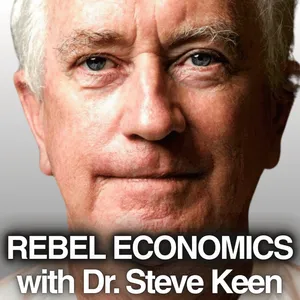
Free Daily Podcast Summary
Rebel Economics with Professor Steve Keen: Daily Summaries Delivered
by Dr. Steve Keen
Learn 50+ Years of Economics in 10 mins a day. Join Dr. Steve Keen as he shows you how he predicted the 2008 Financial Crisis YEARS before it happened. Welcome to Rebel Economics with Dr. Steve Keen, hosted by the distinguished economist
Latest Episodes
The most recent episodes — sign up to get AI-powered summaries of each one.
- 2 weeks ago22 min
Top Economist: NEW "Tax The Rich" Rule Will Change The US Economy Forever
👉 Learn 50+ years of economics in only 7 weeks: https://www.skool.com/stevekeen📚 Download my 3-Book Rebel Economist Bundle (Free this week here): https://www.stevekeen.com--------------- 👉 Learn 50+ years of economics in only 7 weeks: https://www.skool.com/stevekeenDownload my 3-Book Rebel Economist Bundle (Free this week here): https://www.stevekeen.comIs a billionaire tax actually the solution for California's economic issues? Economist Steve Keen breaks down why this policy misses the mark.This analysis examines the proposed billionaire tax in California and critiques its effectiveness as a tool for economic reform. By reviewing the actual financial flows and existing tax structures, the video explains why policymakers might be targeting the wrong metrics. If you are interested in how economic policy impacts the broader financial system, this breakdown provides a clear look at the structural realities behind these proposals.We also look at the decline of worker income share and why current strategies often fail to address the root causes of wealth disparity. Steve Keen uses charts and diagrams to illustrate how capital accumulation functions differently than many assume. Understanding these mechanisms is essential for anyone following debates on fiscal policy and economic inequality.Subscribe for weekly economic policy breakdowns, and comment below with your thoughts on whether a wealth tax is a viable solution for the current economic climate.Can federal spending actually unite California? Learn why current economic policy models might be based on outdated accounting.This video examines the disconnect between public perception of federal debt and the actual mechanics of government finance. If you are interested in how California could bridge the gap between billionaires and the working class, this breakdown clarifies the core argument presented. We look at the specific proposal suggesting that union organizing and a shift in fiscal strategy could resolve long-standing economic tensions.By challenging the standard economic textbooks that define modern political discourse, this analysis offers a fresh perspective on why we worry about the national debt. You will understand why the current framing of federal spending is often criticized as a false model and what that means for future economic policy. We focus on the practical implications of changing these accounting methods rather than just the political rhetoric.Subscribe for weekly economic policy breakdowns and comment below on which financial theory you want us to explain next.----👉 Download my 3-Book Rebel Economist Bundle (Free this week here): https://www.stevekeen.com----#USEconomy #SteveKeen #BritainCrisis #EconomicCollapse #Neoliberalism #UKPolitics #DebtCrisis #LabourParty #StarmerResignation
- 2 weeks ago21 min
What Happens to Your Debt if the Dollar Collapses: Top Economist
👉 Learn 50+ years of economics in only 7 weeks: https://www.skool.com/stevekeen📚 Download my 3-Book Rebel Economist Bundle (Free this week here): https://www.stevekeen.com--------------- 👉 Learn 50+ years of economics in only 7 weeks: https://www.skool.com/stevekeenDownload my 3-Book Rebel Economist Bundle (Free this week here): https://www.stevekeen.comWhat if everything you've been told about the national debt is wrong?A top economist sits down with a Government Accountability Office report warning Congress of an imminent debt crisis and systematically dismantles it. Using double-entry bookkeeping and live simulations, he reveals that government deficits don't "crowd out" the private sector they create money. The real threat isn't the $39.4 trillion national debt. It's the private debt sitting on household balance sheets, crushing the velocity of money and dragging GDP down with it. This is the argument the mainstream doesn't want you to hear.✅ How government deficits actually create money not destroy it✅ Why the GAO and CBO are using a 19th-century model of banking✅ The double-entry bookkeeping truth banks don't advertise✅ Why reducing private debt is more urgent than cutting government spending✅ What happens to your mortgage, savings, and purchasing power if the dollar collapses✅ The velocity of money crisis no one is talking about Top economist Steve Keen warns that the U.S. debt crisis headlines are pointing at the wrong target.Government debt is a symptom private debt is the disease. The dollar collapse scenario everyone fears won't come from the national debt ceiling. It will come from a private debt deflation that mainstream economists, the Federal Reserve, and the GAO continue to ignore. If you're searching for financial education, economic analysis, or simply trying to understand what causes a fiat currency collapse, this breakdown of private debt vs public debt, velocity of money, and real money creation is essential viewing before the next recession hits.----👉 Download my 3-Book Rebel Economist Bundle (Free this week here): https://www.stevekeen.com----#USEconomy #SteveKeen #BritainCrisis #EconomicCollapse #Neoliberalism #UKPolitics #DebtCrisis #LabourParty #StarmerResignation
- 2 weeks ago27 min
The Real Reason Governments Can’t Just Print More Money: Top Economist
👉 Download my 3-Book Rebel Economist Bundle (Free this week here): https://www.stevekeen.comWhy do mainstream economics models fail to predict financial crises? Economist Steve Keen explains the ignored role of private debt.Mainstream economics often overlooks the mechanics of how banks create money, leading to a fundamental misunderstanding of our financial system. This discussion breaks down why conventional models fail to account for the massive impact of private debt on our economy. If you have ever questioned why standard forecasts miss the mark during market downturns, this analysis provides the missing context.Steve Keen argues that private debt acts as the primary engine behind economic booms and busts, rather than government spending or interest rates alone. By examining the reality of credit creation, you will gain a clearer picture of what actually drives financial instability. We also address common misconceptions surrounding government debt and how it functions compared to private lending.Subscribe for weekly economic theory breakdowns, and comment below with your thoughts on whether private debt or government policy is the bigger risk to the economy.Who is Dr. Steve Keen?Dr. Steve Keen is an influential economist who has dedicated over 50 years to challenging mainstream economic theories. Since his days as a university student, he has been engaged in a David vs. Goliath battle against conventional economic models. Holding a Ph.D. in economics, Dr. Keen is well-known for his critical analysis and advocacy for more realistic economic approaches. His work emphasizes the importance of accounting for financial instability and incorporates elements of complex systems theory. Curious Minds, Engineers, and Finance Professionals will appreciate his methodical breakdown of economic phenomena and his development of the Minsky software, which models financial crises. Dr. Keen's contributions are crucial for anyone seeking a deeper understanding of how economic systems can impact technological and financial environments. His teachings offer valuable insights into the economic forces shaping our world. By following his analysis, professionals can gain a better grasp of economic dynamics that influence their fields.----👉 Download my 3-Book Rebel Economist Bundle (Free this week here): https://www.stevekeen.com----#usinflation #stevekeen #newworldorder #financialcrash #oilprices #Famine2026 #economiccollapse #trumpiran #irannuclear #energymarkets #chinaeconomy
- 3 weeks ago10 min
The New Fed Chair's Plan to Cancel $39T Debt Crisis: Top Economist
👉 Download my 3-Book Rebel Economist Bundle (Free this week here): https://www.stevekeen.comIn 2026, Kevin Warsh steps into the most powerful economic role on earth Federal Reserve Chairman inheriting America's staggering $39 trillion debt. World-renowned economist Steve Keen, who famously predicted the 2008 global financial crisis, delivers a sobering warning: Warsh is "cut from the same cloth" as every Fed chair before him. Trained in neoclassical economics a discipline Keen argues is built on fantasies that completely ignore money, banks, and private debt Warsh won't bring the radical change America desperately needs. Meanwhile, Trump's military escalation in the Strait of Hormuz has triggered a supply shock that conventional economists are misdiagnosing as demand-driven inflation. By raising interest rates to fight the wrong enemy, the Fed is accelerating bankruptcies, crushing the private sector, and destabilizing the very economy it claims to protect. Keen's verdict? 2026 is the year of chaos a financial crisis born not of market forces, but of human ignorance.Why did Trump pick Kevin Warsh as the next Federal Reserve Chairman and what happens when Warsh inevitably disappoints him? How could a Strait of Hormuz blockade disrupt global fertilizer, helium, and sulfuric acid supplies and trigger a worldwide food crisis? Why does Steve Keen argue that raising interest rates during a supply shock actually causes more bankruptcies, not less inflation? What is neoclassical economics hiding and how do its "fantasy models" that ignore private debt make every financial crisis worse? Will Trump turn on his own hand-picked Fed chair the same way he turned on Jerome Powell? What role will the biggest El Niño in history play in the economic collapse of 2026?In this in-depth economic analysis, top economist Steve Keen breaks down why the new Federal Reserve Chairman Kevin Warsh cannot solve the United States' spiraling $39 trillion debt crisis. As the Iran war escalates and the Strait of Hormuz blockade threatens global oil prices and supply chains, conventional economic policy, driven by flawed neoclassical economics, continues raising interest rates despite clear evidence this is a supply shock, not demand-driven inflation. Keen warns that Trump's Federal Reserve appointment will fail to prevent the coming global economic crisis, as private debt burdens crush American households and firms. With El Niño's economic impact compounding the destruction of productive capacity, 2026 is shaping up to be a year of unprecedented financial chaos.00:00 — Kevin Warsh: The New Federal Reserve Chairman01:15 — Meet Steve Keen: The Economist Who Predicted the 2008 GFC02:30 — Why 2026 Is "The Year of Chaos"03:30 — Neoclassical Economics: A Fantasy World That Ignores Money & Debt04:30 — Why Warsh Is "Cut from the Same Cloth" as Every Fed Chair Before Him05:30 — Supply Shock vs. Demand Shock: The Fed Is Fighting the Wrong War06:30 — Strait of Hormuz: Fertilizer, Helium & Sulfuric Acid — The Hidden Supply Chain07:30 — How Interest Rate Hikes Actually Cause More Bankruptcies08:30 — Trump Will Turn on Warsh It's Only a Matter of Time09:30 — 2026: A Financial Crisis Caused Purely by Human Ignorance----👉 Download my 3-Book Rebel Economist Bundle (Free this week here): https://www.stevekeen.com----#usinflation #stevekeen #newworldorder #financialcrash #oilprices #Famine2026 #economiccollapse #trumpiran #irannuclear #energymarkets #chinaeconomy
- 3 weeks ago18 min
The Real Reason Why Keir Starmer Has Resigned: Top Economist
👉 Download my 3-Book Rebel Economist Bundle (Free this week here): https://www.stevekeen.comWhen Keir Starmer walked into Downing Street two years ago, he promised to fix what was broken. Instead, he became the latest prime minister crushed by forces far bigger than one man's leadership. In this video, top economist Steve Keen the man who predicted the 2008 Global Financial Crisis explains why Starmer's resignation isn't a personal failure. It's the inevitable result of 40 years of neoliberal economic policy that has trebled UK private debt, collapsed the velocity of money to just 1.2 times per year, and redistributed wealth from the working class to asset owners. Britain's economy hasn't just slowed it's been hollowed out, and no prime minister, not Starmer, not Cameron, not whoever comes next, can fix it without a fundamental shift in economic thinking.Why did Keir Starmer really resign? What happened to Britain's 4% per capita growth rate and why did it fall to just 1.8% under neoliberalism? How did UK private debt explode from under 60% of GDP to 180% in a single generation? What does the cyclically adjusted price-to-earnings ratio hitting 40 above 1929 crash levels signal about the next financial crisis? And why does Steve Keen argue that politicians keep applying the same failed policies, decade after decade, despite the data showing catastrophic results for the physical economy? If you've been asking what comes next for Britain after Starmer, this analysis answers the question no mainstream news coverage will touch.Key Themes:✅ Starmer's resignation as a symptom of systemic neoliberal failure, not personal incompetence✅ UK private debt tripled from under 60% to 180% of GDP between 1980 and the GFC✅ Per capita growth collapsed from 4% to 1.8% under neoliberal policy✅ Velocity of money declined from 2.2x to 1.2x, the hidden engine of economic stagnation✅ CAPE ratio at 40 signals a stock market more overvalued than before the 1929 crash✅ Why conventional economics textbooks keep producing politicians who repeat the same failuresWho is Dr. Steve Keen?Dr. Steve Keen is an influential economist who has dedicated over 50 years to challenging mainstream economic theories. Since his days as a university student, he has been engaged in a David vs. Goliath battle against conventional economic models. Holding a Ph.D. in economics, Dr. Keen is well-known for his critical analysis and advocacy for more realistic economic approaches. His work emphasizes the importance of accounting for financial instability and incorporates elements of complex systems theory. Curious Minds, Engineers, and Finance Professionals will appreciate his methodical breakdown of economic phenomena and his development of the Minsky software, which models financial crises. Dr. Keen's contributions are crucial for anyone seeking a deeper understanding of how economic systems can impact technological and financial environments. His teachings offer valuable insights into the economic forces shaping our world. By following his analysis, professionals can gain a better grasp of economic dynamics that influence their fields.----👉 Download my 3-Book Rebel Economist Bundle (Free this week here): https://www.stevekeen.com----#KeirStarmer #UKEconomy #SteveKeen #BritainCrisis #EconomicCollapse #Neoliberalism #UKPolitics #DebtCrisis #LabourParty #StarmerResignation
- 3 weeks ago19 min
Top Economist: What's Coming Is WORSE Than the 1973 Inflation Crisis
👉 Download my 3-Book Rebel Economist Bundle (Free this week here): https://www.stevekeen.comThe Start Of A New World Order and Why the new world order will be worse than you thinkIs the global financial system entering a new phase of instability?Are oil prices really about to crash overnight? Could the Iran War trigger a global food crisis in just 3 months? What happens when a financial crash expert connects the dots between military escalation and the collapse of your food supply?In this video, our financial crash expert breaks down the real economic earthquake behind the US-Israel-Iran war and why food prices rising is just the beginning.✅ How the iran war 2026 is already pushing oil price spike beyond what markets can handle✅ Why a full-scale iran nuclear war could crash global energy markets overnight triggering food supply collapse within 90 days✅ The truth behind trump war iran escalation and why ordinary people will pay the price at the grocery store✅ How the global food crisis is being accelerated by dollar instability and unchecked military spending✅ What the US, China & Russia are really fighting over and how it ends your access to affordable food✅ Iran's nuclear capability decoded and what it means for Middle East alliances and global supply chains✅ The hidden link between energy market crashes and the fastest-moving famine the modern world has ever seenQuestions this video answers:➡ Is the Iran war already causing food shortages?➡ How will rising oil prices lead to famine?➡ What is Trump's real agenda behind the Iran conflict?➡ Will the dollar collapse because of the Iran war?➡ How close are we to a global food supply crisis?➡ What happens to food prices when energy markets collapse?➡ Is a financial crash in 2025 now inevitable?This isn't speculation, it's geopolitical analysis backed by facts most channels are afraid to cover.Who is Dr. Steve Keen?Dr. Steve Keen is an influential economist who has dedicated over 50 years to challenging mainstream economic theories. Since his days as a university student, he has been engaged in a David vs. Goliath battle against conventional economic models. Holding a Ph.D. in economics, Dr. Keen is well-known for his critical analysis and advocacy for more realistic economic approaches. His work emphasizes the importance of accounting for financial instability and incorporates elements of complex systems theory. Curious Minds, Engineers, and Finance Professionals will appreciate his methodical breakdown of economic phenomena and his development of the Minsky software, which models financial crises. Dr. Keen's contributions are crucial for anyone seeking a deeper understanding of how economic systems can impact technological and financial environments. His teachings offer valuable insights into the economic forces shaping our world. By following his analysis, professionals can gain a better grasp of economic dynamics that influence their fields.----👉 Download my 3-Book Rebel Economist Bundle (Free this week here): https://www.stevekeen.com----#usinflation #stevekeen #newworldorder #financialcrash #oilprices #Famine2026 #economiccollapse #trumpiran #irannuclear #energymarkets #chinaeconomy
- Jun 25, 20268 min
Top Economist: U.S. Debt Bomb Is About to Wreck the Stock Market
👉 Download my 3-Book Rebel Economist Bundle (Free this week here): https://www.stevekeen.comThe US national debt death spiral is growing by $6 billion every single day, now totaling nearly $38 trillion. Learn why this matters for you.This breakdown covers the mechanics behind our current debt trajectory and the economic concept of secular stagnation. If you are trying to understand how excessive global savings and a consistent decline in corporate investment are reshaping the financial landscape, this analysis provides the necessary context.We examine the relationship between the US national debt and broader economic trends, moving past headlines to look at the structural issues at play. By analyzing the current US economy, you will gain clarity on why traditional growth models are shifting and what the massive scale of the national debt crisis implies for the future of investment.Subscribe for weekly economic breakdowns, and comment below with your thoughts on how secular stagnation impacts your financial planning.✅ The global economy was built on a theory that never worked mainstream economics ignores the role of credit and debt in driving economic performance✅ Steve Keen predicted the 2008 crash years before it happened by modeling private debt levels that mainstream economists refused to examine✅ The United States currently owes almost $40 trillion and is increasing at $6 billion every single day on pace to reach $50 trillion by 2030✅ Economies fall into two categories: "Walking Debt" (US, Spain, UK, Ireland) still carrying 2008 crisis debt anchors, and "Zombies to Be" (Canada, Australia, South Korea, China) that avoided 2008 by borrowing even more✅ The next global crisis is predicted within 1-3 years, with Canada and Australia as the standout nominations for where it will hit hardest✅ Australia doubled and trebled first-home buyer grants to restart a housing bubble delaying the inevitable crash by pushing debt to its ceiling✅ The US economy is "moderately strong" but fragile — private debt only reduced from 1.7x GDP to 1.5x before growing again, like climbing Mount Everest without oxygen✅ The Federal Reserve raising interest rates "in ignorance of the real economy" will trigger credit turning negative again, sucking the wind out of the economy-----👉 Download my 3-Book Rebel Economist Bundle (Free this week here): https://www.stevekeen.com-----#usdebtcrisis #usstockmarket #stevekeen #economynews #economiccollapse
- Jun 24, 202616 min
Top Economist: The Real Reason Why Trump Agreed to a Peace Deal
👉 Download my 3-Book Rebel Economist Bundle (Free this week here): https://www.stevekeen.comThis isn't a story about a peace deal. It's a story about what happens when the world's most powerful military machine meets a nation that refuses to break. When the bombs stopped falling on Iran, Donald Trump declared victory. But economist Steve Keen, the man who predicted the 2008 crash, tells a very different story: one where a superpower, unable to admit it was outmaneuvered, spins defeat as triumph. Behind the headlines are real human consequences shattered supply chains, looming fertilizer shortages, and the quiet threat of famine for millions who never asked for this war. While leaders posture, ordinary people from Tehran to Tel Aviv to towns nowhere near the conflict zone brace for the collateral damage that history shows never stays contained.Did Iran already have a nuclear weapons program before the war, or was the "dismantling" simply theater? Why did Israel push the United States into a conflict it couldn't win, and what happens when Netanyahu's government refuses to accept the ceasefire? Can the Iron Dome truly protect Israel now that Iran has demonstrated it can penetrate those defenses? Will the Strait of Hormuz remain open, or is the "victory" Trump claims merely a pause before the next blockade? And the biggest unanswered question: when the global fertilizer shortage hits and food prices spiral, who pays the real price for this failed intervention?In this Iran war explained analysis, economist Steve Keen breaks down the US Iran peace deal and why the Trump Iran ceasefire represents a strategic failure for American foreign policy. Covering the Middle East conflict 2026, the role of the military industrial complex, and the humanitarian cost of disrupted global supply chains, this video examines what the Israel Iran war escalation means for geopolitics in the region. From the Strait of Hormuz to Iran nuclear program concerns, oil price war impact analysis, and the ongoing Iran economy sanctions debate, Keen delivers the breaking news perspective mainstream outlets won't give you on Iran news and the real state of US foreign policy failure in the Middle East.-----👉 Download my 3-Book Rebel Economist Bundle (Free this week here): https://www.stevekeen.com-----#usiranwar #peacedeal #ceasefire #stevekeen #collapse
Get Rebel Economics with Professor Steve Keen summaries in your inbox
Free AI-powered daily recaps. Key takeaways, quotes, and mentions — in a 5-minute read.
Get Free Summaries →Free forever for up to 3 podcasts. No credit card required.
You Might Also Like
Listeners also like.

The Real Eisman Playbook
A legendary investor analyzes markets, economic trends, and financial crises with candid, no-nonsense commentary.
Optimist Economy
Economists discuss U.S. economic challenges and practical solutions to improve outcomes for workers, retirees, and aspiring Americans.

Planet Money Summer School
A crash course in economics that teaches fundamental concepts through real-world examples in everyday life.
Thoughtful Money with Adam Taggart
Expert advice on building wealth and managing money from top financial professionals.

EconTalk
Long-form conversations on economics, philosophy, history, and human behavior with experts from diverse fields.

It's The Economy
A weekly breakdown of economic concepts and their real-world impact, explained by experts in short, accessible episodes.
Planet Money
Explains how economic forces influence everyday life and global events through storytelling and deep dives into surprising topics.
The Economics Show
Explores pressing economic issues through expert analysis and conversations with Financial Times contributors and guest economists.

People I (Mostly) Admire
Economist Steve Levitt interviews high achievers across diverse fields, exploring their lives, work, and unconventional paths to success.

Pitchfork Economics with Nick Hanauer
A deep dive into middle-out economics and the shift away from trickle-down policies, featuring leading thinkers and policy experts.
Platypus Economics with Justin Wolfers
Economists Betsey Stevenson and Justin Wolfers explain core economic concepts and how they apply to everyday decisions.

The Paul Morris Podcast
Entrepreneurs and investors share strategies for building wealth, scaling businesses, and leading high-performance teams.
About Rebel Economics with Professor Steve Keen
Learn 50+ Years of Economics in 10 mins a day. Join Dr. Steve Keen as he shows you how he predicted the 2008 Financial Crisis YEARS before it happened. Welcome to Rebel Economics with Dr. Steve Keen, hosted by the distinguished economist
Customized Recaps
AI-powered recaps with compact key takeaways, quotes, and insights.
Straight to Your Inbox
Get key takeaways from Rebel Economics with Professor Steve Keen in a 5-minute read.
Save Hours Every Week
Stay current on your favorite podcasts without falling behind.
Frequently Asked Questions
What is Podzilla's Rebel Economics with Professor Steve Keen daily summary?
It's a free AI-powered email that summarizes new episodes of Rebel Economics with Professor Steve Keen as soon as they're published. You get the key takeaways, notable quotes, and links & mentions — all in a quick read.
How does the Rebel Economics with Professor Steve Keen podcast summary work?
When a new episode drops, our AI transcribes and analyzes it, then generates a personalized summary tailored to your interests and profession. It's delivered to your inbox every morning.
Is this an official Rebel Economics with Professor Steve Keen product?
No. Podzilla is an independent service that summarizes publicly available podcast content. We're not affiliated with or endorsed by Dr. Steve Keen.
Can I get summaries of other podcasts too?
Absolutely! The free plan covers up to 3 podcasts. Upgrade to Pro for 15, or Premium for 50. Browse our full catalog at /podcasts.
How often does Rebel Economics with Professor Steve Keen release new episodes?
Rebel Economics with Professor Steve Keen publishes daily. Our AI generates a summary within hours of each new episode.
What topics does Rebel Economics with Professor Steve Keen cover?
Rebel Economics with Professor Steve Keen covers topics including Science, Education, Business, Investing, Courses, Mathematics. Our AI identifies the specific themes in each episode and highlights what matters most to you.
Start getting Rebel Economics with Professor Steve Keen summaries tomorrow morning.
Free forever for up to 3 podcasts. No credit card required.
Free forever for up to 3 podcasts. No credit card required.