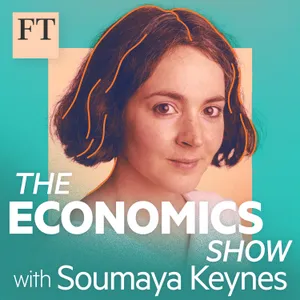
Free Daily Podcast Summary
The Economics Show: Daily Summaries Delivered
by Financial Times
The Economics Show with Soumaya Keynes is a new weekly podcast from the Financial Times packed full of smart, digestible analysis and incisive conversation. Soumaya Keynes digs deep into the hottest topics in economics along with a cast of FT colleagues and special guests. Come for the big ideas, stay for the nerdery.Soumaya Keynes is an economics columnist for the Financial Times. Prior to joining the FT she worked at The Economist for eight years as a staff writer, where as well as covering trade, the US economy and the UK economy she co-hosted the Money Talks podcast. She also co-founded the Trade Talks podcast. Hosted on Acast. See acast.com/privacy for more information.
Latest Episodes
The most recent episodes — sign up to get AI-powered summaries of each one.
- Yesterday31 min
Why Big Tech wants more economists
Tech companies are hiring economists to study how AI is reshaping work and society. But what happens when the companies building the technology also produce the research into its effects? Host Soumaya Keynes talks to Ara Kharazian, chief economist at Ramp and Peter McCrory chief economist at Anthropic, alongside FT data journalist John Burn-Murdoch, about why economists are in such demand, what proprietary data can reveal about AI’s impact, and whether industry-backed research can avoid conflicts of interest.Want more?Are economists making themselves too useful in the AI boom?Find John Burn Murdoch and Sara O’Connor’s The AI Shift newsletter herePresented by Soumaya Keynes. Produced by Mischa Frankl-Duval. Original music by Breen Turner, sound design by Sam Giovinco and Sean O’Garrety. Manuela Saragosa is the executive producer. Flo Phillips is the FT’s head of audio.Read a transcript of this episode on FT.com Hosted on Acast. See acast.com/privacy for more information.
- 1 weeks ago31 min
How to be a middle power in a superpower world. With Jenny Bates
The global economy is becoming increasingly hostile with tariffs, export controls and industrial policy being used as geopolitical weapons, while the world’s biggest powers compete for economic advantage. So where does that leave a middle power like Britain? Host Soumaya Keynes speaks to UK senior civil servant Jenny Bates, who’s just completed the Heywood Fellowship at Oxford university, where she got to think about Britain's place in the world and how it should adapt to a changing geopolitical seascape. They discuss what Britain can learn from historic partnerships and why closer co-operation between government and business could be crucial to navigating a more dangerous global economy.Subscribe to Soumaya's show on Apple, Spotify, Pocket Casts or wherever you listen.Further reading: Mark Carney urges EU to cement trade deal as Ottawa seeks pivot from USUrsula von der Leyen backs Canada’s ‘associate membership’ bidTrump lays a new trap for TakaichiPresented by Soumaya Keynes. Produced by Mischa Frankl-Duval. Original music and sound design by Breen Turner. Manuela Saragosa is the executive producer. Flo Phillips is the FT’s head of audio.Read a transcript of this episode on FT.com Hosted on Acast. See acast.com/privacy for more information.
- 2 weeks ago27 min
Can you spreadsheet your way to equal parenting? With Corinne Low
Dads today are doing more childcare than previous generations, so why hasn’t the parenting gap between mothers and fathers disappeared? One reason: mums are doing more too. Host Soumaya Keynes talks to Corinne Low, associate professor at the University of Pennsylvania's Wharton School and author of 'Femonomics’ (titled ‘Having it all’ in the US), about what the data tells us about how couples divide the work of raising a family and what same-sex couples can teach us about gender roles in parenting. Plus, can Soumaya’s parenting spreadsheet really help make childcare more equal?Subscribe to Soumaya's show on Apple, Spotify, Pocket Casts or wherever you listen.Further reading: The perks of parenting by spreadsheetCan AI improve parenting?Presented by Soumaya Keynes. Produced by Mischa Frankl-Duval. Original music and sound design by Samantha Giovinco and Breen Turner. Manuela Saragosa is the executive producer. Flo Phillips is the FT’s head of audio.Read a transcript of this episode on FT.com Hosted on Acast. See acast.com/privacy for more information.
- 3 weeks ago27 min
Will US debt burst the AI bubble? With Ruchir Sharma
Building data centres and running the US government have something in common: they cost a lot of money. Tech companies are borrowing heavily to fund the AI build out, just as Washington is borrowing vast sums to fund the US government, and those two borrowing binges may be on a collision course. Investors are already worried about America’s mounting debt burden and about whether the AI boom has become a bubble. Ruchir Sharma, chair of Rockefeller International and contributing editor to the FT, explains how the two worries might be more closely connected than they first appear, how rising US Treasury yields could raise borrowing costs for AI companies and which number investors should be watching.Subscribe to Soumaya's show on Apple, Spotify, Pocket Casts or wherever you listen.Further reading: Why America’s debt binge is starting to matterRead a transcript of this episode on FT.com Hosted on Acast. See acast.com/privacy for more information.
- 4 weeks ago32 min
Memory chip mania isn’t going away, with Dan Kim
In recent months, part of the chip market has been going bananas. Prices for memory chips – which AI data centres use in droves – have rocketed, as US tech companies lock in massive orders. That’s bad news for consumers facing more expensive electronic devices. But what are the broader consequences of misalignment in this market? How will the chip squeeze end? And, as memory chips become a strategic commodity, how are the US and China looking to secure supply? Host Soumaya Keynes is joined by Dan Kim, chief strategy officer at semiconductor analysis firm TechInsights and former chief economist at the CHIPS Program Office at the US Department of Commerce.Further reading: Why memory chips are the new frontier of the AI revolutionMemory chip boom leaves PC and smartphone makers in the coldMaybe the chips are down because memory’s too expensivePresented by Soumaya Keynes. Produced by Mischa Frankl-Duval. Original music and sound design by Breen Turner. Manuela Saragosa is the executive producer. Flo Phillips is the FT’s head of audio.Read a transcript of this episode on FT.com Hosted on Acast. See acast.com/privacy for more information.
- Aug 29, 202619 min
Kevin Warsh spoke — what did we learn? With Torsten Slok
Federal Reserve chair Kevin Warsh took to the stage at Jackson Hole under pressure. Inflation is sticky, bond markets have been wobbling and his insistence on minimal Fed communication has been seen by some to make matters worse. Soumaya speaks to Torsten Slok, chief economist at Apollo Global Management, to discuss what Warsh did (and didn’t say), the changing relationship between the Fed and the Treasury and how the central bank should fight America’s growing fiscal issues.Subscribe to Soumaya's show on Apple, Spotify, Pocket Casts or wherever you listen.Join Soumaya Keynes on Saturday September 5 at Kenwood House Gardens in London, or online as the FT Weekend paper comes to life. Register now at ft.com/festival and enjoy 10% off with code FTPODCAST.Further reading: Hawkish Kevin Warsh hints Fed will raise rates if inflation does not fall soonWarsh settles some nerves at Jackson HoleScott Bessent’s bond intervention puts US Treasury on collision course with Fed Presented by Soumaya Keynes. Produced by Mischa Frankl-Duval. Original music and sound design by Breen Turner. Manuela Saragosa is the executive producer. Flo Phillips is the FT’s head of audio.Read a transcript of this episode on FT.com Hosted on Acast. See acast.com/privacy for more information.
- Aug 21, 202650 min
From "The Story of Money": How a stock market crash gave birth to modern antisemitism
The 1873 Gründerkrach, the spectacular stock market crash that followed Germany’s unification, is one of history’s great financial maelstroms. But its most enduring legacy isn’t about money. Host Robin Wigglesworth speaks to Pulitzer Prize-winning author Liaquat Ahamed about how the resulting economic malaise fuelled social division and transformed old prejudices into antisemitic conspiracy. It gave birth to ideas that would resurface with catastrophic consequences decades later in the 20th century.Further reading:1873: The Rothschilds, the First Great Depression, and the Making of the Modern World (2026), by Liaquat Ahamed Gold and Iron: Bismarck, Bleichröder, and the Building of the German Empire (1977), by Fritz SternHosts: Gillian Tett and Robin WigglesworthSenior producers: Michela Tindera and Laurence Knight Executive producer: Manuela SaragosaOriginal music and sound design: Breen TurnerBroadcast engineers: Bianca Wakeman and Petros GioumpasisPodcast development: Laura ClarkeFT global head of audio: Flo Phillips Video editors: Josh Divney and Kristen Kenyon at Podcast DiscoveryLearn more at www.ft.com/tsom or get in touch at thestoryofmoney@ft.com Hosted on Acast. See acast.com/privacy for more information.
- Aug 14, 202624 min
From "Trumponomics": Can the US Actually Tax Billionaires?
As wealth becomes increasingly concentrated — and artificial intelligence threatens to shift even more income from workers to investors — has the US tax system become outdated? Stephanie Flanders speaks with Harvard professor Jason Furman, a former economic adviser to President Barack Obama, and Bloomberg reporter Caitlin Reilly about wealth taxes, capital gains, inheritance and whether taxing America's richest is politically or constitutionally possible.Hear more from Trumponomics: https://podcasts.apple.com/us/podcast/trumponomics/id1038108799 Hosted on Acast. See acast.com/privacy for more information.
Get The Economics Show summaries in your inbox
Free AI-powered daily recaps. Key takeaways, quotes, and mentions — in a 5-minute read.
Get Free Summaries →Free forever for up to 3 podcasts. No credit card required.
You Might Also Like
Listeners also like.
Economist Podcasts
Daily global news analysis from correspondents on major international stories.

It's The Economy
A weekly breakdown of economic concepts and their real-world impact, explained by experts in short, accessible episodes.

The Intelligence from The Economist
Global news and analysis on politics, business, and culture from The Economist’s correspondents, with weekday stories and a weekend deep-dive.
Merryn Talks Money
A financial podcast exploring markets, investing, and personal finance through in-depth conversations with experts and thought leaders.
Optimist Economy
Economists discuss U.S. economic challenges and practical solutions to improve outcomes for workers, retirees, and aspiring Americans.

The Ezra Klein Show
Conversations on pressing political, social, and cultural issues with experts and thinkers.

WSJ's Take On the Week
Weekly analysis of markets, the economy, and finance from Wall Street Journal reporters Telis Demos and Miriam Gottfried.
Slate Money
A weekly analysis of major business and financial news stories.

Planet Money Summer School
A crash course in economics that teaches fundamental concepts through real-world examples in everyday life.

Babbage from The Economist
A weekly exploration of science and technology, from AI and genetics to space travel, featuring interviews with leading researchers.

Intelligence Squared
Live debates and in-depth discussions on pressing global issues featuring leading experts and thinkers.
Money Stuff: The Podcast
A weekly discussion on Wall Street, finance, and related topics with Matt Levine and Katie Greifeld.
About The Economics Show
The Economics Show with Soumaya Keynes is a new weekly podcast from the Financial Times packed full of smart, digestible analysis and incisive conversation. Soumaya Keynes digs deep into the hottest topics in economics along with a cast of FT colleagues and special guests. Come for the big ideas, stay for the nerdery.Soumaya Keynes is an economics columnist for the Financial Times. Prior to joining the FT she worked at The Economist for eight years as a staff writer, where as well as covering trade, the US economy and the UK economy she co-hosted the Money Talks podcast. She also co-founded the Trade Talks podcast. Hosted on Acast. See acast.com/privacy for more information.
Customized Recaps
AI-powered recaps with compact key takeaways, quotes, and insights.
Straight to Your Inbox
Get key takeaways from The Economics Show in a 5-minute read.
Save Hours Every Week
Stay current on your favorite podcasts without falling behind.
Frequently Asked Questions
What is Podzilla's The Economics Show daily summary?
It's a free AI-powered email that summarizes new episodes of The Economics Show as soon as they're published. You get the key takeaways, notable quotes, and links & mentions — all in a quick read.
How does the The Economics Show podcast summary work?
When a new episode drops, our AI transcribes and analyzes it, then generates a personalized summary tailored to your interests and profession. It's delivered to your inbox every morning.
Is this an official The Economics Show product?
No. Podzilla is an independent service that summarizes publicly available podcast content. We're not affiliated with or endorsed by Financial Times.
Can I get summaries of other podcasts too?
Absolutely! The free plan covers up to 3 podcasts. Upgrade to Pro for 15, or Premium for 50. Browse our full catalog at /podcasts.
How often does The Economics Show release new episodes?
The Economics Show publishes weekly. Our AI generates a summary within hours of each new episode.
What topics does The Economics Show cover?
The Economics Show covers topics including News, Business, Commentary. Our AI identifies the specific themes in each episode and highlights what matters most to you.
Start getting The Economics Show summaries tomorrow morning.
Free forever for up to 3 podcasts. No credit card required.
Free forever for up to 3 podcasts. No credit card required.