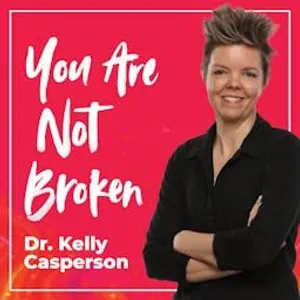
Free Daily Podcast Summary
You Are Not Broken: Daily Summaries Delivered
by Kelly Casperson, MD
Medicine got a lot wrong about women. We’re here to fix it. I’m Dr. Kelly Casperson, urologic surgeon and women's health advocate. Every week, the smartest experts in sex, hormones, and midlife join me to challenge what you were told and tell you what the evidence actually says. Expect science, honesty, advocacy, and a lot of laughs. Perimenopause? Desire? Your pelvic floor? Hormones? Your partner? We cover it all. You are not broken. You were just never given the manual. (This is not individual medical advice. Just truth bombs and great conversation.)
Latest Episodes
The most recent episodes — sign up to get AI-powered summaries of each one.
- Today49 min
398. Postpartum Mental Health: Deeper Than the Headlines
Pregnancy and the postpartum period can bring major changes in mental health, hormones, relationships, and identity—but many people still struggle to find informed, compassionate care. Dr. Kelly Casperson is joined by Dr. Stephanie Waggel and Dr. Misty Richards to discuss perinatal mental health, medication questions, the importance of support, and gaps in the systems meant to help families.The conversation also considers how intense media coverage of postpartum tragedies can create fear, why providers need time and training to discuss treatment options, and how care can be better coordinated. The guests emphasize that postpartum depression and psychosis are treatable, and that people facing mental health concerns are not alone.Topics discussedThe guests’ paths into reproductive and perinatal mental healthDr. Waggel’s ongoing review of research on medications and maternal, fetal, and neonatal outcomesWeighing treatment decisions against the risks of untreated mental illnessHormonal changes during pregnancy and after birthPostpartum depression, intrusive thoughts, and postpartum psychosisThe impact of sensationalized news coverage on parents seeking helpSocial support, recovery time, and the transition to parenthoodScreening, provider education, and coordinated careBarriers such as limited appointment time, insurance requirements, and fear of litigationResources mentioned: MotherToBaby and Postpartum Support InternationalGuestsDr. Stephanie Waggel is a physician, educator, and founder of Improve Medical Culture, an organization dedicated to improving medical culture and supporting healthcare professionals and students. She has more than 20 years of experience in mental health, specializing in depression, anxiety, OCD, ADHD, and PTSD. Certified in perinatal mental health, she has advanced training in psychopharmacology and focuses on safe, evidence-informed treatment during pregnancy. Her work also includes mentoring future physicians and advocating for improved mental health support within healthcare.Dr. Misty Richards is an Associate Clinical Professor with appointments in the UCLA Division of Child and Adolescent Psychiatry and the Department of Obstetrics and Gynecology. She directs the UCLA Child and Adolescent Psychiatry Fellowship and serves as Associate Medical Director of the UCLA Maternal Mental Health Partial Hospitalization Program. She is also Co-Founder and Medical Director of Perinatal Psychiatry for the Maternal Outpatient Mental Health Services (MOMS) Clinic. Her clinical and academic work focuses on perinatal psychiatry and infant mental health.This episode is an educational discussion, not personalized medical advice. For individual treatment questions, consult a qualified health professional.Dr. Waggel online:https://www.ImproveLifePLLC.comhttps://m.youtube.com/@improvelifepllchttps://www.instagram.com/improvemedicalculturehttps://www.improvemedicalculture.org https://www.momsphysician.comhttps://linktr.ee/improvemedicalcultureAs always, this podcast is for educational purposes and is not a substitute for individualized medical advice — talk to your own doctor about your own health.Subscribe, leave a review, and share this episode with someone who needs it.🎙️ You Are Not Broken is available on Apple Podcasts, Spotify, and wherever you listen.Take my Adult Sex Ed Master Class:My WebsiteInterested in my sexual health and hormone clinic? Clinic is OpenListen to this podcast on Pinnacle to earn CMEThanks to our sponsor: Addyi, the little pink pill. To find out if Addyi is right for you, go to addyi.com/notbroken and use
- 1 weeks ago46 min
397. Testosterone, hair loss, the female prostate and more with Dr. Yih
Episode 397: Dr. Jessica Yih on Sexual Health, Testosterone, and Hair LossDoes testosterone always make your hair fall out?No. But that’s what a lot of people, including a lot of doctors, believe.This week I’m joined by my friend Dr. Jessica Yih, a professor at UC Irvine who works in sexual health. We talk about why research takes so long to reach patients, what it’s like being a woman in urology, why informed consent before pelvic surgery should include sexual function, and what the evidence actually says about testosterone and hair loss.It’s a wide-ranging and honest conversation about how sexual medicine research and care really work, and where they still fall short.In this episode:Research barriers. Bureaucratic hurdles and open-access publishing, including research on vaginal estrogen and on testosterone and hair loss. Research delays cost lives and slow progress.Women in urology. Why women are still underrepresented in urology and academic medicine, and why mentorship and representation matter.Dr. Yih’s path to urology. An elective, and placing a ureteral stent, drew her to the field.Rethinking anatomy. How learning about the female prostate and Skene’s glands changed her understanding of sexual anatomy.Informed consent after pelvic surgery. Patients deserve to hear about possible changes in sexual function. That doesn’t mean don’t have surgery. It means know what you’re signing up for.Fellowship work. Persistent sexual side effects after SSRIs, post-finasteride syndrome, and how hard it can be to find a clinician who understands either one.Testosterone and hair loss. We challenge the assumption that testosterone always causes hair loss. We go through the evidence and the open questions, the difference between serum hormone levels and what may be happening at the follicle, and how to think about hair loss before starting treatment.The placebo effect. What it tells us about testosterone studies.Conference highlights. Pellets versus gel, injections, lab testing and assay accuracy, prescribing practices, and new research on women’s sexual health.Advocacy. Why public comments to the FDA matter.Blood flow and sexual response. A small study of sublingual testosterone combined with sildenafil, and a vibrator study measuring clitoral blood flow. Blood flow is key to sexual health and response.Looking ahead. Education, mentorship, and Dr. Yih’s work in sexual health across genders and in male infertility.https://www.instagram.com/drsexandsperm/As always, this podcast is for educational purposes and is not a substitute for individualized medical advice — talk to your own doctor about your own health.Subscribe, leave a review, and share this episode with someone who needs it.🎙️ You Are Not Broken is available on Apple Podcasts, Spotify, and wherever you listen.Take my Adult Sex Ed Master Class:My WebsiteInterested in my sexual health and hormone clinic? Clinic is OpenListen to this podcast on Pinnacle to earn CMEThanks to our sponsor: Addyi, the little pink pill. To find out if Addyi is right for you, go to addyi.com/notbroken and use code NOTBROKEN for a $10 telemedicine appointment.And great news: with commercial insurance coverage Addyi is as little as $20 a month! Visit Addyi.com/notbroken. Eligible patients only. Restrictions apply. See Full Prescribing Information including Boxed Warning at addyi.com/piThis episode is sponsored by Joi and Blokes.If you’ve been wondering whether hormones could be playing a role in how you feel, Joi and Blokes can help you get answers. Start with comprehensive lab testing, then work with a licensed clinician to understand your results and discuss treatment options that may be right for you.Visit <a href="http://jo
- 2 weeks ago40 min
396. Hope Is Not a Strategy — Dr. Marty Klein on Communication, Masculinity, and What Makes Sex Satisfying
Episode 396: Hope Is Not a Strategy — Dr. Marty Klein on Communication, Masculinity, and What Makes Sex SatisfyingWhat if the biggest obstacle in your sex life isn’t your body? What if it’s your expectations?This week I sit down with sex therapist Dr. Marty Klein for a wide-ranging conversation about communication, intimacy, and what actually happens in a sex therapist’s office. We start with ego. When it drives the conversation, we listen to respond instead of to understand, and then we wonder why we feel disconnected. Marty also shares what he sees in his Silicon Valley practice, where a culture built on optimization and problem-solving shapes how people approach intimacy. We talk about people turning to AI for relationship advice. It’s convenient, and it might simplify things. But it can’t replace the depth of a real human connection, and it may just tell your ego what it wants to hear.Then we get into sexual function. Expectations play a huge role in erectile dysfunction, and good therapy starts by asking a simple question: what do you actually want? Marty explains why defining a “satisfying sexual event” matters so much, especially for older adults looking for intimacy. His blunt reminder: hope alone is not a treatment plan.We also take on modern masculinity. We talk about the manosphere, the anger many young men are carrying, and why anger is not an effective way to attract a partner. Many young men feel isolated and are struggling with the social skills dating requires. Early wounds to masculinity can shape a man’s confidence for decades, and Marty explains why men often have a harder time recovering from them than women. We close with trauma, relaxation, and the body. Relaxation matters more than intensity. Sex is an idea as much as a physical act. And you can have a full, rich life without being defined by what happened to you.In this episode, we talk about:How ego undermines communication, and the habit of listening to respond instead of to understandActive listening, open-ended questions, and validating feelingsHow Silicon Valley’s culture shapes the way people approach intimacyAI as a relationship advisor: what it offers, and what it can’t replaceWhat sex therapists actually do, and why they help with non-sexual relationship problems tooThe role of expectations in erectile dysfunctionWhy defining a “satisfying sexual event” is central to sex therapyThe unique challenges older adults face in finding intimacyWhy therapy should focus on what clients want to achieve, and why hope alone is not a strategyWhy understanding the context of sexual dysfunction is essentialThe manosphere, and why anger doesn’t attract partnersIsolation and the social skills deficit many young men face in datingThe long-lasting effects of early wounds to masculinityHow trauma affects identity and recoveryReconnecting with your body for a more fulfilling sex lifeWhy relaxation matters more than intensitySex as an idea, not just a physical actBuilding a fulfilling life after traumahttps://www.instagram.com/doctormartykleinhttps://www.youtube.com/c/DrMartyKlein1As always, this podcast is for educational purposes and is not a substitute for individualized medical advice — talk to your own doctor about your own health.Subscribe, leave a review, and share this episode with someone who needs it.🎙️ You Are Not Broken is available on Apple Podcasts, Spotify, and wherever you listen.Take my Adult Sex Ed Master Class:My WebsiteInterested in my sexual health and hormone clinic? Clinic is OpenListen to this podcast on Pinnacle to earn CMEThanks to our sponsor: Addyi, the little pink pill. To find out if Addyi is right for you, go to addyi.com/notbroken and use code NOTBROKEN for a $10 telemedicine appointment.And great news: with commercial insurance coverage Addyi is as little as $20 a month! Visit
- 3 weeks ago1h 3m
395. Numb, Addicted, or Replaced? Vibrator Myths Busted
Vibrator 101: Everything You Wanted to Know, But Were Too Embarrassed to AskDr. Kelly Casperson explores vibrator basics through anatomy, blood flow, arousal, and pleasure. She discusses why sex education often misses important information about women’s bodies, reviews research on vibrator use, demonstrates different toy styles, and answers audience questions about squirting, pain, prolapse, and beginner-friendly options.The conversation emphasizes education over shame: understanding the clitoris, allowing time for arousal, and seeing vibrators as one possible tool for sexual wellbeing—not a replacement for a partner or a one-size-fits-all solution.Key topicsHow blood flow relates to genital arousal and sexual functionThe clitoris, the primary organ of orgasm for most women, and how it relates to the vaginaHow desire can be responsive and emerge during or after arousalWhy arousal matters before penetration, particularly when pain or low hormones are involvedThe G spot as a sensitive area associated with clitoral anatomyWater-based, silicone-based, and oil-based lubricantsResearch on vibrator use and sexual function, satisfaction, and pelvic healthKelly’s HEAL framework: hormones, education, arousal and vibration, and lube and moisturizersDifferent vibrator styles and considerations when choosing oneMyths about numbness, replacing partners, or becoming “addicted” to vibratorsAudience questions about squirting, prolapse, clitoral hood fusion, pain after orgasm, and antidepressantsAs always, this podcast is for educational purposes and is not a substitute for individualized medical advice — talk to your own doctor about your own health.Subscribe, leave a review, and share this episode with someone who needs it.🎙️ You Are Not Broken is available on Apple Podcasts, Spotify, and wherever you listen.Take my Adult Sex Ed Master Class:My WebsiteInterested in my sexual health and hormone clinic? Clinic is OpenListen to this podcast on Pinnacle to earn CMEThanks to our sponsor: Addyi, the little pink pill. To find out if Addyi is right for you, go to addyi.com/notbroken and use code NOTBROKEN for a $10 telemedicine appointment.And great news: with commercial insurance coverage Addyi is as little as $20 a month! Visit Addyi.com/notbroken. Eligible patients only. Restrictions apply. See Full Prescribing Information including Boxed Warning at addyi.com/piThis episode is sponsored by Joi and Blokes.If you’ve been wondering whether hormones could be playing a role in how you feel, Joi and Blokes can help you get answers. Start with comprehensive lab testing, then work with a licensed clinician to understand your results and discuss treatment options that may be right for you.Visit JoiAndBlokes.com/notbroken and use code NOTBROKEN for 65% off labs and 20% off treatment.See Privacy Policy at https://art19.com/privacy and California Privacy Notice at https://art19.com/privacy#do-not-sell-my-info.
- 4 weeks ago1h 2m
394. Testicular Pain and Stage 4 Breast Cancer
Episode 394 – Dr. Susan MacDonald on Testicular Pain, Pelvic Floor Dysfunction, and Rebuilding Life After Stage 4 Breast CancerNormal scan. Normal labs. Still in pain. Now what?Dr. Casperson is joined by fellow urologist Dr. Susan MacDonald for a conversation that starts with male pelvic pain and ends somewhere much more personal. They discuss why men with testicular pain are so often dismissed, how chronic pain gets mislabeled, and why pelvic floor dysfunction and referred pain get missed again and again.Then Dr. MacDonald shares her own story. She was diagnosed with de novo stage 4 bilateral breast cancer after missing her own early symptoms, and she describes what it's like to go from surgeon to patient. She talks openly about fatigue, grief, hormonal changes, and the career pivot she never chose. She also explains why she now wants to help patients move beyond survival mode toward resilience and joy.In this episode:How Dr. MacDonald found urology by accident (Grand Rounds, free pizza, and the realization that it's a surgical specialty)Why male reconstruction and urethroplasty won her overWhat urethral strictures are, and why tissue from inside the cheek is used to repair themHow common testicular and pelvic pain is. She estimates about 5% of urology consults.Why chronic pain is harder to treat than a kidney stone, and why normal imaging doesn't mean the pain isn't realThe harm of forcing a diagnosis, and patients carrying "heavy bricks in a backpack" of labelsThinking through a differential diagnosis out loud, with the patient as a partnerPlacebo effects, and why antibiotics can seem to help even when infection isn't the causePelvic floor dysfunction as the missing center of the Venn diagram, and the value of working with pelvic floor physical therapistsHer stage 4 breast cancer diagnosis, and how surgeons are trained to ignore their own bodiesLiving through treatment: fatigue, insomnia, arthritis, hormonal changes, and griefWhy leaving full-time academic surgery was forced, not voluntary, and her pivot into video education and speakingSex after cancer, and why the messaging for men and women is so differentTart cherry juice and hot flashesDr. MacDonald Linked InAs always, this podcast is for educational purposes and is not a substitute for individualized medical advice — talk to your own doctor about your own health.Subscribe, leave a review, and share this episode with someone who needs it.🎙️ You Are Not Broken is available on Apple Podcasts, Spotify, and wherever you listen.Take my Adult Sex Ed Master Class:My WebsiteInterested in my sexual health and hormone clinic? Clinic is OpenListen to this podcast on Pinnacle to earn CMEThanks to our sponsor: Addyi, the little pink pill. To find out if Addyi is right for you, go to addyi.com/notbroken and use code NOTBROKEN for a $10 telemedicine appointment.And great news: with commercial insurance coverage Addyi is as little as $20 a month! Visit Addyi.com/notbroken. Eligible patients only. Restrictions apply. See Full Prescribing Information including Boxed Warning at addyi.com/piThis episode is sponsored by Joi and Blokes.If you’ve been wondering whether hormones could be playing a role in how you feel, Joi and Blokes can help you get answers. Start with comprehensive lab testing, then work with a licensed clinician to understand your results and discuss treatment options that may be right for you.Visit JoiAndBlokes.com/notbroken and use code NOTBROKEN for 65% off labs and 20% off treatment.See Privacy Policy at https://art19.com/privacy and California Privacy Notice at <a href="https://art19.com/privacy#do-not-sell-my-info" r
- Oct 18, 20261h 25m
393. Stronger in Midlife: Muscle, Hormones, and Longevity for Women
Dr. Casperson is joined by Dr. Rebbecca Hertel, DO, MSCP, for a candid conversation about getting stronger through perimenopause and beyond. They talk about how hormonal shifts change training, recovery, and body composition. They also cover why bone health deserves your attention now, and how to read research and lab results with a critical eye.Along the way, Dr. Hertel explains what osteopathic medicine actually is. She also shares why your pain might not be coming from where you feel it. The two dig into protein, GLP-1s, testosterone, and hormone therapy, and why finding a clinician who listens matters as much as any prescription.In this episode:What osteopathic medicine and osteopathic manipulative treatment (OMT) involveWhy pain can show up somewhere other than its sourceHow perimenopause affects muscle, recovery, sleep, and body compositionWhy gaining muscle in midlife takes longer, and why it's still worth itBone health, fracture prevention, and the case for resistance trainingProtein, hydration, and fueling your body during weight lossGLP-1 medications and strategies to help preserve muscleHormone approaches in perimenopause and postmenopauseWhy hormone therapy is not contraceptionTestosterone: symptoms, side effects, and how to think about lab resultsHealth span, independence, and prevention across the lifespanHormone stigma and the need for better education at puberty, postpartum, and midlifeDr. Hertel's IGDr Hertel's WebsiteAs always, this podcast is for educational purposes and is not a substitute for individualized medical advice — talk to your own doctor about your own health.Subscribe, leave a review, and share this episode with someone who needs it.🎙️ You Are Not Broken is available on Apple Podcasts, Spotify, and wherever you listen.Take my Adult Sex Ed Master Class:My WebsiteInterested in my sexual health and hormone clinic? Clinic is OpenListen to this podcast on Pinnacle to earn CMEThanks to our sponsor: Addyi, the little pink pill. To find out if Addyi is right for you, go to addyi.com/notbroken and use code NOTBROKEN for a $10 telemedicine appointment.And great news: with commercial insurance coverage Addyi is as little as $20 a month! Visit Addyi.com/notbroken. Eligible patients only. Restrictions apply. See Full Prescribing Information including Boxed Warning at addyi.com/piThis episode is sponsored by Joi and Blokes.If you’ve been wondering whether hormones could be playing a role in how you feel, Joi and Blokes can help you get answers. Start with comprehensive lab testing, then work with a licensed clinician to understand your results and discuss treatment options that may be right for you.Visit JoiAndBlokes.com/notbroken and use code NOTBROKEN for 65% off labs and 20% off treatment.See Privacy Policy at https://art19.com/privacy and California Privacy Notice at https://art19.com/privacy#do-not-sell-my-info.
- Oct 11, 202649 min
392. When in Menopause: Advocacy, Policy, and the Power of Speaking Up
Episode 392 – When in Menopause: Advocacy, Policy, and the Power of Speaking UpWho gets to be a menopause advocate? You do. You probably already are.Dr. Casperson sits down with Jennifer Weiss-Wolf, a lawyer, women's leadership leader at NYU Law, and author of When in Menopause: A User's Manual and Citizen's Guide. Jennifer helped drive the fast, bipartisan wins in period policy. Now she's applying those lessons to menopause, and she's honest about why this one is harder.They cover where the policy wins are coming from, what still blocks progress, and why workplace perks miss the point. They also talk about why the real work is bigger than any one issue. If you're a clinician, an advocate, or just someone who wants to make change without a big platform, this one is for you.In this episode:How Jennifer moved from menstruation policy to menopause around 2020. It started with a friend's question about the policy landscape, not with her own symptoms.Advocacy as a choose-your-own-adventure. Legislative language, storytelling, and community-building all count.What period policy taught her about state-level wins and working across the aisle.Why menopause reform is more complicated than it looks. Decades of neglected science and deeply interconnected issues make it hard. She describes the field as organic rather than fractured.Language, stigma, and culture. How do you change policy when people still can't say "vagina" in public or on social media?Why most workplace accommodations fall short. Many are too small, too generic, or built on a weak understanding of menopause. Protections also have to come before anyone asks employees to disclose.The legal gap. The U.S. has no clear anti-discrimination protection for menopause. The ADA, pregnancy protections, and age-discrimination law help in some cases, but they leave holes.What actually moves the needle: access, research funding, clinician education and training, and reimbursement reform. Business leaders should fund these upstream fixes instead of offering superficial perks.Clinicians already have a platform. Patient visits, office materials, and staff handouts all spread accurate information, and small repeated messages add up.Community is the engine. Jennifer's examples include gyms, book clubs, schools, libraries, and PTAs. Midlife women are an underestimated political and social force.Jennifer's IGJennifer's New BookAs always, this podcast is for educational purposes and is not a substitute for individualized medical advice — talk to your own doctor about your own health.Subscribe, leave a review, and share this episode with someone who needs it.🎙️ You Are Not Broken is available on Apple Podcasts, Spotify, and wherever you listen.Take my Adult Sex Ed Master Class:My WebsiteInterested in my sexual health and hormone clinic? Clinic is OpenListen to this podcast on Pinnacle to earn CMEThanks to our sponsor: Addyi, the little pink pill. To find out if Addyi is right for you, go to addyi.com/notbroken and use code NOTBROKEN for a $10 telemedicine appointment.And great news: with commercial insurance coverage Addyi is as little as $20 a month! Visit Addyi.com/notbroken. Eligible patients only. Restrictions apply. See Full Prescribing Information including Boxed Warning at addyi.com/piThis episode is sponsored by Joi and Blokes.If you’ve been wondering whether hormones could be playing a role in how you feel, Joi and Blokes can help you get answers. Start with comprehensive lab testing, then work with a licensed clinician to understand your results and discuss treatment options that may be right for you.Visit JoiAndBlokes.com/notbroken and use code <st
- Oct 4, 202638 min
391. Say It Out Loud: PCOS Gets a New Name, PMDD Gets Real, and Your Ovaries Deserve Better
Dr. Sameena Rahman on menopause, PMDD, PCOS, and why naming things mattersThis week I sat down with practicing gynecologist Dr. Sameena Rahman to talk about some of the most misunderstood areas in women's health: hormone replacement after oophorectomy, PMDD, and the recent renaming of PCOS. We move fast from clinical nuance to culture, stigma, and medical bias, and you'll walk away with plenty of practical takeaways whether you're a patient or a clinician.Sameena also shares the story behind her book, Brown Girls Disease, and why she's reclaiming language around pain, shame, and access to care.In this episode, we talk about:Why women who have their ovaries removed need full hormone replacement, not just a low-dose patchThe difference between menopause management and medical neglect after hysterectomy or oophorectomyThe evidence that early menopause plus hormone therapy can have major survival benefitsWhat PMDD is, how it differs from typical PMS, and why it can feel like "Jekyll and Hyde" every monthWhy PMDD may be more about hormone sensitivity and brain receptor interactions than progesterone alonePMDD treatment options, including SSRIs, specific birth control formulations, progesterone, and in extreme cases medical suppressionWhy the old label PCOS creates stigma and hides the cardiometabolic risk behind the syndromeThe new name, polyendocrine metabolic ovarian syndrome, and why I think the rename could finally bring primary care and internal medicine into the conversationHow PCOS affects fertility, diabetes risk, heart health, weight gain, and endometrial cancer riskHow pelvic pain, vaginismus, and sexual dysfunction are shaped by culture, religion, and medical biasWhy Sameena chose the title Brown Girls Disease as a way of reclaiming a term that had been used dismissivelyHow language changes care, from saying "vagina" out loud to replacing shame-based terms with clearer onesNaming things matters. You are not broken.Dr. Rahman's IGAs always, this podcast is for educational purposes and is not a substitute for individualized medical advice — talk to your own doctor about your own health.Subscribe, leave a review, and share this episode with someone who needs it.🎙️ You Are Not Broken is available on Apple Podcasts, Spotify, and wherever you listen.Take my Adult Sex Ed Master Class:My WebsiteInterested in my sexual health and hormone clinic? Clinic is OpenListen to this podcast on Pinnacle to earn CMEThanks to our sponsor: Addyi, the little pink pill. To find out if Addyi is right for you, go to addyi.com/notbroken and use code NOTBROKEN for a $10 telemedicine appointment.And great news: with commercial insurance coverage Addyi is as little as $20 a month! Visit Addyi.com/notbroken. Eligible patients only. Restrictions apply. See Full Prescribing Information including Boxed Warning at addyi.com/piThis episode is sponsored by Joi and Blokes.If you’ve been wondering whether hormones could be playing a role in how you feel, Joi and Blokes can help you get answers. Start with comprehensive lab testing, then work with a licensed clinician to understand your results and discuss treatment options that may be right for you.Visit JoiAndBlokes.com/notbroken and use code NOTBROKEN for 65% off labs and 20% off treatment.See Privacy Policy at https://art19.com/privacy and California Privacy Notice at https://art19.com/privacy#do-not-sell-my-info
Get You Are Not Broken summaries in your inbox
Free AI-powered daily recaps. Key takeaways, quotes, and mentions — in a 5-minute read.
Get Free Summaries →Free forever for up to 3 podcasts. No credit card required.
You Might Also Like
Listeners also like.
Everyday Wellness: Midlife Hormones, Menopause, and Science for Women 35+
A nurse practitioner shares science-based strategies for managing midlife hormones, menopause, and women's health.
Live Like a Girl with Dr. Mindy Pelz
Dr. Mindy Pelz explores women's health through hormone science and wellness conversations to help women live in rhythm with their bodies.

Afterpause
Evidence-based guidance on menopause, hormone health, sleep, and metabolism from a certified wellness coach and women's health experts.

unPAUSED with Dr. Mary Claire Haver
A board-certified OB-GYN hosts candid discussions with experts and leaders on women's health, identity, and empowerment in midlife.
Red Pill Your Healthcast
Two healthcare providers discuss overlooked health issues and empower listeners to make informed decisions for their families.

The Food Medic
Dr. Hazel Wallace
Treated with Dr. Sara Szal
Dr. Sara Szal explores holistic health solutions through conversations with experts and patients seeking mind, body, and soul healing.

Dr. Sex Fairy
Dr. Kanwal Bawa

The PGspot
Dr. Patty Jalomo

Imperfect Love
A psychologist answers real-life questions on love, self-acceptance, and personal growth using a mindfulness-based approach.

Real Talk, Whole Life
Cloud10

Healthful with Norah O'Donnell
A podcast exploring women’s health through expert insights on reproductive health, menopause, cancer, and wellness.
Mentions
Most frequently mentioned across all episodes.
People
Books
Companies
Products & Tools
Research & Papers
About You Are Not Broken
Medicine got a lot wrong about women. We’re here to fix it. I’m Dr. Kelly Casperson, urologic surgeon and women's health advocate. Every week, the smartest experts in sex, hormones, and midlife join me to challenge what you were told and tell you what the evidence actually says. Expect science, honesty, advocacy, and a lot of laughs. Perimenopause? Desire? Your pelvic floor? Hormones? Your partner? We cover it all. You are not broken. You were just never given the manual. (This is not individual medical advice. Just truth bombs and great conversation.)
Customized Recaps
AI-powered recaps with compact key takeaways, quotes, and insights.
Straight to Your Inbox
Get key takeaways from You Are Not Broken in a 5-minute read.
Save Hours Every Week
Stay current on your favorite podcasts without falling behind.
Frequently Asked Questions
What is Podzilla's You Are Not Broken daily summary?
It's a free AI-powered email that summarizes new episodes of You Are Not Broken as soon as they're published. You get the key takeaways, notable quotes, and links & mentions — all in a quick read.
How does the You Are Not Broken podcast summary work?
When a new episode drops, our AI transcribes and analyzes it, then generates a personalized summary tailored to your interests and profession. It's delivered to your inbox every morning.
Is this an official You Are Not Broken product?
No. Podzilla is an independent service that summarizes publicly available podcast content. We're not affiliated with or endorsed by Kelly Casperson, MD.
Can I get summaries of other podcasts too?
Absolutely! The free plan covers up to 3 podcasts, any in the catalog. Basic raises that to 15, Pro to 40 and Max to 100. Browse our full catalog at /podcasts.
How often does You Are Not Broken release new episodes?
You Are Not Broken publishes weekly. Our AI generates a summary within hours of each new episode.
What topics does You Are Not Broken cover?
You Are Not Broken covers topics including Medicine, Fitness, Health & Fitness. Our AI identifies the specific themes in each episode and highlights what matters most to you.
Start getting You Are Not Broken summaries tomorrow morning.
Free forever for up to 3 podcasts. No credit card required.
Free forever for up to 3 podcasts. No credit card required.