Free Daily Podcast Summary
Wonders of Relativity: Daily Summaries Delivered
by Val Chrome
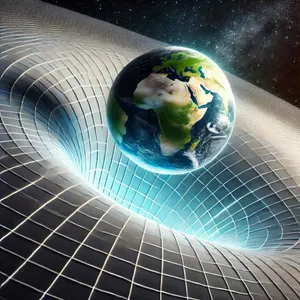
"Theory of Relativity: Simplified" makes Einstein’s groundbreaking ideas accessible to everyone. We break down complex topics like special relativity, general relativity, time dilation, mass-energy equivalence (E=mc²), and gravitational waves in a clear, step-by-step manner. Discover how time slows down, why moving objects shrink, and how gravity warps spacetime—all explained in a way that anyone can understand. Whether you’re a beginner or just curious, join us to explore the wonders of relativity, one concept at a time.
Latest Episodes
The most recent episodes — sign up to get AI-powered summaries of each one.
- Aug 20, 202624 min
Quantum Mechanics vs General Relativity: The Biggest Divide in Physics Right Now
Imagine the universe as a grand puzzle, but two of its most fundamental pieces refuse to fit. Quantum mechanics, the realm of the infinitesimally small, and General Relativity, the theory of gravity and the cosmos, offer wildly different, and often conflicting, pictures of reality. In this episode, we delve into the shocking contradictions that arise when these two pillars of modern physics collide. Why does the smooth, predictable universe of Einstein's gravity clash so violently with the probabilistic, uncertain world of quantum mechanics? We explore the places where this cosmic divide becomes glaringly apparent: the singularity at the heart of black holes, the birth of the universe, and the enigmatic realm of quantum gravity. Could this fundamental incompatibility mean our understanding of the universe is fundamentally flawed? Or is there a deeper, hidden reality waiting to be uncovered? Join us as we confront the terrifying implications of this cosmic schism, where the very fabric of space and time is caught in a battle between two seemingly irreconcilable truths.
- Aug 13, 202616 min
Could Quantum Gravity Save Physics?
We examine the current state of Lambda Cold Dark Matter (Lambda CDM), our best model of cosmology. While it remains the reigning champion of cosmology, it is facing an unprecedented onslaught of data from the James Webb Space Telescope (JWST) and advanced underground detectors that are stirring up revolutionary questions.Lambda CDM has brilliantly predicted the Cosmic Microwave Background (CMB), the distribution of galaxies in colossal filaments, and the chemical elements forged just after the Big Bang. However, several "tensions" are pushing the model to its limits.
- Aug 6, 202625 min
The Information Paradox: Can Black Holes Disappear?
Imagine a black hole, that devours everything in its path, including information—the fundamental building block of reality. But what if that information isn't truly lost? In this episode, we dive into the mind-bending information paradox, a clash between Einstein's relativity and quantum mechanics that challenges our very understanding of the universe. We'll explore the bizarre concept of Hawking radiation, the faint glow emitted by black holes, and the shocking possibility that these cosmic behemoths might actually evaporate, taking their secrets with them. Do black holes erase information, violating the laws of quantum mechanics? Or does it somehow escape, encoded in the subtle whispers of Hawking radiation? We'll delve into the radical theories, including the controversial 'firewall' paradox, that attempt to reconcile these conflicting ideas. Join us as we journey into the heart of the black hole mystery, where the fate of information—and perhaps the universe itself—hangs in the balance.
- Jul 30, 202612 min
Amplitude of primordial ripples: Numbers That Make Universe Possible
This episode investigates Q, the fifth of the fundamental constants, which represents the amplitude of primordial ripples in the newborn universe. Measuring approximately 1 in 100,000, this number represents the faint "tremor" at the dawn of time that determined whether the cosmos would become a fertile ground for life or a sterile void.Is this "exquisite calibration" a cosmic coincidence, or are we simply living in one rare bubble of a vast multiverse where the lottery of physics happened to go our way?
- Jul 25, 202619 min
Einstein Called this his "Biggest Blunder". Here's Why?
We're talking about the cosmological constant, a mysterious term that once seemed like a mathematical fudge factor, but now appears to be driving the accelerating expansion of the cosmos. In this episode, we journey through the turbulent history of this enigmatic constant, tracing its roots from Einstein's attempts to create a static universe to its modern-day resurgence as a key player in the dark energy puzzle. Why did Einstein call it his biggest mistake? What hidden truths about the vacuum of space does it reveal? And could this 'blunder' actually hold the key to understanding the universe's ultimate destiny? Join us as we delve into the shocking twists and turns of a cosmic mystery that continues to baffle and intrigue the world's greatest minds.
- Jul 22, 202623 min
Gravastars: Black Holes' Evil Twin - Part 2
In this second installment, we move past the theory of the Gravastar to look at its engineering—and the massive structural flaws that might break the whole idea. On paper, a static gravastar works perfectly. But the real universe is a messy, spinning place, and calculations show that the moment a gravastar begins to rotate, it faces catastrophic structural instability. We pull apart the gravastar’s outer shell—an impossibly delicate skin that, for an object the size of our sun, would be only a tiny fraction of a centimeter thick. This razor-thin boundary has to handle a brutal cosmic tug-of-war: resisting immense outward pressure from a dark energy core while managing the crushing gravitational pull on the outside. We explore how this engineering crisis has forced physicists to dream up even wilder alternatives, from "smooth" continuous-pressure stars to the mind-bending "Nestar"—a theoretical object that behaves like a Russian Matryoshka doll of nested matter shells and dark energy cores. Finally, we look at how these black hole mimickers would actually look through our telescopes, and whether the Event Horizon Telescope can spot the difference between a true singularity and a phantom shell.
- Jul 15, 202627 min
Gravastars: Black Holes' Evil Twin - Part 1
In this episode, we pull back the curtain on the most terrifying objects in the cosmos to ask a fundamental question: Do black holes actually exist, or are we looking at something else entirely? We trace the incredible journey of how these dark stars went from a dismissed 18th-century theory to an accepted reality, cemented by Karl Schwarzschild's wartime mathematics, Oppenheimer's theories of total collapse, and groundbreaking imagery from the Event Horizon Telescope. But there is a catch. Our advanced telescopes don't actually see inside a black hole; they only record the superheated plasma swirling outside its borders.This leaves a small but critical blind spot in our physics—one that avoids the impossible, infinite density of a singularity. Enter the Gravastar (Gravitational Vacuum Star). We introduce this leading alternative theory: a structured, bizarre cosmic entity that perfectly mimics a black hole from the outside, but operates as a deadly, hollow twin on the inside.
- Jul 8, 202621 min
Can Time Flow in Multiple Directions?
In this episode, we dive into one of the most profound mysteries in modern physics: the arrow of time. While our daily lives march relentlessly from past to future, the fundamental equations of the universe don’t actually care which way time flows; they work perfectly fine in reverse. We start by exploring the traditional explanation for this one-way street: entropy and the thermodynamic journey from order to disorder. But then, we push into radical new territory. What if the Big Bang wasn't the absolute beginning of a single timeline, but a "Janus Point"—a cosmic mirror where time split into two futures heading in opposite directions? We examine the mind-bending theory proposed by physicist Julian Barbour, which flips cosmology on its head by suggesting that time isn't driven by a universe slowly degrading into chaos, but by a relentless, beautiful growth in complexity and structure.
Get Wonders of Relativity summaries in your inbox
Free AI-powered daily recaps. Key takeaways, quotes, and mentions — in a 5-minute read.
Get Free Summaries →Free forever for up to 3 podcasts. No credit card required.
You Might Also Like
Listeners also like.

The Rest Is Science
Hannah Fry and Michael Stevens explore the strange and overlooked questions at the boundary of scientific understanding.

From First Principles
Breaks down major science stories weekly, explaining the mechanics behind physics, space, AI, and biotech developments.
The Science of Everything Podcast
Explores diverse topics in natural and social sciences through the lens of the scientific method.
Physics to God
Explores the intersection of modern physics and theology, examining fine tuning, the multiverse, and the concept of God.

Ask a Spaceman!
An astrophysicist answers listener questions about space, time, and the universe.
The Joy of Why
Mathematicians and astrophysicists explore fundamental scientific and mathematical questions with leading researchers.

PBS Space Time
An astrophysicist explains cosmic phenomena like black holes and galaxy evolution through accessible, science-driven discussions.
The Joy of x
A mathematician explores the lives and ideas of leading scientists through in-depth conversations.

Cosmos in a Pod
Explores space, science, philosophy, and technology to reveal the wonders of the universe and humanity's place within it.

The Quanta Podcast
A weekly discussion on groundbreaking science and math stories with Quanta's editorial team.
Math & Physics Podcast
Two University of Toronto students discuss topics in math and physics.
Relatively Prime: Stories from the Mathematical Domain
A podcast featuring stories from the world of mathematics.
About Wonders of Relativity
"Theory of Relativity: Simplified" makes Einstein’s groundbreaking ideas accessible to everyone. We break down complex topics like special relativity, general relativity, time dilation, mass-energy equivalence (E=mc²), and gravitational waves in a clear, step-by-step manner. Discover how time slows down, why moving objects shrink, and how gravity warps spacetime—all explained in a way that anyone can understand. Whether you’re a beginner or just curious, join us to explore the wonders of relativity, one concept at a time.
Customized Recaps
AI-powered recaps with compact key takeaways, quotes, and insights.
Straight to Your Inbox
Get key takeaways from Wonders of Relativity in a 5-minute read.
Save Hours Every Week
Stay current on your favorite podcasts without falling behind.
Frequently Asked Questions
What is Podzilla's Wonders of Relativity daily summary?
It's a free AI-powered email that summarizes new episodes of Wonders of Relativity as soon as they're published. You get the key takeaways, notable quotes, and links & mentions — all in a quick read.
How does the Wonders of Relativity podcast summary work?
When a new episode drops, our AI transcribes and analyzes it, then generates a personalized summary tailored to your interests and profession. It's delivered to your inbox every morning.
Is this an official Wonders of Relativity product?
No. Podzilla is an independent service that summarizes publicly available podcast content. We're not affiliated with or endorsed by Val Chrome.
Can I get summaries of other podcasts too?
Absolutely! The free plan covers up to 3 podcasts. Upgrade to Pro for 15, or Premium for 50. Browse our full catalog at /podcasts.
How often does Wonders of Relativity release new episodes?
Wonders of Relativity publishes weekly. Our AI generates a summary within hours of each new episode.
What topics does Wonders of Relativity cover?
Wonders of Relativity covers topics including Science, Education, Courses, Astronomy, Physics. Our AI identifies the specific themes in each episode and highlights what matters most to you.
Start getting Wonders of Relativity summaries tomorrow morning.
Free forever for up to 3 podcasts. No credit card required.
Free forever for up to 3 podcasts. No credit card required.