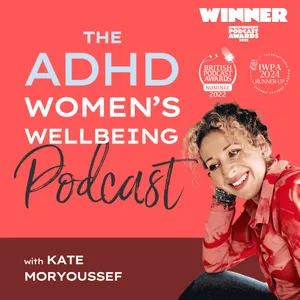
Free Daily Podcast Summary
ADHD Women's Wellbeing Podcast: Daily Summaries Delivered
by Kate Moryoussef
Are you struggling with the challenges of life as a woman with ADHD? Perhaps you need support with your mental and physical wellbeing, so you can feel calmer, happier and more balanced? Perhaps you’re newly diagnosed with ADHD – or just ADHD curious – and don’t know where to turn for support. Or perhaps you’re wondering how neurodivergence impacts your hormones or relationships? If so, the ADHD Women’s Wellbeing Podcast is for you. This podcast is hosted by Kate Moryoussef, an ADHD lifestyle and wellbeing coach, author, EFT practitioner, mum of four, and late-in-life diagnosed with ADHD herself. Each week, thousands of women just like you tune in to hear Kate chat with top ADHD experts, thought leaders, professionals and authors. Their powerful insights will help you harness your health and enhance your life as a woman with ADHD. From tips on nutrition, sleep and motivation to guidance on regulating your nervous system, dealing with anxiety and living a calmer and more balanced life, you’ll find it all here. The ADHD Women’s Wellbeing Podcast will help you live alongside your ADHD with more awareness, self-compassion and acceptance. It’s time to put an end to self-criticism, judgment and blame – and get ready to live a kinder and more authentic life. In The ADHD Women’s Wellbeing Toolkit, Kate Moryoussef shares the psychology and science behind the challenges faced by women with ADHD and lays out a roadmap for you to uncover your authentic self. With practical lifestyle tools on how to manage mental, emotional, physical, and hormonal burnout and lean into your unique strengths to create more energy, joy, and creativity, this book will help you (re)learn to not only live with this brain difference but also thrive with it.
Latest Episodes
The most recent episodes — sign up to get AI-powered summaries of each one.
- 3 days ago49 min
Creating a More Meaningful ADHD Life
What Actually Helps You? This ADHD Awareness Month, I’m putting real experiences, community and practical support at the heart of the conversation. Join live conversations, podcast events and opportunities to share what actually helps you. Add your name to my event waitlist as well! Visit the Events page to see what’s happening and get involved. _________________________________________ What if the burnout, the guilt and the relentless doing weren't signs that you were failing, but signs that the playbook you'd been given was never designed for you in the first place? On this week's episode of The ADHD Women's Wellbeing Podcast, I'm joined by Meghan French Dunbar, bestselling author, business anthropologist and founder of Conscious Company Magazine, the first nationally distributed print magazine in the US focusing on impact-driven business. Meghan's book, This Isn't Working: How Working Women Can Overcome Stress, Guilt, and Overload to Find True Success, is a USA Today bestseller and Next Big Idea Club selection. She works with companies including Coach, John Deere, Torani and Kate Spade on leadership and culture strategy, writes for Forbes, Fast Company and Inc, and hosts the podcast Unbehaved. She was diagnosed with ADHD four years ago, and this conversation made a lot of sense of a lot of things. We talk about purpose burnout, motherhood, identity, joy and what it actually looks like to build a life and career around meaning rather than productivity. Meghan is warm, honest and brilliantly funny, and this is one of those conversations that leaves you feeling both validated and quietly ready to do something differently. Advertisement⏐Try AG1 now at http://drinkag1.com/adhdwomen and get £20 off your first order + 5 AG1 Travel Packs for on the go, a bottle of Vitamin D3+K2, and the Welcome Kit for FREE. No risk with the 30-day money-back guarantee. Find all details about the health benefits in the link. Study results are on file with AG1, 2023. In this episode, we cover: How Meghan's ADHD diagnosis four years ago reframed her entire career and the relentless curiosity that drove it Why she burnt out running her own organisation, resigned from it, and spent two years rebuilding from the ground up The difference between social success and soul success, and the three elements the most fulfilled leaders Meghan interviewed all had in common Why sustained leadership is about the quality of your being, not the quantity of your doing The six key predictors of burnout, and why ADHD makes several of them almost inevitable without the right support What the broaden and build theory tells us about joy, and why nurturing it is not indulgent but a genuine performance strategy The joy trip: what it is, why Meghan introduced it into her family and what it has given her every year since Why ADHD women are often the outliers who model a different way of working, and why that matters for everyone around them What enough looks like, and why deciding that with your partner is one of the most radical acts available to us Why autonomy is the non-negotiable for so many neurodivergent entrepreneurs Timestamps: 00:00 - Welcome and introducing Meghan French Dunbar 02:00 - What drives Meghan's passion for business, impact and entrepreneurship 05:00 - How her ADHD diagnosis reframed decades of relentless curiosity 08:00 - Burning out as founder, resigning in 2020 and two years of rebuilding 12:00 - What the outliers taught her: soul success, purpose and quality of life 16:00 - Sustained leadership: why quality of being beats quantity of doing 19:00 - The practical foundations: sleep, movement, joy and professional support 22:00 - Why younger generations are already rewriting the playbook 25:00 - The joy trip: how it started, what it involves and why it changed everything 31:00 - The broaden and build theory: the science behind why joy makes you better at everything 35:00 - Modeling a different way for other women 38:00 - What Meghan's working life looks like now, and what enough means to her 42:00 - Autonomy, ADHD and why working for yourself so often becomes the answe Links and Resources: Find my popular ADHD Women's Wellbeing workshops and resources on my website here. Follow the podcast on Instagram: @adhd_womenswellbeing_pod Get my book, The ADHD Women's Wellbeing Toolkit (also available in ebook and audiobook) here Join the More Yourself membership community here Visit Meghan's website: meghanfrenchdunbar.com Connect with Meghan on Instagram Connect with Meghan on LinkedIn Subscribe to Meghan's Substack: Unbehaved Listen to Meghan's podcast: Unbehaved Watch Meghan's TEDx talk Get Meghan's book: This Isn't Working: How Working Women Can Overcome Stress, Guilt, and Overload to Find True Success Kate Moryoussef is a women's ADHD lifestyle and wellbeing coach and EFT practitioner who helps ove
- 5 days ago35 min
The Collision Between ADHD, Femininity, and Gender from Understood.org
ADHD Awareness Month 2026: What Actually Helps? This October, I'm putting community, real experiences and practical support at the heart of ADHD Awareness Month. There are live conversations and ways for you to share what actually helps in your own life. Visit the Events page to see what’s happening and get involved. Understood.org's The ADHD Channel for Women features three shows hosted by three different hosts, unpacking a different side of life with ADHD. They cover everything from sex, dating, and relationships to deep dives into where neurodivergence meets the biggest news stories, like how a newly discovered gene variant could change the way we treat ADHD. There's also an ADHD coach who answers listeners' questions. Check out The ADHD Channel for Women here This episode from The ADHD Channel for Women is called 'I’ve never felt like a good woman...' You'll hear a complex conversation about ADHD, femininity, gender, and why talking about the hard stuff is important. Cate sits down with Rae Jacobson, host of Understood.org’s Hyperfocus podcast, journalist, and a producer on this show. They talk about something they’ve both struggled to name: the collision between ADHD, femininity, and gender expression. They dig into what it felt like to watch other girls “get it.” The tidiness. The calm. The effortlessness. All things that executive dysfunction made feel out of reach. They talk about the pressure to be nurturing, organized, and endlessly available — and what happens when your brain doesn’t cooperate with any of it. And they look at the research on outcomes for women and girls with ADHD." This week’s episode is sponsored by Understood.org, the leading nonprofit dedicated to empowering the millions of people with learning and thinking differences, such as ADHD and dyslexia. For all things ADHD Women's Wellbeing, including the podcast, resources and events, head here: www.adhdwomenswellbeing.co.uk Learn more about your ad choices. Visit megaphone.fm/adchoices
- 1 weeks ago50 min
ADHD, Gut Health and Your Nervous System: A Compassionate Guide with Dr Miguel Toribio-Mateas
ADHD Awareness Month 2026: What Actually Helps? This October, I'm putting community, real experiences and practical support at the heart of ADHD Awareness Month. There are live conversations, Instagram Lives, podcast events and ways for you to share what actually helps in your own life. Visit the Events page to see what’s happening and get involved. If you've ever felt shame about what you eat, how you forget to eat, or why your safe foods feel so necessary, this episode is going to be a genuine relief. On this week's episode of The ADHD Women's Wellbeing Podcast, I'm delighted to welcome back Dr Miguel Toribio-Mateas, clinical neuroscientist, applied microbiologist, nutrition researcher, Honorary Research Fellow at Cardiff University and Senior Lecturer at the University of West London. Miguel has just published his brilliant new book, ADHD Body and Mind: A Compassionate Guide to Rewilding Your Nervous System with Neuroscience, Nutrition, and Gut-Brain Health, published by Jessica Kingsley/Hachette. His research has appeared in leading journals including the BMJ and BMC Psychiatry, and his work is known for translating complex science into something genuinely human and accessible. This is one of those conversations that covers a huge amount of ground while never once feeling overwhelming. We talk about why the ADHD brain is wired for resilience and what that actually costs us, why the gut-brain connection matters so much for neurodivergent people, how to approach nutrition with compassion rather than perfectionism, and why your safe foods are not something to be ashamed of. We also get into the language of science, why terms like comorbidity matter, and how researchers like Miguel are slowly shifting the field towards a more neuroaffirmative approach. Advertisement⏐Try AG1 now at http://drinkag1.com/adhdwomen and get £20 off your first order + 5 AG1 Travel Packs for on the go, a bottle of Vitamin D3+K2, and the Welcome Kit for FREE. No risk with the 30-day money-back guarantee. Find all details about the health benefits in the link. Study results are on file with AG1, 2023. In this episode, we cover: Why compassion and kindness are at the heart of Miguel's approach to ADHD, nutrition and the nervous system How the ADHD nervous system forms in high alert, and what that means for resilience and hypervigilance Why ADHD is far more than a dopamine deficiency, and how hormones, gut bacteria and the nervous system are all part of the picture The gut-brain axis and why looking after your gut has a direct impact on your ADHD brain Why the language of science still creates problems, including terms like comorbidity and healthy cohort, and how researchers are starting to push back How to read ADHD Body and Mind in whichever way works for your brain, whether that's cover to cover or jumping straight to chapter nine Why understanding the why behind your ADHD behaviours is the keystone to change, even when it doesn't fix things overnight Miguel's approach to nutrition: keep your safe foods, add rather than subtract, and never shame what nourishes you Why safe foods are doing an important job for your nervous system, and why being pushed out of your comfort zone too quickly never lasts The circle approach to expanding your diet gently, starting from your anchors and building outward Why a hot bath is an act of self-compassion backed by neuroscience, and why you don't need to get into cold water to support your nervous system The self-kindness toolkit at the end of the book and what it covers Chapters: 00:00 - Welcome and introducing Dr Miguel Toribio-Mateas back to the podcast 02:00 - What's at the heart of ADHD Body and Mind, and why compassion comes first 05:00 - Why the ADHD nervous system is wired for hypervigilance and resilience 08:00 - ADHD as more than dopamine: hormones, gut bacteria and the full picture 11:00 - The neuroaffirmative lens in academic research and why language matters 15:00 - How the gut-brain axis connects to ADHD and emotional regulation 19:00 - The awareness and repetition model: why understanding the why is the keystone 23:00 - Nutrition without perfectionism: how to approach food with kindness 27:00 - Safe foods, anchors and adding rather than subtracting 32:00 - The circle approach: expanding your diet gently from the inside out 37:00 - The ADHD cookery school: creativity, condiments and cooking without recipes 42:00 - Hot baths, cold water and why softness is sometimes the braver choice 46:00 - The self-kindness toolkit and what the book offers neurodivergent readers and clinicians Links and Resources: Find my popular ADHD Women's Wellbeing workshops and resources on my website here. Follow the podcast on Instagram: @adhd_womenswellbeing_pod Get my book, The ADHD Women's Wellbeing Toolkit (also available in ebook and audiobook) here Join the More Yourself membership co
- 1 weeks ago21 min
Your ADHD Nervous System Explained
ADHD Awareness Month 2026: What Actually Helps? This October, I'm putting community, real experiences and practical support at the heart of ADHD Awareness Month. There are live conversations, Instagram Lives, podcast events and ways for you to share what actually helps in your own life. Visit the Events page to see what’s happening and get involved. If you've ever wondered why some days feel manageable and others feel completely impossible, even when nothing has obviously changed, your nervous system is trying to tell you something. Welcome to this week's More Yourself Monday episode. Today I'm sharing a clip from one of my workshops on the nervous system, polyvagal theory and how understanding both can genuinely change the way you move through your days with ADHD. This is not a clinical lecture. This is a simple, accessible explanation of why your nervous system behaves the way it does, what the polyvagal ladder actually means in real life, and how you can start to work with your nervous system rather than against it. I also introduce the concept of glimmers, those small micro moments of safety and joy that can shift your entire day when you learn to notice and actively seek them out. The full workshop is available on my website, and the link is below. In this episode, we cover: What it means to feel grounded, connected and safe in your nervous system, and why so many of us rarely get there A simple explanation of polyvagal theory and why it matters so much for neurodivergent people The three states of the polyvagal ladder: ventral vagal, sympathetic and dorsal vagal, and what each one feels like from the inside Why the ADHD brain so often operates in fight or flight mode, and what that costs us over time What the dorsal vagal shutdown state feels like, and why it shows up as fatigue, numbness and withdrawal The window of tolerance: what it is, what opens and closes it, and why ADHD narrows it The difference between hyper arousal and hypo arousal, and why each needs a different response What glimmers are and why they matter as much as knowing your triggers How to identify your own personal glimmers and actively harness them across the day Why regulating your own nervous system is not selfish but has a ripple effect on everyone around you The role of co-regulation and why our nervous system state affects the people we live and work with Links and Resources: Find my popular ADHD Women's Wellbeing workshops and resources on my website here. Follow the podcast on Instagram: @adhd_womenswellbeing_pod Get my book, The ADHD Women's Wellbeing Toolkit (also available in ebook and audiobook) here Join the More Yourself membership community here Get the full nervous system and polyvagal theory workshop series here with a 10% discount for Podcast listeners Kate Moryoussef is a women's ADHD lifestyle and wellbeing coach and EFT practitioner who helps overwhelmed and unfulfilled newly diagnosed women with ADHD find more calm, balance, hope, health, compassion, creativity, and clarity. Learn more about your ad choices. Visit megaphone.fm/adchoices
- 2 weeks ago52 min
Is the ADHD Brain an Intuitive Brain?
Looking for further guidance and support on ADHD Women's Wellbeing? Check out my workshop library here or search for any topic on the Podcast here. Content note: This episode contains references to suicide and family bereavement. If you are struggling, please reach out to a trusted support resource. In the UK, the Samaritans can be contacted on 116 123. In the US, the National Suicide Prevention Hotline is 1-800-273-8255. In Australia, the crisis support service Lifeline is on 13 11 14. Hotlines in other countries can be found here. You can also check out the Campaign Against Living Miserably here What if the traits you've spent a lifetime apologising for are actually the source of your greatest ability? On this week's episode of The ADHD Women's Wellbeing Podcast, I'm joined by Laura Day, New York Times bestselling author, teacher and intuitive consultant who has spent four decades working with individuals and some of the world's largest companies to help them identify and achieve their goals. Laura's new book, The Prism: Seven Steps to Heal Your Past and Transform Your Future, is the book she describes as an ADHD manual — a practical, evidence-informed framework for building the scaffolding that helps neurodivergent brains thrive. With two New York Times bestsellers to her name and a 40-year teaching community, Laura is also someone who has lived with ADHD her entire life, and this conversation is one of the most honest, warm and genuinely surprising I have had on the podcast. We talk about Laura's childhood in a household where neurodivergence was everywhere but unnamed, why girls of her generation were never allowed to act out and what that suppression cost them, how she built a career advising billion-dollar companies using her intuitive mind, and why the ADHD brain is uniquely suited to intuition, just not always in the way we expect. In this episode, we cover: Laura's diagnosis at 10 or 11, and why girls of her generation were never treated Growing up in a household where neurodivergence showed up in multiple family members, often with devastating consequences How Laura used survival, focus and necessity as her prosthetic scaffolding before she understood her own neurology Why the ADHD brain is the intuitive brain, and how to make that work for you rather than against you Why intuition is not something you tap into but something that is always downloading, and how to structure it usefully The difference between the voice of fear and the voice of intuition, and why documentation matters more than belief How Laura advises billion-dollar companies using intuitive methods, and why business and science do what works regardless of belief Why Laura says you are your own worst intuitive, and why community-based intuitive practice is so powerful The shame and blame pages: a research-backed tool for releasing what no longer serves you Why doing just the next thing is one of the most powerful strategies for ADHD brains How Laura built scaffolding for her household without knowing it was for neurodivergence Why vulnerability is not a weakness but the source of extraordinary ability The Prism: what it offers neurodivergent people and why Laura considers it her ADHD manual Timestamps: 00:00 - Welcome and introducing Laura Day 02:00 - Laura's diagnosis at 10 or 11 and why girls weren't treated in her generation 05:00 - Growing up with neurodivergence all around her, and what it cost her family 08:00 - How she used her role as oldest child to create focus and structure 10:00 - Spatial difficulties, irritability and the compensations she built over decades 13:00 - Why the ADHD brain is the intuitive brain 16:00 - How intuition actually works and why it is always downloading 20:00 - Documenting intuition and building a feedback loop with the world 23:00 - How she works with billion-dollar companies and why they don't need to believe in it 27:00 - Social dynamics, masking and forgetting to say hello 31:00 - Emotional regulation, overstimulation and learning to step away rather than snap 35:00 - Generational patterns, self-awareness and raising neurodivergent children 40:00 - Just do the next thing: why this is the most powerful ADHD strategy 44:00 - The shame and blame pages and the research behind letting go 47:00 - The Prism: seven steps, and why Laura considers it her ADHD manual 50:00 - How to find Laura and join her teaching community Links and Resources: Find my popular ADHD Women's Wellbeing workshops and resources on my website here. Follow the podcast on Instagram: @adhd_womenswellbeing_pod Get my book, The ADHD Women's Wellbeing Toolkit (also available in ebook and audiobook) here Join the More Yourself membership community here Visit Laura's website: lauraday.com Get Laura's new book: The Prism: Seven Steps to Heal Your Past and Transform Your Future, a
- 3 weeks ago48 min
Why Doesn’t My GP Understand ADHD & What’s Really Happening in the 10-Minute Appointment
If you've ever left a GP appointment feeling dismissed, confused or like you had to fight to be taken seriously, this episode will help you understand why, and what you can actually do about it. On this week's episode of The ADHD Women's Wellbeing Podcast, I'm joined by Dr Victoria Galvis, a GP based in Greater Manchester with over 20 years of lived experience of neurodivergence and a fierce passion for changing how the healthcare system supports neurodivergent people. Victoria qualified as a doctor in Colombia and has been practising in the UK since 2010, working across both hospital medicine and primary care. Alongside Dr Safiya Virji, GP and Associate Professor at Queen Mary University of London, she has written Neurodivergence in Primary Care: A Practical Guide for UK Healthcare Professionals, a comprehensive, research-backed resource designed to educate clinicians and support patients in navigating the system more effectively. In this episode, Victoria explains the structural reasons why GPs often don't know enough about ADHD and neurodivergence, and it is not as simple as them not caring. She talks about the discrimination she faced as a neurodivergent doctor, why the 10-minute consultation is both a challenge and something patients can learn to work with, and how the book came about from 20 years of clinical experience and a determination to change things for her son, her patients and the next generation of healthcare professionals. In this episode, we cover: Why GPs receive less than two hours of ADHD training and have zero budget to update their knowledge How media narratives and ableist assumptions about ADHD have shaped clinical attitudes Victoria's own experience of disability discrimination as a neurodivergent doctor, and why she kept going Why ADHD and autism could not even be co-diagnosed until 2013, and what that means for the doctors currently practising How the 10-minute GP consultation works, and practical ways to make the most of it Why bringing a list to a GP appointment is genuinely helpful, not annoying How to ask for the right GP in your practice for your specific needs When and how to share your own research with your doctor, and how most GPs actually receive it Why executive dysfunction affects how patients experience healthcare at every stage The importance of bringing someone with you, recording the appointment or using other memory tools Why most mental health presentations in primary care have a deep-rooted neurodivergent component Kate and Victoria's grassroots idea for getting this book into every GP surgery Timestamps: 00:00 - Welcome and introducing Dr Victoria Galvis 02:00 - Victoria's ADHD diagnosis at 19 and her early career in the UK 05:00 - The discrimination she faced as a neurodivergent doctor and why she fought back 09:00 - Why GPs don't know more about ADHD, and why it is not their fault 13:00 - Zero training budget, no CPD funding and what that means in practice 16:00 - Why most mental health presentations have a neurodivergent component 19:00 - How the 10-minute consultation works from the doctor's side 23:00 - Practical tips for making the most of your GP appointment 28:00 - How to share your own research with your GP and what to expect 32:00 - When to ask for a follow-up, and why you should book with the right person 36:00 - How the book came about, and what it covers 40:00 - Kate and Victoria's grassroots idea: getting the book into every GP surgery 43:00 - How to get the book and where to find Victoria Links and Resources: Find my popular ADHD Women's Wellbeing workshops and resources on my website here. Connect with the podcast on Instagram: @adhd_womenswellbeing_pod Get my book, The ADHD Women's Wellbeing Toolkit (also available in ebook and audiobook) here Join the More Yourself membership community here Visit Victoria's website: victoriagalvis.com Get the book: Neurodivergence in Primary Care: A Practical Guide for UK Healthcare Professionals - Also available free on Kindle Unlimited Kate Moryoussef is a women's ADHD lifestyle and wellbeing coach and EFT practitioner who helps overwhelmed and unfulfilled newly diagnosed women with ADHD find more calm, balance, hope, health, compassion, creativity, and clarity. Learn more about your ad choices. Visit megaphone.fm/adchoices
- 3 weeks ago21 min
Routines vs Rituals: A Gentler Approach to Structure with ADHD
Looking for further guidance and support on ADHD Women's Wellbeing? Check out my workshop library here or search for any topic on the Podcast here. Find my popular ADHD Women's Wellbeing workshops and resources on my website here. September has always felt more like a new start than January. And if you're ready to think differently about how you structure your days, this episode is a good place to begin. On this week's More Yourself Monday episode, I'm sharing a clip from one of my workshops on ADHD routines and structures, because this time of year tends to bring up that familiar urge to get organised and finally get on top of things. But this isn't about neurotypical productivity systems or trying to force your ADHD brain into a shape it was never meant to hold. This is about understanding your own energy, working with your nervous system rather than against it, and finding a rhythm that actually feels sustainable for you. In this clip I introduce my four-pillar framework for building a personalised daily flow, talk about the difference between rituals and routines and why that distinction matters, and explore why so many of us get stuck in boom-and-bust cycles, even when we genuinely want things to be different. The full workshop is available on my website with a discount code below. In this episode, we cover: Why ADHD brains seek both structure and stimulation, and how that tension creates the boom and bust cycle How dopamine, executive function, working memory, hormones and emotional regulation all affect our ability to build and maintain routines Why neurotypical systems can feel suffocating and punishing for ADHD brains The difference between rituals and routines, and why rituals often feel softer, more grounding and more sustainable How to visualise the version of you that's working in flow, and what that tells you about what you actually need What it means to be your own energy detective and do a daily or weekly audit of what fills and depletes you Why knowing your why is one of the most powerful grounding tools you have Kate's four-pillar framework: energy awareness, time perception, body-based cues and returning to your values Why interoception, noticing hunger, thirst, tiredness and sensory input, matters more than most productivity advice acknowledges Links and Resources: Follow the podcast on Instagram: @adhd_womenswellbeing_pod Get my book, The ADHD Women's Wellbeing Toolkit (also available in ebook and audiobook) here Join the More Yourself membership community here Get the full ADHD Routines and Structures workshop with a 10% discount here Kate Moryoussef is a women's ADHD lifestyle and wellbeing coach and EFT practitioner who helps overwhelmed and unfulfilled newly diagnosed women with ADHD find more calm, balance, hope, health, compassion, creativity, and clarity. Learn more about your ad choices. Visit megaphone.fm/adchoices
- Sep 3, 202644 min
Why You Keep Snapping at the People You Love with Anna Mathur
The sharp words, the slammed drawer, the guilt that follows. If you've ever wondered how you became someone who snaps at the people you love most, this conversation is going to feel very familiar. On this week's episode of The ADHD Women's Wellbeing Podcast, I'm welcoming back psychotherapist and bestselling author Anna Mathur for a conversation that is honest, warm and full of the kind of insight you don't often get permission to sit with. Anna is the author of multiple bestselling books and the host of The Therapy Edit podcast, which has reached over four million downloads. She's passionate about taking therapy beyond the consulting room and into the everyday moments where we actually need it most. Her new book, How to Stop Snapping at the People You Love (As Well As the Ones You Don't): A Compassionate Guide to Rage, Regulation and Repair, is out now, and we get into a lot of it here. Anna and I talk about why snapping isn't a character flaw but a signal, what it's really communicating when everything feels like too much, and how so much of it connects to what we hold inside as women, as ADHD women, as people who were never really taught that anger was allowed. We also talk about hormones, perimenopause, sensory overwhelm, the cheese incident, WhatsApp groups, and why buying calm every day is not a luxury but a necessity. Do also go back and listen to our previous conversation, which we'll link in the show notes, where we talked about burnout, exhaustion and holding it all together. In this episode, we cover: Why snapping and irritability are signals of overwhelm rather than signs of being a bad person How the good girl conditioning many of us grew up with can turn unexpressed anger inward Why women with ADHD and neurodivergent women often have a more activated nervous system as a baseline The connection between perimenopause, hormonal shifts and rising irritability and sensory sensitivity Why masking all day means the dysregulation has to go somewhere, often home How circumstantial overwhelm and internal stress create a perfect storm The unspoken narratives and generational conditioning that keep us holding what isn't ours to hold Why anger is not the enemy, and what happens when we finally listen to it The difference between rage and snapping, and why shame makes it harder to process either Practical ways to create circuit breakers across the day rather than relying on one big reset Why co-regulation starts with us, and how to buy calm when you have nothing left Anna's untangling framework from the book, and how to start befriending the anger rather than suppressing it The importance of finding people and spaces where you can fully unmask Timestamps: 00:00 - Welcome and introducing Anna Mathur back to the podcast 02:00 - What led Anna to write the book and why snapping shocked her so much 05:00 - The pressure cooker: why it all has to come out somewhere 08:00 - Viewing snapping through a neuro-affirming and hormonal lens 11:00 - How perimenopause amplified sensory sensitivity for Kate and Anna 14:00 - Circumstantial versus internal stress and why both matter 17:00 - The unspoken truths, suppressed emotions and generational conditioning 20:00 - The things we're not saying and how to start listening to that inner voice 24:00 - Rewiring the cognitive narrative that keeps us agreeable at our own expense 27:00 - Late diagnosis, masking and the dysregulation that comes home with us 30:00 - Recognising your personal warning signs before the Richter scale tips 34:00 - The WhatsApp group tipping point and what it's really about 38:00 - How to buy calm: rest, joy, unmasking and snacking on regulation 42:00 - Why co-regulation with our children starts with resourcing ourselves 45:00 - Anna's untangling framework: befriending anger and finding grace in the mess Links and Resources: Find my popular ADHD Women's Wellbeing workshops and resources on my website here. Connect with the podcast on Instagram: @adhd_womenswellbeing_pod Get my book, The ADHD Women's Wellbeing Toolkit (also available in ebook and audiobook) here Join the More Yourself membership community here Visit Anna's website: annamathur.com Connect with Anna on Instagram Listen to Anna's podcast: The Therapy Edit Get Anna's book: How to Stop Snapping at the People You Love (As Well As the Ones You Don't) Listen to Kate's previous conversation with Anna here Kate Moryoussef is a women's ADHD lifestyle and wellbeing coach and EFT practitioner who helps overwhelmed and unfulfilled newly diagnosed women with ADHD find more calm, balance, hope, health, compassion, creativity, and clarity. Learn more about your ad choices. Visit megaphone.fm/adchoices
Get ADHD Women's Wellbeing Podcast summaries in your inbox
Free AI-powered daily recaps. Key takeaways, quotes, and mentions — in a 5-minute read.
Get Free Summaries →Free forever for up to 3 podcasts. No credit card required.
You Might Also Like
Listeners also like.

ADHD for Smart Ass Women with Tracy Otsuka
Explores the strengths and brilliance of ADHD in high-ability women, helping them embrace their unique brains and thrive.

Own Your Health
Katie Brindle discusses health, ageing, and wellness topics with expert insights and personal anecdotes to help listeners improve their well-being.
The Balanced, Beautiful and Abundant Show - Rebecca Whitman
A coach helps high-achieving women overcome burnout using a framework centered on spiritual, emotional, physical, and financial well-being.

Live Like a Girl with Dr. Mindy Pelz
Dr. Mindy Pelz explores women's health through hormone science and wellness conversations to help women live in rhythm with their bodies.
Growth Mindset Psychology: The Science of Self-Improvement
Explores the science behind lasting self-improvement through psychology, neuroscience, and timeless wisdom traditions.

Ready For Love with Hilary Silver
A therapist examines how women can reclaim self-trust and reshape their lives by changing internal beliefs and patterns.

Everyday Wellness: Midlife Hormones, Menopause, and Science for Women 35+
A nurse practitioner shares science-based strategies for managing midlife hormones, menopause, and women's health.

SHE MD
Obstetrician Dr. Thais Aliabadi and women’s advocate Mary Alice Haney discuss women’s health issues with experts and celebrity guests.

Get Obsessed : With Living Your Best Life
Two hosts explore transformative stories and taboo topics with people challenging norms and living unfiltered lives.
Treated with Dr. Sara Szal
Dr. Sara Szal explores holistic health solutions through conversations with experts and patients seeking mind, body, and soul healing.
Therapy in a Nutshell
A licensed therapist teaches practical mental health skills to process emotions, overcome trauma, and reduce anxiety and depression.

A Really Good Cry
Radhi Devlukia hosts intimate, emotional conversations exploring life's challenges, vulnerabilities, and growth with guests and listeners.
About ADHD Women's Wellbeing Podcast
Are you struggling with the challenges of life as a woman with ADHD? Perhaps you need support with your mental and physical wellbeing, so you can feel calmer, happier and more balanced? Perhaps you’re newly diagnosed with ADHD – or just ADHD curious – and don’t know where to turn for support. Or perhaps you’re wondering how neurodivergence impacts your hormones or relationships? If so, the ADHD Women’s Wellbeing Podcast is for you. This podcast is hosted by Kate Moryoussef, an ADHD lifestyle and wellbeing coach, author, EFT practitioner, mum of four, and late-in-life diagnosed with ADHD herself. Each week, thousands of women just like you tune in to hear Kate chat with top ADHD experts, thought leaders, professionals and authors. Their powerful insights will help you harness your health and enhance your life as a woman with ADHD. From tips on nutrition, sleep and motivation to guidance on regulating your nervous system, dealing with anxiety and living a calmer and more balanced life, you’ll find it all here. The ADHD Women’s Wellbeing Podcast will help you live alongside your ADHD with more awareness, self-compassion and acceptance. It’s time to put an end to self-criticism, judgment and blame – and get ready to live a kinder and more authentic life. In The ADHD Women’s Wellbeing Toolkit, Kate Moryoussef shares the psychology and science behind the challenges faced by women with ADHD and lays out a roadmap for you to uncover your authentic self. With practical lifestyle tools on how to manage mental, emotional, physical, and hormonal burnout and lean into your unique strengths to create more energy, joy, and creativity, this book will help you (re)learn to not only live with this brain difference but also thrive with it.
Customized Recaps
AI-powered recaps with compact key takeaways, quotes, and insights.
Straight to Your Inbox
Get key takeaways from ADHD Women's Wellbeing Podcast in a 5-minute read.
Save Hours Every Week
Stay current on your favorite podcasts without falling behind.
Frequently Asked Questions
What is Podzilla's ADHD Women's Wellbeing Podcast daily summary?
It's a free AI-powered email that summarizes new episodes of ADHD Women's Wellbeing Podcast as soon as they're published. You get the key takeaways, notable quotes, and links & mentions — all in a quick read.
How does the ADHD Women's Wellbeing Podcast podcast summary work?
When a new episode drops, our AI transcribes and analyzes it, then generates a personalized summary tailored to your interests and profession. It's delivered to your inbox every morning.
Is this an official ADHD Women's Wellbeing Podcast product?
No. Podzilla is an independent service that summarizes publicly available podcast content. We're not affiliated with or endorsed by Kate Moryoussef.
Can I get summaries of other podcasts too?
Absolutely! The free plan covers up to 3 podcasts. Upgrade to Pro for 15, or Premium for 50. Browse our full catalog at /podcasts.
How often does ADHD Women's Wellbeing Podcast release new episodes?
ADHD Women's Wellbeing Podcast publishes 2x weekly. Our AI generates a summary within hours of each new episode.
What topics does ADHD Women's Wellbeing Podcast cover?
ADHD Women's Wellbeing Podcast covers topics including Education, Fitness, Health & Fitness, Mental Health, Self-Improvement. Our AI identifies the specific themes in each episode and highlights what matters most to you.
Start getting ADHD Women's Wellbeing Podcast summaries tomorrow morning.
Free forever for up to 3 podcasts. No credit card required.
Free forever for up to 3 podcasts. No credit card required.