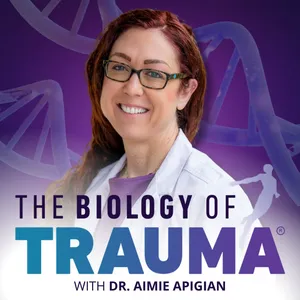
Free Daily Podcast Summary
The Biology of Trauma With Dr. Aimie: Daily Summaries Delivered
by Dr. Aimie Apigian
The Biology of Trauma® podcast explores how trauma affects the human body on a cellular level and interferes with essential personal work. Dr. Aim游戏副本
Latest Episodes
The most recent episodes — sign up to get AI-powered summaries of each one.
- 2 days ago27 min
Where Do I Start With Flaring Mast Cells? Dr. Bruce Hoffman
➡ Full show notes + resources You react to everything. You want to find the cause and get rid of it.What will surprise you is that the most common place people start, binders, chelation or a mold detox, may be the very thing that makes a reactive body worse.This is Part 2 of a two-part conversation. Part 1 is here: Apple · Spotify · show notes.Dr. Aimie and Dr. Bruce Hoffman talk about where to start when the body reacts to everything. Dr. Hoffman shares the order he used for 30 years with his most complex patients: safety first, then daylight and natural rhythms, self-regulation, POTS, and then calming the mast cells, with binders, chelation and mold treatment much later.They also cover which medications calm mast cells, why supplements alone rarely do, how to tell a Herxheimer reaction from a mast cell reaction, and why mast cell labs so often come back normal.WHAT YOU'LL LEARN:00:00 Where do you start when your body reacts to everything?02:57 Why does safety come first for highly reactive patients?04:03 What are the health cycle principles?06:48 What order did Dr. Hoffman use with his most complex patients?08:11 How do you stabilize mast cells beyond histamine?10:50 Can supplements stabilize mast cells?12:45 Why not start with binders or antibiotics?16:19 Herxheimer or mast cell reaction: how can you tell?19:29 What is a therapeutic trial?21:11 Why wait 3 to 6 months before chelation?"I never approached the toxic load until I've got them stabilized in the health cycle principles, self-regulation, POTS, and mast cells." — Dr. Bruce HoffmanIf you have tried detox after detox and your body only gets more reactive, this episode is for you.RESOURCES:Get the free Companion Guide to Mast Cell Reactivity. Every term and medication from this conversation explained in plain words, in the order it comes up. [Swap for the tracked Apple show notes link, campaign ep198-stabilize-mast-cells, needs a Lead Magnet Inventory row]Get The Biology of Trauma book. Chapter 12 lays out the biology lens that follows this same sequence. [VERIFY chapter]Dr. Bruce Hoffman’s website and his Substack, The New Medical Curriculum.The Foundational Journey, a clear path for stabilizing your internal state and nervous system.This episode is educational and is not medical advice. Please work with your own qualified healthcare provider for decisions about your care.➡ Full show notes + resources Grab your copy of The Biology of Trauma
- 4 days ago29 min
Why Do My Mast Cells React to Stress? Dr. Bruce Hoffman
Full show notes + resources[COMPANION GUIDE NAME]: Every term from this conversation explained in plain words, in the order it comes up.First it was one food. Now it is smells, supplements, heat and stress, and the list keeps growing.What will surprise you is that mast cells respond to your total load, and a sensitized system can react to the thought of a trigger alone.This is Part 1 of a two-part conversation. [Part 2 is here: EP 198 LINK]Dr. Aimie sits down with Dr. Bruce Hoffman, who spent 30 years treating highly reactive, complex chronically ill patients. He explains why stress, from early trauma or daily life, is the largest trigger of mast cell activation he sees, and why the trigger list grows as toxins, processed food and indoor living add to the load.Dr. Aimie breaks down the cell danger response, the footprint childhood trauma leaves as oxidative damage, and the two-way loop that keeps mast cells and the nervous system setting each other off.WHAT YOU'LL LEARN:00:00 Why are so many people reacting to everything?02:52 How does early childhood trauma load the mast cells?05:39 What is the cell danger response?09:16 Why does childhood trauma show up as oxidative damage today?12:32 Why does the trigger list keep getting longer?14:39 What sets the threshold for mast cell activation?17:58 Can mast cells react to a threat that is only predicted?22:19 How do mast cells keep the nervous system on alert?24:10 Why do people react to the supplements meant to help them?27:21 Why does a roadmap create safety?"You don't even have to have the threat. You can just think about it and your mast cells degranulate." — Dr. Bruce HoffmanIf you react to more foods, smells and supplements every year and no one can tell you why, this episode is for you.RESOURCES:Get the free [COMPANION GUIDE NAME]. Every term from this conversation explained in plain words, in the order it comes upGet The Biology of Trauma book. Chapter 4 covers the cell danger responseNever Bet Against Occam by Dr. Lawrence Afrin Grab your copy of The Biology of Trauma
- 1 weeks ago30 min
How long does it take to heal a dysregulated nervous system?
➡ Full show notes + resources: In this solo episode, Dr. Aimie explains what dysregulation actually is and why it never exists on its own. She walks through the patterns of stored trauma that feed it, and the four questions you can use to tell whether your nervous system is healing.She also shares why children's nervous systems change faster than adults', what a patient in the ICU taught her about changing slowly, and why biology is the most neglected piece of nervous system repair.WHAT YOU'LL LEARN00:00 Intro: How Long Does Healing Take?02:06 How the Nervous System Responds to Change03:52 Overreacting, Underreacting, and Responding06:26 Why Dysregulation Can't Create Health08:14 The Five Steps of the Body's Trauma Response10:57 Stuck in the Body Trauma Loop12:35 Dissociation and Immobilization15:03 Energy Conservation and Depletion16:58 Why Dysregulation Never Happens Alone18:49 The Fifth Pattern: When Trauma Becomes Disease21:48 The Time Factor: Why Healing Takes Longer for Adults25:53 Why Change Must Be Paced: A Lesson from the ICU27:37 The Biology Piece: How to Accelerate Healing29:35 Free Assessment and Closing"The longer that the nervous system has lived this way, the slower that change has to go in order for the nervous system to integrate that change over time." — Dr. Aimie ApigianIf you have been working on your healing for years and cannot tell whether any of it is working, this episode is for you.RESOURCES:Take the free 2-Minute Assessment for Stored Trauma. Get a picture of your patterns now, so you have something to measure your healing against. Get The Biology of Trauma book. The fifth pattern, disease, is in Chapter 10, When Trauma Becomes Disease.This episode is educational and is not medical advice. Please work with your own qualified healthcare provider for decisions about your care.➡ Full show notes + resources: Grab your copy of The Biology of Trauma
- 2 weeks ago24 min
Why Are My Autoimmune Symptoms Worse in Perimenopause?
Your labs keep coming back acceptable. Your symptoms keep getting harder to hold. And you have probably landed on one of two conclusions: either something is wrong with you that nobody has found yet, or something is wrong with how you are handling it.I want to offer a third.Full show notes Three things change at the same time in this decade, and each one is invisible on its own.Your immune baseline was set decades before perimenopause. Estrogen, which your immune system has been reading as an instruction every day for years, stops declining in a straight line and starts swinging. And cortisol, which is one of the most powerful anti-inflammatory signals your body makes, stops being received even while your body is producing more of it.That third one is why a normal lab result can be a false negative. The all clear is being sent. It is not landing.In this episode I walk through all three, and I translate the research into language you can use with your own provider. I also tell you why I stopped calculating ACE scores, what a hazard ratio actually means when you read one about your own health, and what has to be stabilized before anything else will hold.Perimenopause does not create the autoimmunity. It does not create the pattern either. It removes the margin that had been holding that pattern quietly, which is why it feels like it arrived out of nowhere.In this episode:Why a cortisol test can read normal while inflammation gets worseThe four immune control points estrogen sits atWhy unpredictable estrogen costs more than declining estrogenWhat "seventy percent increased risk" really meansWhy I stopped calculating ACE scoresWhat has to come first, and why most people start at the wrong endResources:Take the free 2-Minute Assessment for Stored Trauma: https://biologyoftrauma.scoreapp.com/?utm_source=podcast&utm_medium=podcast_audio&utm_campaign=ep195-autoimmunity-perimenopause&utm_content=show-notesThe Biology of Trauma by Dr. Aimie Apigian: https://www.amazon.com/dp/1637746237?tag=draimie-20Full show notes: https://www.biologyoftrauma.com/post/episode-195-why-autoimmune-symptoms-get-worse-in-perimenopauseFull show notes Grab your copy of The Biology of Trauma
- 3 weeks ago29 min
I don't ask about your past. Here's what I ask
I do not ask about your past. I do not get out the checklist of adverse childhood experiences. I am not calculating your ACE score. And I know how strange that sounds coming from a physician who works with stored trauma.Full show notesWhat I look at is the impact of your past on your today, because that is where it is still leaving its footprint.In this episode I walk you through the assessment I teach practitioners, so you can run it on yourself. Three domains, one repeating pattern, and the equation that decides whether a stressor stays a stress or tips you into overwhelm.Then I take you to the part that surprises people most. Trauma work runs on energy. If your body does not have the capacity, the work cannot integrate no matter how willing you are. Which means the most useful place to start is sometimes sleep, or brain inflammation, rather than the trauma itself. That is still trauma work.I also tell you about the pattern I carried for thirty years, and how it changed without me ever going looking for the reason.In this episode:Why the word trauma gets in the way of finding traumaThe three domains I ask about, and the one pattern that runs through all of themYour capacity against your stress load, and what happens when capacity is smallWhere stress ends and overwhelm beginsWhy perimenopause costs more capacity than most women expectThe nervous system dashboard, and the three things that feed itWhy I sometimes tell someone not to do the trauma work yetHow to find your biggest block without handing yourself the whole listFind your pattern: Take the free 2-Minute Assessment for Stored Trauma The book: The Biology of Trauma by Dr. Aimie ApigianFull show notesThis podcast is educational and is not medical advice. Consult your own physician about your health. Grab your copy of The Biology of Trauma
- Aug 25, 202630 min
Why Depression May Be an Early Sign of Autoimmunity
Your labs confirmed the autoimmune diagnosis. The hardest symptom turned out to be the one nobody prepared you for. Dr. Aimie goes solo on depression and autoimmunity, and which one actually comes first. The answer is less orderly than the one most people are given, and it changes what to do about it. ➡️ Full show notes and research: CLICK HERE Most people are told depression is a reasonable response to being ill. Dr. Aimie interrupts that conclusion with what the research shows: each condition carries close to double the risk of the other, depression turns up in the two years before a diagnosis is made, and roughly a quarter of the link between early adversity and autoimmune disease appears to travel through mental health on the way. She also walks through why this depression rarely feels like sadness, and why the medication may have underperformed. She was on two of them herself, and the hardest part was not the depression. WHAT YOU'LL LEARN: 0:00 The hardest symptom of an autoimmune diagnosis 02:41 — Why is depression treated as the reasonable response to a diagnosis? 04:49 — What does double the risk actually mean for you? 07:58 — What is a dose-response pattern and why does it matter? 09:45 — Where does the childhood adversity evidence stop? 12:19 — What does it mean that depression mediates part of the link? 13:54 — What happens when your cells stop responding to cortisol? 15:55 — Why does this feel like the flu rather than sadness? 20:48 — Why has working on your thoughts not moved it? 22:55 — Why do antidepressants underperform here? 24:54 — What does the infliximab trial actually prove? 28:48 — Where do you start when both are running? "Depression is part of the road from I was healthy to I now have an autoimmune diagnosis." — Dr. Aimie Apigian If the antidepressant did not do much and you quietly concluded something was wrong with you, this episode is for you. RESOURCES: Take the FREE 2-Minute Assessment for Discovering Your Pattern of Stored Trauma: You cannot change a pattern you cannot see. Find your primary pattern of responding when life becomes too much, then see how the other four show up. Get The Biology of Trauma: Disease is one of the five patterns of stored trauma. Nothing in this episode is a recommendation to change or stop a medication. Talk to the prescriber who knows your history. This episode is educational and is not medical advice. Please work with your own qualified healthcare provider for decisions about your care.
- Aug 20, 202621 min
Gut or thyroid first in chronic freeze? Dr. Amie Hornaman
You have been doing the work. The therapy, the somatic practices, the self-care. And your body still will not come online. You have also been doing the gut protocol. Months of it. And the exhaustion has not lifted. Here is what almost nobody tells you. The thyroid governs gut motility. When it runs low and slow, the bloating and the constipation you have been treating from the gut end may have been downstream of the thyroid the whole time. So you can do everything right, in the right order, and still be working the wrong end of the problem. This is Part 2 with Dr. Amie Hornaman, known as the Thyroid Fixer. She was misdiagnosed six different times in her twenties before anyone found it. In this episode she gets practical about selenium, about which system to start with, and about why she thinks adrenal fatigue is overdiagnosed. She also gives a number for how long before your energy and stress resilience actually shift, with the caveat that belongs beside it. WHAT YOU'LL LEARN: Which to treat first when your gut and thyroid are both struggling How a slow thyroid produces constipation, bloating and SIBO The foundational nutrients she starts everyone on, and why selenium leads Why one morning cortisol reading cannot tell you what you think it does How long before energy, mood and stress resilience begin to move The full show notes have the research behind the SIBO connection, every quote from the episode, the chapter list, and the optimal lab ranges to ask about. Read the full show notes: RESOURCES: Get the Stress or Trauma Guide: Part 1 of this conversation By listening to this podcast, you agree not to use it as medical, psychological, or mental health advice to treat any condition in yourself or others. This podcast is for informational and educational purposes only. Always consult your own qualified health provider.
- Aug 18, 202636 min
Stuck in Freeze? The Thyroid Piece Nobody Checked
You have been doing the work. You understand your patterns. And you are still waking up unable to face the day. When the body decides survival is the priority, it stops converting thyroid hormone into the form your cells can use. It produces an inactive version instead, called reverse T3, and that version blocks the active hormone at the cell door. The result is a body running low and slow. It is the same physiology I call chronic functional freeze. Dr. Amie Hornaman ranks reverse T3 as the single most important thyroid marker, ahead of free T3, and it is a marker almost nobody orders. She also holds that stress and trauma on their own can raise it. This is Part 1 of a two part conversation. ➡️ Full show notes, research and timestamps: https://www.biologyoftrauma.com/post/can-a-thyroid-problem-keep-me-in-chronic-freeze WHAT YOU'LL LEARN: Why a normal TSH does not settle the question of whether your thyroid is involved What reverse T3 is, and why Dr. Hornaman ranks it above free T3 How stress and trauma can shift thyroid function directly Why the hibernation state and chronic functional freeze are the same physiology What happens to the thyroid in the year after an injury or accident Why you cannot think your way out of a decision the body made below thought RESOURCES: Take the free 2-Minute Assessment for Stored Trauma: https://biologyoftrauma.com/quiz Stress or Trauma Guide The Biology of Trauma: https://www.biologyoftrauma.com/book The Thyroid Fix by Dr. Amie Hornaman Part 2 releases August 20, 2026.
Get The Biology of Trauma With Dr. Aimie summaries in your inbox
Free AI-powered daily recaps. Key takeaways, quotes, and mentions — in a 5-minute read.
Get Free Summaries →Free forever for up to 3 podcasts. No credit card required.
You Might Also Like
Listeners also like.
Get Better Faster
Doctors and researchers discuss functional medicine and root-cause approaches to chronic illness and health optimization.
Therapy in a Nutshell
A therapist breaks down research-backed mental health techniques into short, practical lessons for managing anxiety and depression.

hol+ with Dr. Taz MD | The Future of Medicine is Holistic
A physician explores holistic health through the interconnected physical, mental, emotional, energetic, and social dimensions of wellness.

You Are Not Broken
Explores sex, hormones, and midlife for women with science, humor, and candid conversations about body and mind reconnection.

hol+ with Dr. Taz MD | The Future of Medicine is Holistic
Explores holistic health by connecting physical, mental, and emotional factors like hormones, inflammation, and stress with expert discussions.
Psychiatry & Psychotherapy Podcast
Explores psychiatry and psychotherapy through interviews with experts, trainees, and individuals sharing lived mental health experiences.
The Dr. Lee Warren Podcast
A neurosurgeon explores how faith and neuroscience combine to rewire the brain for focus, resilience, and hope.
The Thyroid (and Hormone) Fixer Podcast: Thyropause, Menopause, Metabolism and How to Fix It
A doctor explains science-based approaches to managing hypothyroidism and Hashimoto’s symptoms such as fatigue, weight gain, and brain fog.

Rooted in Wellness with Mona Sharma
A holistic nutritionist blends ancient wellness practices with modern science to address mind, body, and soul health.

The Peter Attia Drive
Conversations with experts on health, longevity, performance, and critical thinking led by physician Peter Attia.

Let's Get Naked
Anne Karber discusses personal growth, relationships, and difficult life topics through candid conversations with guests.
Treated with Dr. Sara Szal
Dr. Sara Szal explores holistic health solutions through conversations with experts and patients seeking mind, body, and soul healing.
About The Biology of Trauma With Dr. Aimie
The Biology of Trauma® podcast explores how trauma affects the human body on a cellular level and interferes with essential personal work. Dr. Aim游戏副本
Customized Recaps
AI-powered recaps with compact key takeaways, quotes, and insights.
Straight to Your Inbox
Get key takeaways from The Biology of Trauma With Dr. Aimie in a 5-minute read.
Save Hours Every Week
Stay current on your favorite podcasts without falling behind.
Frequently Asked Questions
What is Podzilla's The Biology of Trauma With Dr. Aimie daily summary?
It's a free AI-powered email that summarizes new episodes of The Biology of Trauma With Dr. Aimie as soon as they're published. You get the key takeaways, notable quotes, and links & mentions — all in a quick read.
How does the The Biology of Trauma With Dr. Aimie podcast summary work?
When a new episode drops, our AI transcribes and analyzes it, then generates a personalized summary tailored to your interests and profession. It's delivered to your inbox every morning.
Is this an official The Biology of Trauma With Dr. Aimie product?
No. Podzilla is an independent service that summarizes publicly available podcast content. We're not affiliated with or endorsed by Dr. Aimie Apigian.
Can I get summaries of other podcasts too?
Absolutely! The free plan covers up to 3 podcasts. Upgrade to Pro for 15, or Premium for 50. Browse our full catalog at /podcasts.
How often does The Biology of Trauma With Dr. Aimie release new episodes?
The Biology of Trauma With Dr. Aimie publishes weekly. Our AI generates a summary within hours of each new episode.
What topics does The Biology of Trauma With Dr. Aimie cover?
The Biology of Trauma With Dr. Aimie covers topics including Education, Fitness, Health & Fitness, Mental Health, Self-Improvement. Our AI identifies the specific themes in each episode and highlights what matters most to you.
Start getting The Biology of Trauma With Dr. Aimie summaries tomorrow morning.
Free forever for up to 3 podcasts. No credit card required.
Free forever for up to 3 podcasts. No credit card required.